Category Archives: Lesson: Algebra 1

The Student-Generated Word Problem

Submitted by Jacqui Ochoa, Kurt Walker, and Randy Davis, Trabuco Hills H.S., Mission Viejo, CA. (first published in The Math Projects Journal, Nov/Dec 1997)

One of the reasons students have a tough time learning to solve equations is that many do not really know what the algebraic equations represent. In particular, they do not understand the concept of a variable. We discovered this through a new assignment called the “Student-Generated Word Problem,” The student is asked to: write a word problem that can be solved by using an equation, write and solve the equation relating the solution to the original word problem.

Here are some examples of the traditional problems the students had previously experienced:

Question #1: You have three boxes of pencils and you lose 5 pencils. You then buy another box. If you now have a total of 37 pencils, how many are in each box?
Equation #1: 3x – 5 + x = 37

Question #2: The length of a rectangle is 2 more than 3 times the width. If the perimeter is 36,
what are the dimensions of the rectangle?
Equation #2: 2w + 2(3w + 2) = 36

The students were familiar with a variety of word problems for which they would be asked to write and solve the equations. Our fear was that they would simply copy one and submit it. Here is what we received instead:

Student #1: I have 5 Great Danes and 4 Poodles. I get another Great Dane. How many dogs do I have?
Equation #1: 5g + 4p + 1g
Answer #1: 10


Student #2: I have 4 shirts. I buy three more. I sell ten. I get left with 4 shirts. How did I get 4?
Equation #2: 4s + 3s – 10 = 4
Answer #2: s = 2

In the first example, the student created a logical question that did not need algebra to solve. The second student created an illogical question, then correctly solved an unrelated equation. In both cases, there was no cognitive connection among the word problem, the equation, and the solution. This assignment told us volumes about how little our students really understood algebra, even if they could do algebra.

Consequently, we offered them equations for which they were required to write a problem. Eventually our students developed a stronger understanding as demonstrated below.

Equation: 5x -3 = 3x + 10
Answer: On Monday, Joe bought 5 boxes of apples and ate three on the way home. On Tuesday, he bought 3 boxes and a friend gave him 10 more. He noticed that at the end of each day he had the same amount of apples. How many apples were in each box?

Through these assignments, the students’ understanding of the word problems improved, as did their ability to solve algebraic equations. The Student-Generated Word Problem was not only a powerful assessment tool, it proved to be an effective instructional instrument as well.

Nearly 30 years after creating this activity … Edutopia publishes, “Student-Created Math Word Problems Help Motivate Deep Learning” (Jan 2026)

Mr Cornelius’ Desmos Lesson

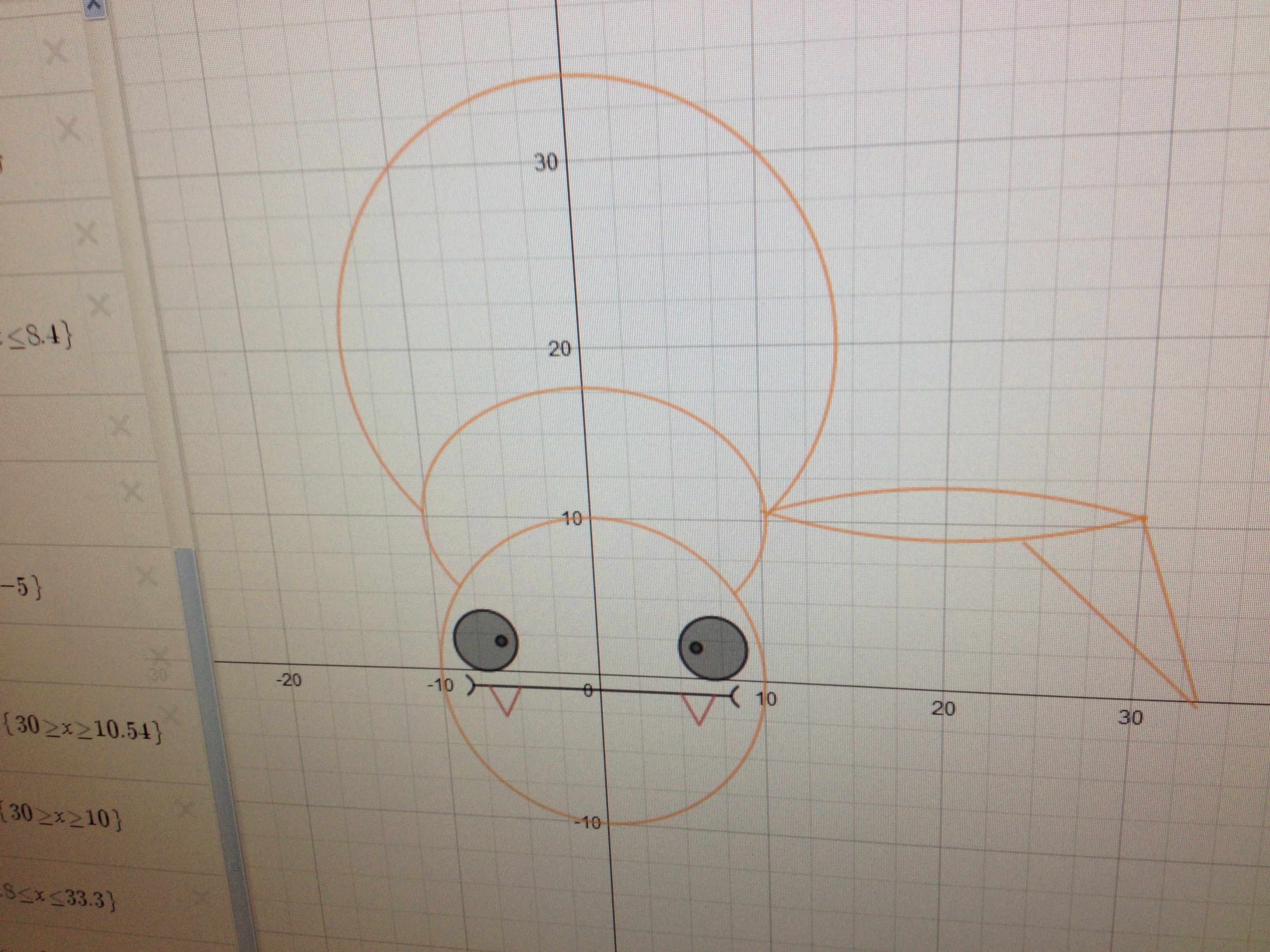
This lesson on graphing conic sections rocked on multiple levels. For the students, it involved concrete mastery of standards, conceptual understanding of several topics, higher order thinking skills, student autonomy and intellectual need. For the teacher, Mr. Cornelius of Great Oak High School, it was a week’s worth of experimenting with new software and pedagogy. The genesis of the lesson was a combination of an email and a diagram. I had sent to my Math Department a link to the free online graphing calculator Desmos.com; a mutual colleague, Michael White, shared the idea of having students use their knowledge of equations to graph a smiley face. Mr. Cornelius merged these ideas into a new 5-day lesson in the computer lab. That week produced a multitude of pleasant surprises.

Desmos smile 2

Michael started with a whole-class demonstration of Demos at the end of the period on a Friday. He posed the Smiley Face graph (shown above) as the minimal requirement for passing the assignment. The strength of this lesson is two-fold: 1) There are a variety of equations involved (circle, ellipse, parabola, absolute value, as well as linear), and 2) repeated restriction of the domain and range.

Michael invited students to create their own designs for a higher grade. He expected only a few takers, but in the end only a few decided to produce the Smiley Face, and this is where the richness of the lesson was truly found. During the week-long lab session, I observed one of the days and took a few pictures of some works-in-progress.

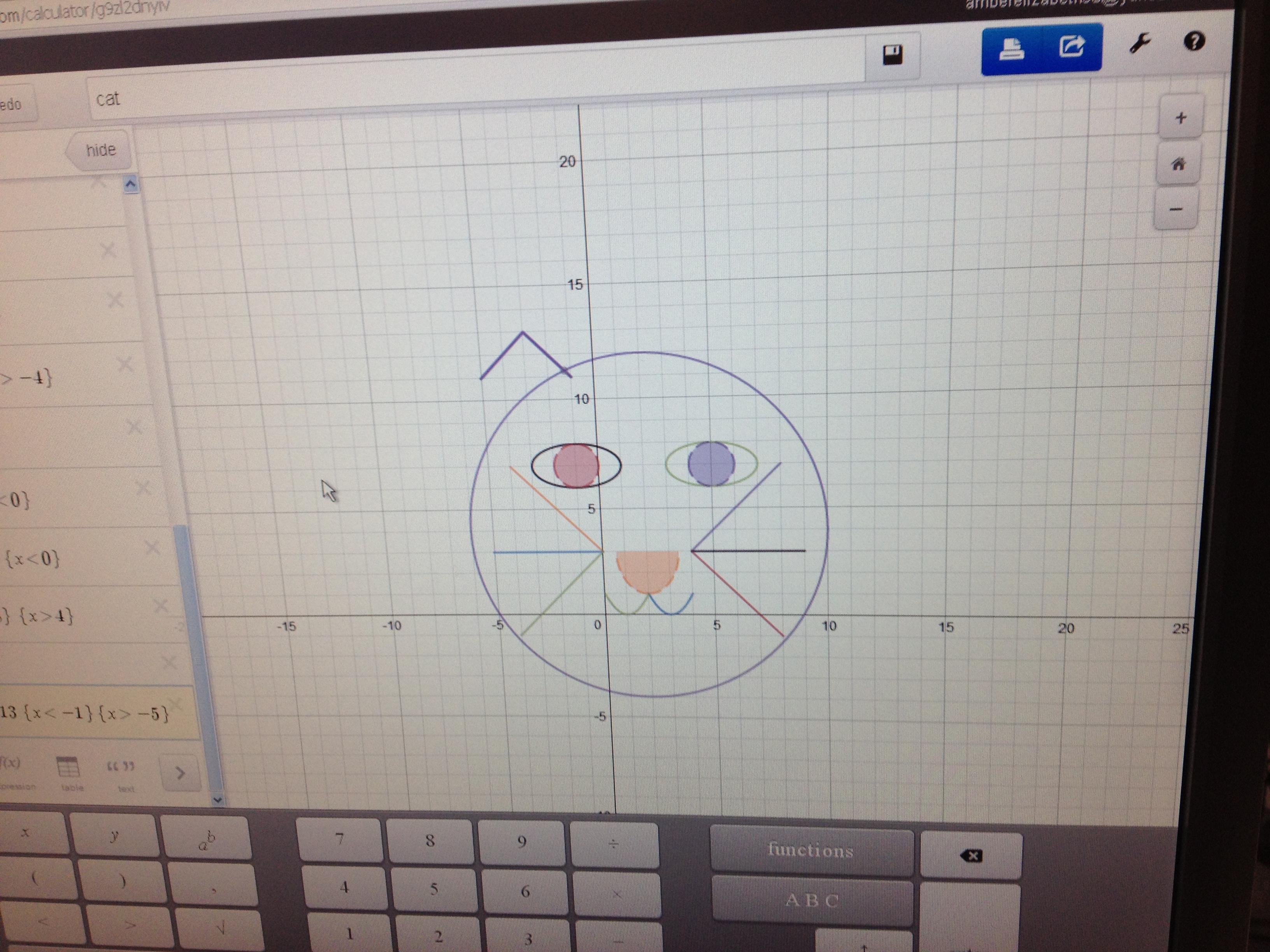
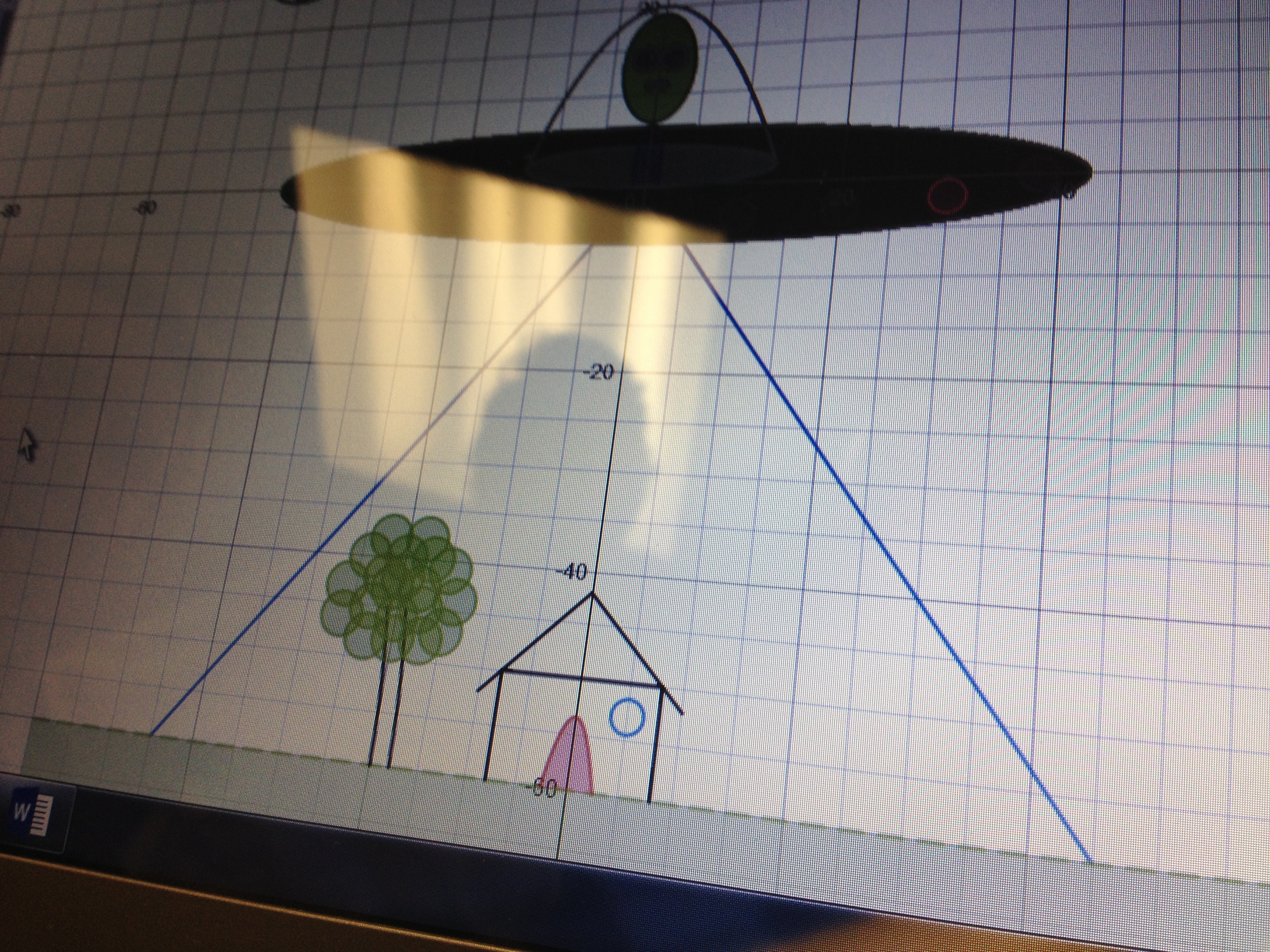
Desmos spiderDesmos MinnieDesmos CatDesmos House Alien
As you can see, the students independently chose to include inequalities in order to produce the shading. Here was my favorite use of shading.

Desmos Arnold

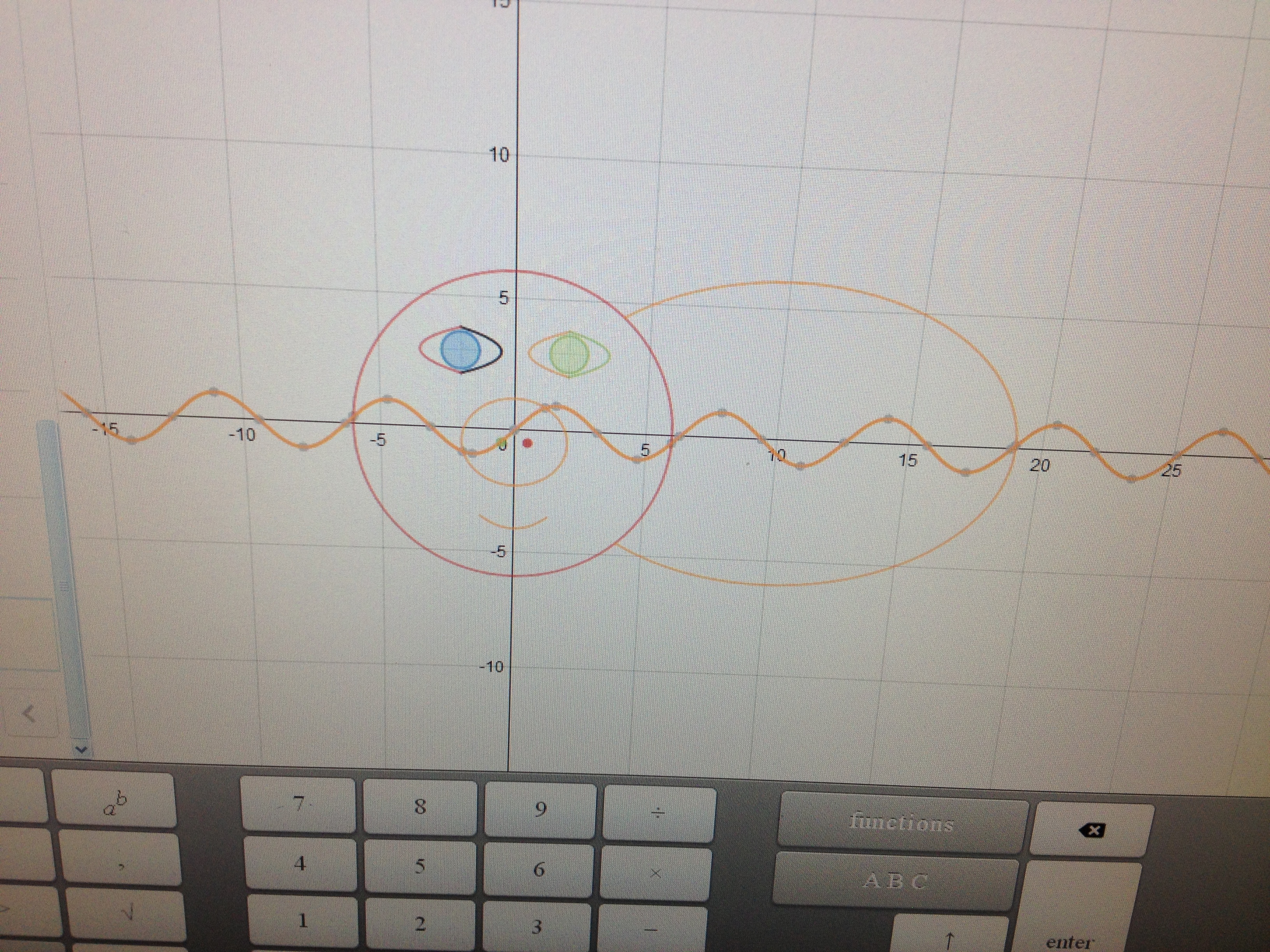
What really impressed me about the lesson was the examples of students who asked to learn something new in order to produce something they chose to create. In the example below, a student wanted a curly (wavy) tail for her pig. Mr. Cornelius taught her how to graph sine and cosine waves. Granted, this was a superficial lesson, but to see someone wanting to learn a skill from next year’s course was a treat.

Desmos Pig 1

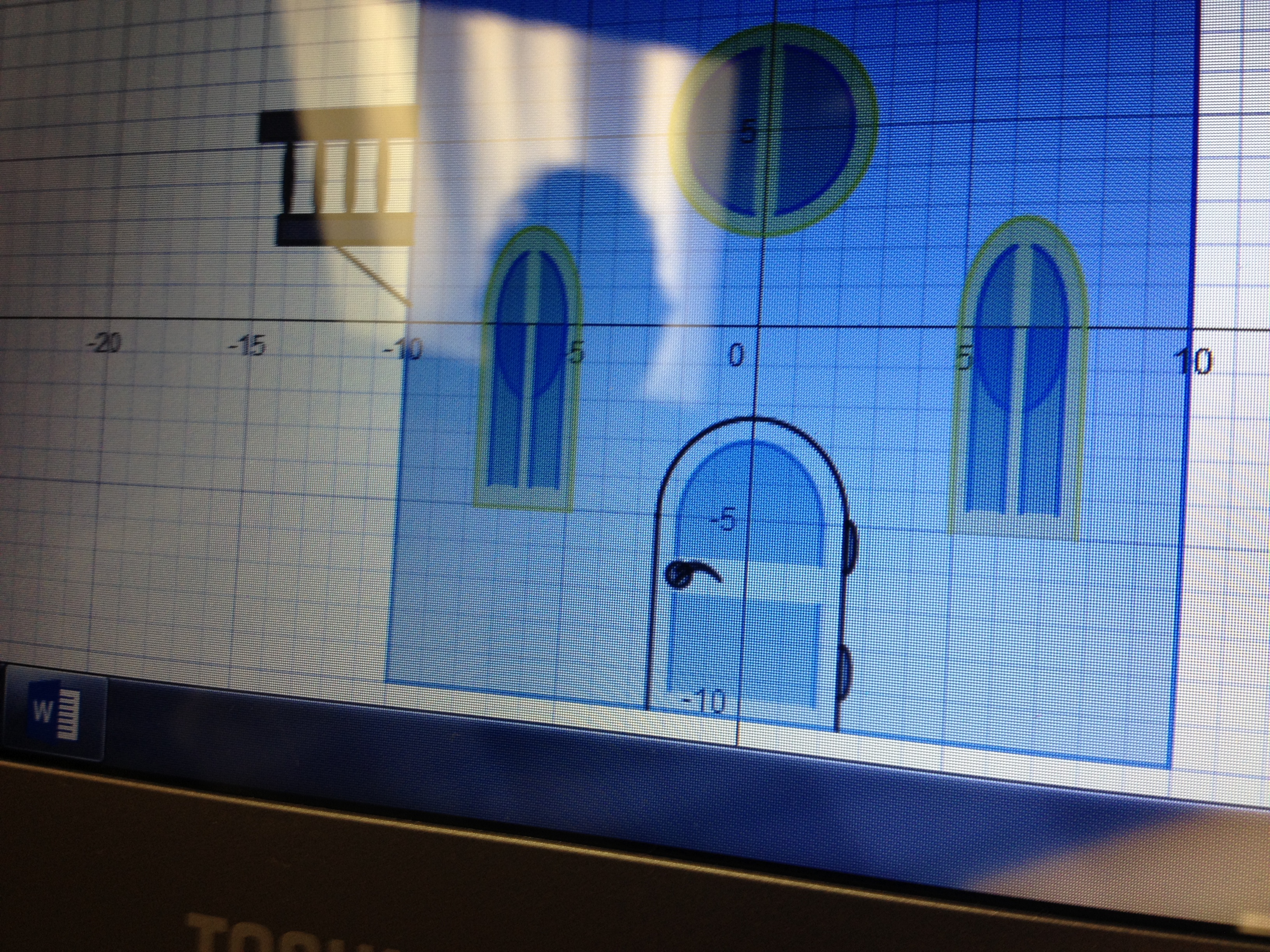
The rigor that the students imposed upon themselves, again as demanded by their creative idea, was remarkable. Look at the detail of the door handle on this house.

Desmos House Desmos Hinge

Desmos Lesson

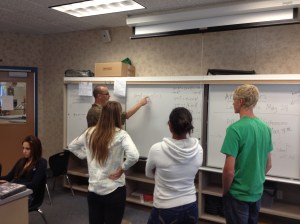
My favorite moment was this one with Michael and a handful of students. It is not as sexy as the pictures that the students were producing, but it was far more significant. Three students all had a similar question, so Mr. Cornelius conducted a mini-lesson on the board while the rest of the class worked away on their graphs. The topic on the board was not part of Michael’s lesson plan. It was sheer improvisation. For me, this interaction was the treasured gem of the lesson experience: A teachable moment generated by an intellectual need.

This was the first run of Michael’s lesson and in a conversation that we had while he was grading the assignments he conceded that he needed a scoring rubric. We also discussed how this idea could be woven throughout both Algebra 1 and 2 courses. The idea of Graphing Designs could span linear, exponential, quadratic and conic equations. I smell a lesson plan brewing!

(P.S. For those of you that get hooked on Desmos, I suggest you also check out the Daily Desmos Challenge)

Interpreting the Graph of a Helicopter Flight

A colleague of mine at Great Oak HS, Reuben Villar, found this wicked cool app at Absorb Learning.Helicopter
Click below to access the free online version of the app, by Adrian Watt.

Helicopter App

We incorporated this app in our latest lesson, Tubicopter (sample page here). It intensely challenges student understanding of graphing by directly contrasting the physical flight path of the helicopter and abstract shape of the graph of the relationship between time and the helicopters altitude. Toy with it and leave your comments here.

Lesson: Get Your Kicks on Route 66 (Preview)

This is an example of the many lessons available only to MPJ Monthly subscribers.

Route 66 ThumbnailRapid Roy drives the highway to demonstrate that absolute value is the distance from zero.

SUBJECT: Pre-Algebra
TOPICS: Absolute value equations, inequalities
PAGES: 3
Preview Page 1


Want this lesson? How about many more like it and a new one every month?
Subscribe to MPJ Monthly and get just that.