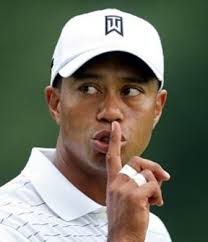
My district is seriously looking into standards-based grading. I have dabbled in it and see both the value and the pitfalls. Interestingly, I wrote the article below in 2002, long before SBG came into vogue and before the Common Core started flirting with Performance Tasks. While Tiger may not be the top golfer in the world anymore, it speaks directly to my hopes and concerns. I invite some push back here from the SBG gurus.
*********************************************************** Earl Woods? Hello sir, thank you for coming to my classroom to speak with me about your son Tiger. Yes sir, I know that he appears to be doing well at home, but Mr. Woods, to be honest with you, Tiger is in danger of failing golf.
Currently his grade is a C-. I can show you the grade breakdown if you like. Certainly. As you know, there are approximately two hundred professional golfers. Each is ranked in various skill categories. Your son, Tiger, ranks as follows.
Driving Distance
2nd
Driving Accuracy
72nd
Greens in Regulation
1st
Putting Avg.
159th
Eagles
132nd
Birdies
2nd
Scoring Avg.
1st
Sand Save Avg.
4th
As you can see, Tiger does very well in most skill categories, but appears to perform poorly in two. Now, failing in two out of the eight leaves him with a score of 75%. There is a third category in which he is only slightly above average; therefore, he only gets partial credit. This diminishes his seventy-five percent to a 70%, and thus, he gets a C-.
My concern is that if Tiger were to falter in any one of these eight categories, he would surely fail golf. However, there is plenty of room for him to improve in these problem areas. He has an excellent work ethic, so I am confident that with a little more effort, Tiger will succeed. Mr. Woods, thank you for your support in this matter.
Can you imagine ever having this conversation regarding Tiger Wood’s ability as a golfer? How does the best golfer in the world get a near failing grade in golf? The answer is in the assessment.
The rankings given in the previous scenario are true. Furthermore, from this list, the All-Around Rankings of each professional golfer is determined by adding the golfer’s relative rank in each category. The lower the score, the better. Adding Tiger’s categorical rankings places him 10th in the “All-Around Rankings.”
In other words, there supposedly are nine other golfers in the world better skilled than Tiger Woods. Being in the top five percent of all golfers in the overall skill category would certainly raise his grade in golf to at least a B, if not an A. However, he still does not rank as the top All-Around player in the world.
If we change the assessment, though, Tiger fares much better. For instance, Tiger is the richest golfer in the world. He is number on in season earnings and is the all-time career money winner. His is also number one in the World Rankings. The World Rankings are based on how well a golfer finishes in tournament play in comparison with the strength of the field. In other words, how well does the golfer compete?
Tiger wins the most tournaments and wins the most money. In my mind, and that of many others, that makes Tiger the bets golfer n the world. Yet, I am basing my opinion on his performance as a golfer rather than his skill as a golfer. Analyzing two other golfers can show the difference between the value of skill and that of performance. Do the names Cameron Beckman or John Huston ring a bell to you? No? Me, neither, and I am an avid golf fan. The reason that you do not know these names is that these two people are average golfers in the World Rankings. (They don’t win much.) Yet, they both outrank Tiger in the All-Around (2nd and 9th respectively). According to certain forms of assessment, Beckman and Huston are better than Tiger Woods.
We can see this scenario being played out in our classrooms. The Beckmans and Hustons get higher grades than the Tiger Woods, because too much of our assessment is based on individual skill rather than on mathematical ability. The Tigers excel in the performance assessments that we occasionally offer, but these are so out weighed by itemized tests that the All-Around Ranking (skill) wins out over the World Ranking (performance),
A more appropriate balance of skills, testing and performance assessment in our classes may send our most underachieving mathematicians to the head of the class.
My teenage son is preoccupied with three things these days: water polo, his girlfriend and expensive cars. He has fantastic talent in water polo, and has a wonderful girlfriend. He does not have an expensive car.
Currently, he is saving for his first car and knows that he will have to start with a used, low-end model, but he dreams big. He is always talking about Ferrari’s and Rolls-Royces. We like to talk about them together and point them out on the road whenever we are driving. He is convinced that he will own one someday. When I respond to his talk of grandeur, I want to sound like the Encouraging Dad (“Terrific, what kind of successful job do see you see yourself having, so you can afford that kind of car?”), but I worry that I sound like the Practical Dad (“That’s nice, it might be more realistic to set your sights on a cheaper car.”). The truth is that my words usually come out somewhere in the middle, which led to our very interesting math conversation the other day.
On a long drive back from a water polo game, we were talking about reasonable incomes (Practical Dad ruling the moment). He is a Junior in high school, so his interest is peaking about how much money is to be made as an adult. The conversation went like this:
Me: Guess what the average annual income is in America.
Preston: I know, because we talked about this in History class. $36,000 a year, but if I make $100,000 a year, a can save half of that and buy a rich car in five years.
Me: Do you know what percentage of Americans make over $100,000 a year?
Preston: 25%?
Me: It is actually about 4%. I know several people who make that kind of money. None of them drive a Ferrari, so you are going to have to make more than that. (Encouraging Dad trying to break through.)
Preston: If I made a million dollars a year, I could buy it in one year and still have enough to live on.
Me: With enough left over to care of me and your Mom. That would be awesome, but you are going to have to do something special, because less than one-half of one percent of Americans make a million dollars a year.
Preston: It has to be more than that. Look at how many rappers there are making bank.
Me: And think about how many are making just a normal living or how many are standing on a street corner singing while they hold their hat out for tips. Very few earn “Checks that look like phone numbers.”
Preston: Look at how many millionaires we know.
Me: I would say less than 5, off the top of my head.
Preston: Yeah, see?
Inspired Math Question #1: If you know 5 millionaires, what percentage is that of all the people you know?
Inspired Math Question #2: If one-half of one percent of the people you know are millionaires, how many people would that be?
Preston: I bet there are at least a million millionaires in the country.
Inspired Math Question #3: Given that there are 300 million people in the U.S., and that 75% are adults, would one-half of one percent of American adults be more than a million people? (to be estimated while driving without a calculator)
Me: I am guessing that we are both correct on this one.
Preston: I still say it has to be more than that then. (Whether I am encouraging or practical, I am still Dad, so he must win!) Look at how many expensive cars we saw just today. There was a Ferrari, a Lamborghini and a Bentley.
Me: Yes, and think of how many other cars we saw today.
Inspired Math Question #4: Approximately how many total cars might you see driving on a freeway for an hour on a Sunday afternoon? (must explain your reasoning on this one)
Inspired Math Question #5: If you see three expensive sport cars on that same trip, what percentage of all the cars would that be?
As we arrived home, Preston was still seeking victory. He is very good with mental math, so he knew where I was going with all the number crunching. In order to get the upper hand, he needed to bring in an expert, and what better expert in the world of teenagerdom to call upon than the internet? He Googled on his smart phone, “How many millionaires are in America?” and got an answer of over 3,000,000. He loudly reveled in glory. I countered with the age-old math argument of the importance of definitions. In this case, there was a difference between annual income and net worth. He was having no part of it. He was to busy flexing and bragging to Mom about how he just “owned” Dad in a math debate.
I recently had the pleasure of learning from Tim Kanold of Stevenson High School fame. I heard him speak on several occasions last fall, and he kept saying that we need to involve students in “rich and robust tasks.” He was addressing the Common Core‘s call to the Standards of Practice. These practices can be summarized by saying that the Common Core is demanding students to think and to communicate their thinking. This can’t get done by taking notes from an overhead and doing the odd problems in the textbook. It gets done by purposefully deciding that students are going to solve rich and robust problems rather than simply watch their teacher complete examples of algorithms.
There is still a time and place for direct instruction and guided practice; but that should not be the complete experience for students, which is what we unfortunately find in the vast majority of American classroom instruction. For quite sometime, MPJ has been producing what we hope to be rich and robust tasks. Due to the growth of the internet, the availability of such rich and robust tasks has expanded tremendously. There are many exotic islands of innovation among the seas of tradition, but the blogosphere has made these islands less remote. Below I have listed a few, alongside my paraphrasing of the some of the Common Core Practices. This is not a comprehensive list by any means, however, I encourage you to take a few minutes and peruse these lessons in order to get a quick taste of what I think Kanold means by Rich and Robust.
Listed here are some additional sites that offer rich and robust tasks. {Note: I will be happy to update this list with any reader-submitted links, subject to review.}
The activities listed above obviously are not your typical math lessons. For good or for bad, the mathematical frontier created by the experiences highlighted here would make for a far different academic education than the gauntlet of lectures that most of us remember from school.
Now, I am going to assume that while the thought of introducing these large-scale examples into one’s repertoire is exhilarating for many, it may be terrifying for some. Let me ease those hearts by saying that rich and robust can be done on a much smaller scale. For example, we could simply ask the students: “Is x times x equal to two x or x squared. In other words, which of the following statements do you think is always true, if either: x·x = 2x or x·x = x2?”
The CC Practices call for students to construct viable arguments and critique the reasoning of others. If your students stare back at you in silence with this question, then you will know why the Common Core Practices are so needed. If you answer the question for them, then they will watch you participate in a rich and robust activity, while they again participate in mundane note taking. For those that believe that this prompt is too elementary for any course above Algebra, let me assure you that it is not. I posed this very question to my International Baccalaureate students. A handful chose incorrectly, while several “could not remember.” When I asked the rest of the class, which was comprised of some of the brightest seniors on campus, no one could justify their correct answer. The best I got was that they “remember someone teaching us that once.” A simple question turned out to be far more rich and robust than it should have been, but it was a worthwhile day. {Try this one and get back to me.}
I must say here that I am grateful for my math education; it was far better than not having one at all. However, admittedly it was not rich and robust. The question is: Will we make it so for our students? It will take a conscious decision on our part to give our students a different educational experience than most of us had. So ask yourselves: When was the last time that you immersed your students in a rich and robust task? When is the next one planned? Has the time between those two dates been far too long? Are we up to the rich and robust task of offering rich and robust tasks?
I found this in some old files. I compiled these thoughts 17 years ago more as inspirational thoughts than scientific edicts, but my long teaching career has proven them all to be true for me, so I thought I would share. They deal with classroom management, student rapport, and grading. It is written in the vernacular of a math teacher, because old habits die hard.
The Triple Bird Principle
The Pigeon Theorem
When feeding pigeons, if you thrust your hand out and chase after the pigeons, they will fly away. If you sit calmly and hold out your hand invitingly, they will eat out of your palm.
The Mother-Chick Corollary(by Isaiah Thomas’ mother on her death bed)
There is no such thing as teaching, only learning. Just as a mother bird can’t teach her chicks to fly, she can only love and nurture them, and allow them to do what they were born to do.
The Eagle Paradox
Eagle chicks learn to fly by being pushed out of the nest by their mother.
The Dewey Principle
“It is folly to believe that the only thing that your students are learning is what they are studying at the time.”
The Push-Pull Principle
Leadership is distinctly different from and just as important as management. You are FIRST among EQUALS.
The Contract Principle
You don’t need to be your students’ friend. You MUST be their ally.
The Mediocrity Principle
The Equilibrium of Rigor
Teachers do not allow too many students to succeed, nor too many to fail; both assessment and instruction are adjusted until the results are “just right.”
X Equals Two Aspirin
Only teachers guarantee their own professional mediocrity. Doctors do not insist that a certain portion of their patients die, allow only a few to be healed, nor do they impose minor complications upon the rest.
The Power-Influence Dichotomy
“To influence is to gain assent, not just obedience; to attract a following, not just an entourage; to have imitators, not just subordinates. Power gets its way. Influence makes its way.”
— Richard Lacayo. June 17, 1996. Time.
A colleague of mine at Great Oak HS, Reuben Villar, found this wicked cool app at Absorb Learning.
Click below to access the free online version of the app, by Adrian Watt.
We incorporated this app in our latest lesson, Tubicopter (sample page here). It intensely challenges student understanding of graphing by directly contrasting the physical flight path of the helicopter and abstract shape of the graph of the relationship between time and the helicopters altitude. Toy with it and leave your comments here.
The premise here is very interesting: Students acquire number sense better by making mental estimations, than from direct instruction. Since I teach an Algebra class to a large group of high-needs students, who have proven to lack number sense, I thought I would give this one a go. While the name of the site implies estimations for 180 days of the school year, we entered at day 75. The students were hooked right away.
The process that Mr Stadel offers is even more useful than the pictures that drive the site. I have my classes participate in the following manner. My students each record their own estimates, then pair up and record on a lapboard, and then as they hold up their boards, I announce the minimum and maximum values that I see. On the Estimation 180 site, I record either the median of these values or the mode if there is preponderance of one value. Depending on the spread, I decide the level of confidence (1-5), and then submit our collective response under “Great Oak” (our high school). This committment raises the level of engagement of the students, who really want to see how close we get to the actual answer.
The site offers a handout for students to record their estimates, and their margins of error for 20 days on each side of the sheet. The students are to average this margin of error at the end each page. This serves two great purposes: 1) Students must add and divide positive and negative numbers as well as practice calculating a mean, and 2) as students progress through the year, they can see if their estimations are getting anymore accurate (average margin of error getting smaller?). In only three weeks, I have already seen my students posing more accurate numbers.
I have other processes that I also use as warm-ups, so I won’t be using all 180 days, but the mathematical gains and enthusiasm that I am seeing in my students will encourage me to use this site as often as possible. (Chris Shore’s 180Blog)
The premise of this site is that students will develop understanding of graphing through visual contexts, in this case, through 15 second video vignettes. The genius of the site is the consistency of its structure.
Every coordinate plane is a one-quadrant grid with time as the domain, from 0-15 seconds. The range and its scale is left to be defined for each video. Each video is shown with a clock tracking the 15 seconds, then the video and clock are replayed at half speed. The answer is revealed by superimposing the grid over the video. The graph is drawn in real-time as the video plays out. There is a variety of the types of functions offered, as well as various degrees of difficulty.
In my class I used this as remediation for the most commonly missed question on the semester final, graphing from a verbal context. So I used only about 7 of the 24 videos offered, over the course of a few days. On the next quiz, students showed a drastic improvement in their ability to, graph both from verbal context as well as from given equations. (Chris Shore’s 180Blog)
This site is intended for teacher use, rather than student use. Its purpose reflects the hyper-focus of its author: self-improvement. I used this site in my most recent math department meeting. I posed two entries from the site. One sample dealt with fractions, the other with graphing. The discussion ensued around two questions: 1) Why might the students be making these mistakes, and 2) How should we as teachers respond if this were occurring in our classes?
The conversation was brief, but very rich. I used it to encourage our PLC meetings to focus more on instructional decisions. It was very well received by my teachers.
I have discovered several teachers who are posting 180Blogs… Blogs for a 180-day school year. These teachers are basically posting a public diary of their daily math lessons. These blogs serve as terrific professional development for both writers and readers.
In many of the trainings I have conducted, teachers continually want to know how more innovative, activity-based lessons, like those that we publish here at MPJ, fit into the grand scheme of the school year. I thought launching my own 180blog would help answer that question. Today, I beginning sharing it with world: Chris Shore’s 180Blog
The biggest lesson that I learned from the experience so far is that a 180Blog would be awfully dull if all I did everyday was go over homework, share notes on an overhead, and assign odd problems from the textbook. For good or for bad, this blog shows nontraditional methods of teaching, in a very traditional school environment. It shows how the unconventional dovetails with the conventional, the fresh with the mundane.
This blog will unofficially be 94Blog, in that I didn’t start it until this second semester after winter break.
It took me awhile to work out the technical bugs of hosting it on my school’s site, so I will be launching the first three full weeks simultaneously, and continue from there.
If I fall behind a day or two, please forgive me. I will make it up on the weekends.
I plan on being very transparent with the Good, the Bad and the Ugly. You can already see elements of this coming out the gate.
While I am using my classroom site to host my daily log, I will use the MPJ blog here to expand upon various tools, lessons and methods that I display, as well as ruminations on student understanding and misconceptions.
I would appreciate your feedback on this effort. I hope it is as helpful for you as it has been fun for me.
I share this story as a gift to my classes every year just before Winter Break. It is an engaging tale that has proven to be as inspirational to others as the true events originally were to me. Central to the story is my unique interaction with Ray Bradbury, author of Fahrenheit 451. This past year, Mr. Bradbury died, so I felt it appropriate to commit my three-decade long oral tradition to writing. The theme of the story is about leaving a legacy. Here is my tribute to a great American legacy.
As we all know there are three phases in life. In high school, cool is sexy; in college, smart is sexy; after college, rich is sexy. Since this true story involves a girl and a holiday gift while I was in college, I have thus dubbed it The Smart is Sexy Christmas Story.
I was a freshman at USC attending a philosophy discussion class. There were seven of us sitting in an arc being led by a young grad student. He was asking us to share out the topic of our term papers. I went first and spoke about Aristotle’s Nicomachean Ethics. I didn’t pay much attention to the others after that, because I was too focused on the gal sitting at the other end of the row. She was cute, petite and I had a mullet that tapered to a thin braided pony tail. So hot! (This was the Pat Benatar era after all.)
When it was her turn to finally speak, she shared that she was perplexed by how Socrates handled his own death. Socrates is well-known for being executed for teaching the youth of the day about democracy. His government let him choose his form of execution. Socrates elected to drink hemlock. On the day of his execution, Socrates held up the cup of Hemlock and toasted, “By doing this, you will forever immortalize my teachings!” He then chugged the poison and died.
Socrates meant that if the government had simply let him do his thing and pass on quietly, maybe no one would notice, but since he was being silenced by the powers-that-be, generations of people were going to want to know what he was saying. And here we are talking about him 2,000 years later.
Although this idea eluded the object of my attraction, it was time to join our professor in Mudd Hall with a few hundred others for our philosophy lecture. Although the teaching assistant said we would finish the discussion next time, I saw an opportunity to break the ice.
I was recently reading a book that I thought might help, Fahrenheit 451. It’s author, Ray Bradbury, did a guest appearance at my high school the year before, so I was inspired to read one of his works. The day before, I read a passage that particularly struck me. I thought it might illuminate Socrates’ words for my classmate, so I copied it down on a sheet of scrap paper and handed it to her on the way to class. She was enormously grateful.
The next time I saw her, my new friend said that she was going to have a present for me at the end of the semester. Sure enough, on the day of the final she handed me a framed sheet of paper. I noticed that on the page was typed the passage that I had written down for her. Since my mind was focused on the impending test, I didn’t exam it very carefully, though I did thank her for the sweet gesture.
After I was done writing about the wisdom of men in togas, I picked up the gift to take a closer look. I now noticed that the passage was typed on Ray Bradbury’s personal stationary … and it was signed by the man himself! “Good Wishes, from Ray Bradbury, Dec. 1982”
How?! I approached my benefactor and inquired as to how this came about. She claimed that what I did was the nicest thing that anyone had ever done for her. My first thought was “Yes!” My second thought was, “This girl has had a rough life.” She told her father the story, and her Dad also thought it was the nicest thing that he had ever heard of anyone doing for anyone else. (Dad must have had a rough life, too.) By unbelievable coincidence, her Dad was friends with none other than Ray Bradbury himself (no kidding) who also thought it was the nicest thing that he had heard of anyone doing for anyone else, so he typed up the passage on a sheet of his personal stationary, signed it, and gave it to his friend, to give to his daughter, to give to me.
And that was the last I ever saw of her. I cannot even remember her name, but I have cherished the gift to this day. When I became a teacher, I hung the framed passage on the wall of my classroom and have told that story every year at this time. And that was the extent of my story, for twenty-four years … until I personally met Ray Bradbury.
In 2007, my town built a new library. Ray Bradbury was scheduled to make a book signing appearance to commemorate the moment. The book everyone was promoted to read and bring to the Grand Opening was none other than Fahrenheit 451. I was so pumped. This was my opportunity to finally thank Ray Bradbury in person, so I pulled some strings and got a ticket to the exclusive event.
At the night of the opening, the literary icon’s much-anticipated arrival was delayed by rainy traffic. While two-hundred fans anxiously stood with copies of Fahrenheit 451 in hand, my smart-is-sexy gift drew quite a bit of attention. I must have told the story a dozen times while we waited. Eventually, we were all escorted to the room where Bradbury was to speak to the crowd. His delay was getting longer, so one of the organizers asked me to entertain the crowd with my story. I stood on the platform and reiterated my tale to a room full of Bradbury junkies. They loved it.
Shortly after I finished, Ray Bradbury finally arrived. He was very old and sick, so he had assistants escort him out in a wheelchair. Despite his infirmity, he spoke with humor and passion. For the next two hours, I listened to the greatest storyteller I have ever heard. He told story after story about events in his life that led to the writing or publishing of his various works. Like being a kid working in a carnival and meeting a man with tattoos all over his body, which led to The Illustrated Man. And how a lunch meeting with an aspiring new magazine editor led to the publishing of Fahrenheit 451 as a three-part series in the first few issues of … Playboy. The young editor was Hugh Hefner. The tales went on. We were all mesmerized.
When Ray Bradbury wrapped up his talk, we were instructed to line up for the book signing. This was my big chance, after a quarter of a century, to finally say thank you. I was so excited, but I found myself about 150th in line. It was late; Bradbury was sick; there was no way he was going to be there long enough for me to get to him. Then people around me started to take notice. They had all heard my story so they started letting me take cuts. Over and over again, I was being allowed to stand in front of the next person, and the next, until in a matter of a few minutes I was 10th in line.
I soon found myself face to face with Ray Bradbury. I knew I didn’t have much time. As kind as everyone was, they all wanted their turn as well, so I handed him my treasure and spoke fast.
“Mr. Bradbury, I have been waiting 24 years to thank you for this,” I started. He held the frame in his shaking hands, and as I rambled on about the girl and the friend of his, he read the passage.
Looking up with a smile, he said, ” That’s a really good quote!”
“Yes, it is,” I responded, “You wrote it!” I continued my brief recap of how he typed it up to give to me through his friend, whom I did not know.
To which he said, “I am a really good guy, huh?”
“Yes you are, sir, so I wanted to thank you.” As I showered him with words of gratitude, an assistant helped him pull the paper out from underneath the framed glass. Unbelievably, he autographed it again. I left Mr. Bradbury to the rest of his fans as I walked away with another amazing, unexpected gift from him.
The gift continues to hang on my classroom wall, and I continue to tell my Smart is Sexy Christmas Story each year. It is my Christmas present to my students, because it speaks about living with purpose and leaving a mark on the world. It is in that spirit that I end my story with what is known as the “Gardner’s Passage.” Merry Christmas to all.
Everyone must leave something behind when he dies, my grandfather said. A child or a book or a painting or house built or a pairs shoes made. Or a garden planted. Something your hand touched some way so your soul has somewhere to go when you die, and when people look at that tree or that flower you planted, you’re there. It doesn’t matter what you do, he said, so long as you change something from the way it was before you touched it into something that’s like you after you take your hands away. The difference between the man who just cuts lawns and a real gardener is in the touching, he said. The lawn cutter might as well not have been there at all; the gardener will be there a lifetime.
“I thought your article was brilliant. My teachers hated it.” Those were the words of my friend who is the Instructional Coach at his high school. He was referring to an article that I wrote several years ago titled Barbie and Beavis: Holding Students Accountable … to What? In essense, the article questioned whether teachers were basing grades on competency or compliance. The point I made was aligned with Robert Marzano’s question “What’s in a grade?” By having his colleagues read my piece, the coach was obviously challenging the traditional practice of grading students on effort rather than performance. Interestingly, the teachers pushed back, insisting that a grade absolutely should be all about the effort.
I am not surprised that these old school habits are still pervasive in the age of accountability. I just found it curious that the teachers were so vocal in publicly defending a practice that has been repeatedly debunked by both research and antecdotal experience. Afterall, where is the evidence that any school has shown drastic improvement by flunking a bunch of kids for not doing homework?
I wonder if the arrival of the common core and it’s significantly different assessment strategy will force teachers to rethink and retool their own grading practices or will they simply continue with the same-old same-old and just tolerate another annoying state test once a year.
(To read the original Beavis & Barbie article click the title below)
When I first began teaching math, I focused on what math skills needed to be taught. It was a changing time in California mathematics with the old guard and their traditional ways pitted against us young, progressively-minded newcomers who wanted to have students explore numeracy and solve the problem-of-the-week. At the end of each day, I slumped at my desk and asked myself, “Now that I have taught that concept, what comes next?” The what of mathematics consumed my thinking. We were moving from a pencil-and-paper age to a calculator-and-computer age, so it was a time of redefining the content of mathematics. Whereas my elementary teachers simply turned to the next page of the textbook, we were asking, “Is it necessary to learn to master long division with decimals?
How important is factoring in this digital age?”
Over the years the pendulum of mathematics swung back and forth between focusing on conceptual understanding or on computation. During these swings, I began to explore the how of teaching. What is the best way to communicate mathematical thinking and processes to the student? Do we begin with a problem? with manipulatives? with a procedure? The emphasis of the how over the what redirected my teaching. The what was still the destination, but the how was the vehicle that would get us there.
This idea was confirmed when I recently read Chris Shore’s blog on the “4½ Principles of Quality Math Instruction”. In the article, Shore noted that the top performing mathematics nations do not demonstrate a similarity in their instructional techniques. However, they do have common underlying principles. Although the what is taught in various ways from one high performing nation to the next, those nations share certain principles. These were the same principles that govern successful math teachers everywhere: Commitment to a few high standards, initial instruction in concepts prior to procedures, good questioning strategies and high accountability.
The focus on how I taught mathematics occupied much of my planning time. However, as the years wore on, I found that I was tiring of the profession. I was floundering through my fourteenth year in education when I learned the lesson that changed my teaching forever. Misbehaving students were making every day a nightmare. I was ready to quit when one morning I decided I had had enough. No longer was someone else going to determine what kind of a day I was going to have. From now on I was going to have a good day regardless of what the students tried to do. I started smiling at their snarling faces. I talked kindly even when they were surly. I commented on their new shoes, asked about their interests, and commended their
accomplishments. The transformation produced immediate results as I connected with my students for the first time.
That’s when I learned that who I taught mattered much more than what I taught. In the past, I had always tried to learn more about math. Now I tried to learn more about my math students. I discovered that students don’t learn math from mathematicians; they learn from people who care about them, and for the first time, they had my heart as well as my head.
There is a wonderful children’s book called The Velveteen Rabbit in which a brand new stuffed toy is given to a boy. Through the years, the boy loves the rabbit and holds it so closely that eventually all its fur is rubbed off. When he grows, the old rabbit is tossed out in the yard. That night the rabbit awakens for the first time to find that he has become real because he was loved. I thought I was a teacher when I first held my brand new teaching credential and state-adopted textbook. Over the years, my students pulled me so close to their hearts that all my hair has since been rubbed off! They grew up, moved on, graduated, and left me behind, but in the process they loved me and I loved them, and somewhere along the way, I became real. We can’t teach the what until we have answered the how. And we can’t teach at all until we know the who.
Brad Fulton, teaches in Redding, CA. He runs Teacher to Teacher Press, with Bill Lombard. The materials and lessons they offer stress conceptual understanding and problem-solving in very creative ways. Brad is an experienced and engaging presenter. I had the chance to sit down to lunch with him at the CMC-South conference this month. We were two old dogs talking about how “we have been doing common core long before they called it common core.” The conversation of how math education has progressed over the last two decades and about the “half principle” led me to invite Brad to write this guest blog.
Innovative math lessons you can use in your classroom today

 My district is seriously looking into standards-based grading. I have dabbled in it and see both the value and the pitfalls. Interestingly, I wrote the article below in 2002, long before SBG came into vogue and before the Common Core started flirting with Performance Tasks. While Tiger may not be the top golfer in the world anymore, it speaks directly to my hopes and concerns. I invite some push back here from the SBG gurus.












 The Math Projects Journal