SMP Posters by MPJ

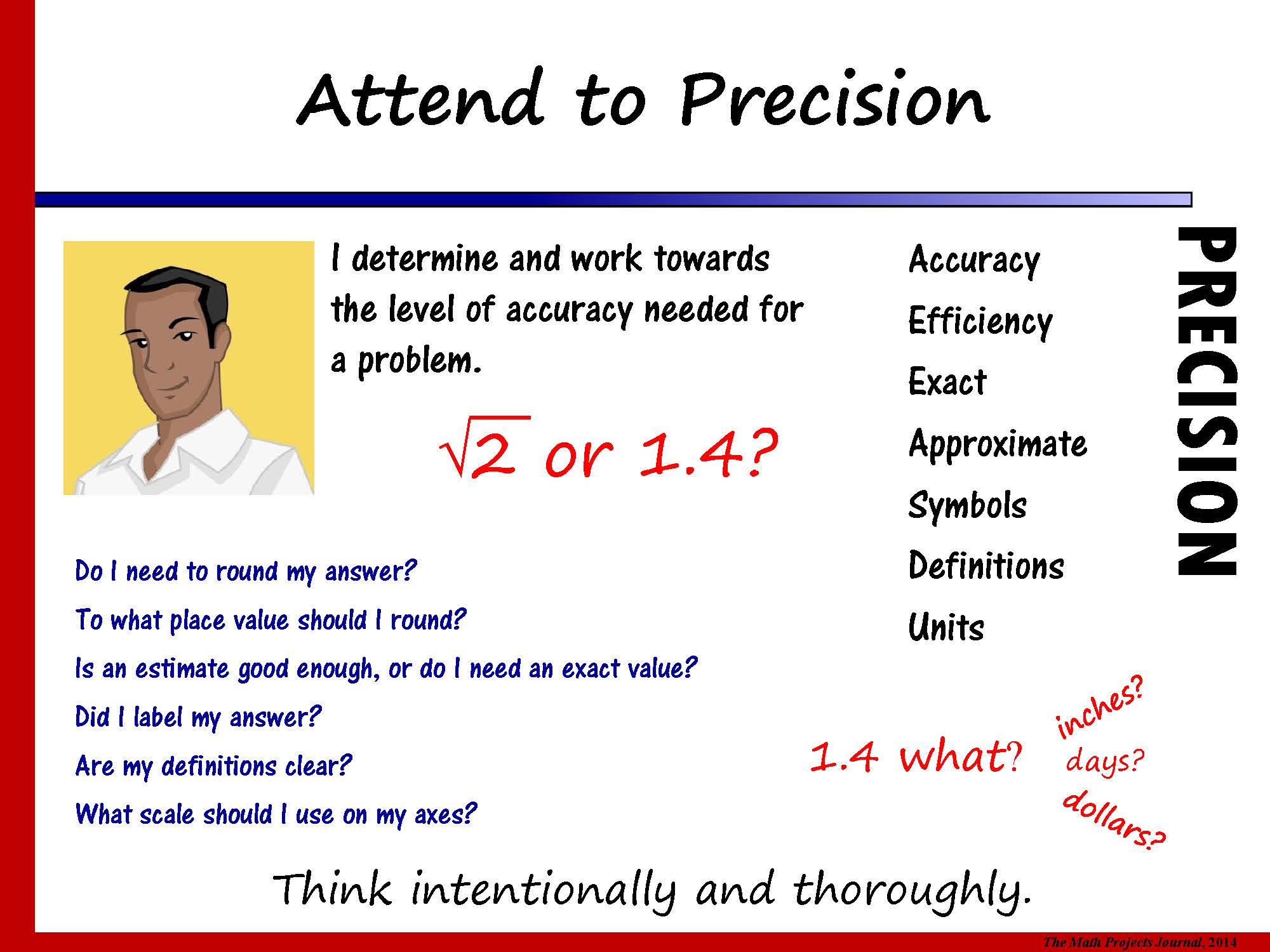
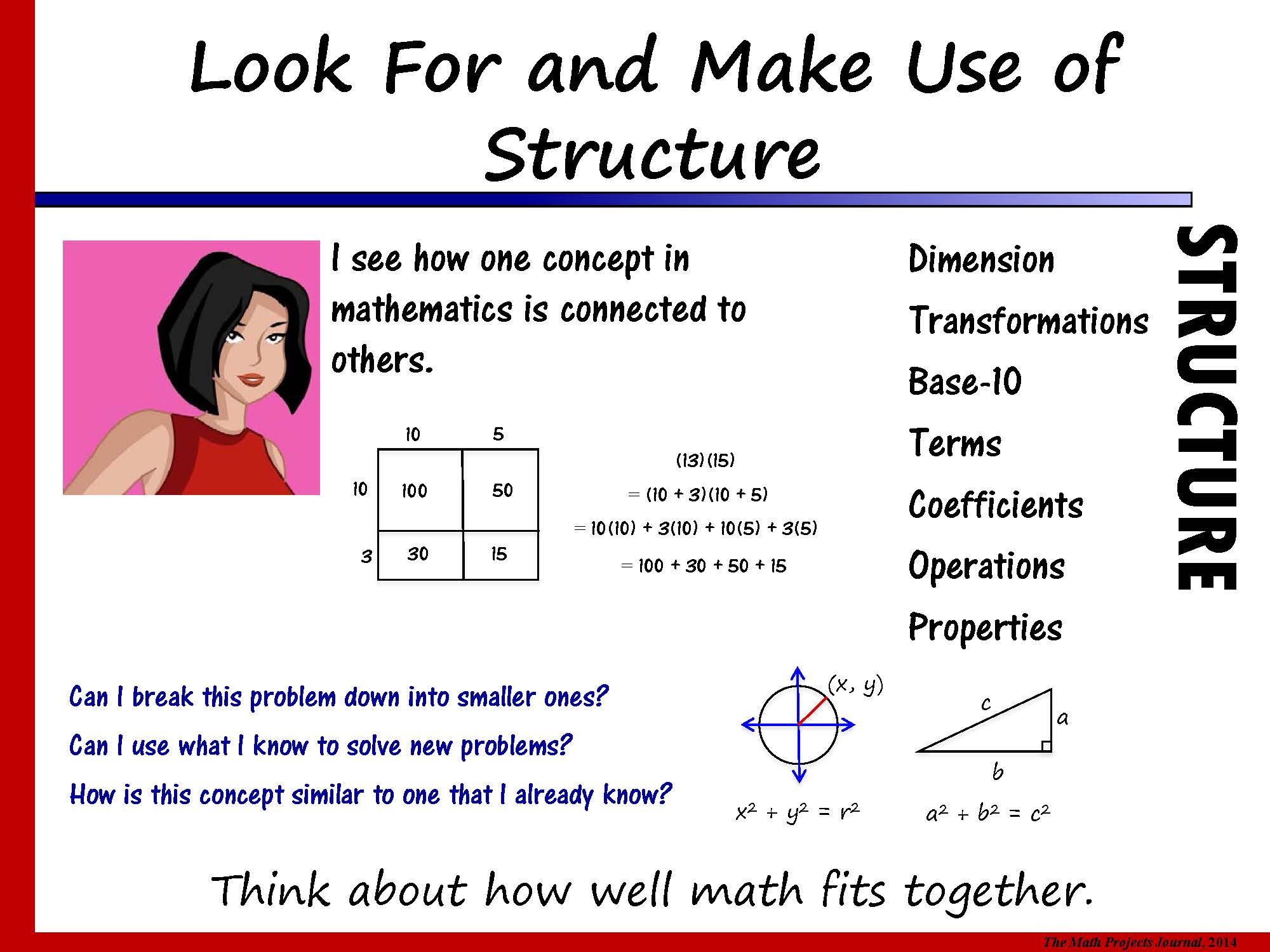
SMP Posters Pic 2_Page_8I created my own posters for the Common Core Standards of Mathematical Practices. I combined the best from what I found from others and added my own structure. Necessity dictated my doing this for two reasons: 1) I wanted to respect others’ copyrights, and 2) I couldn’t find any that were appealing to secondary students.

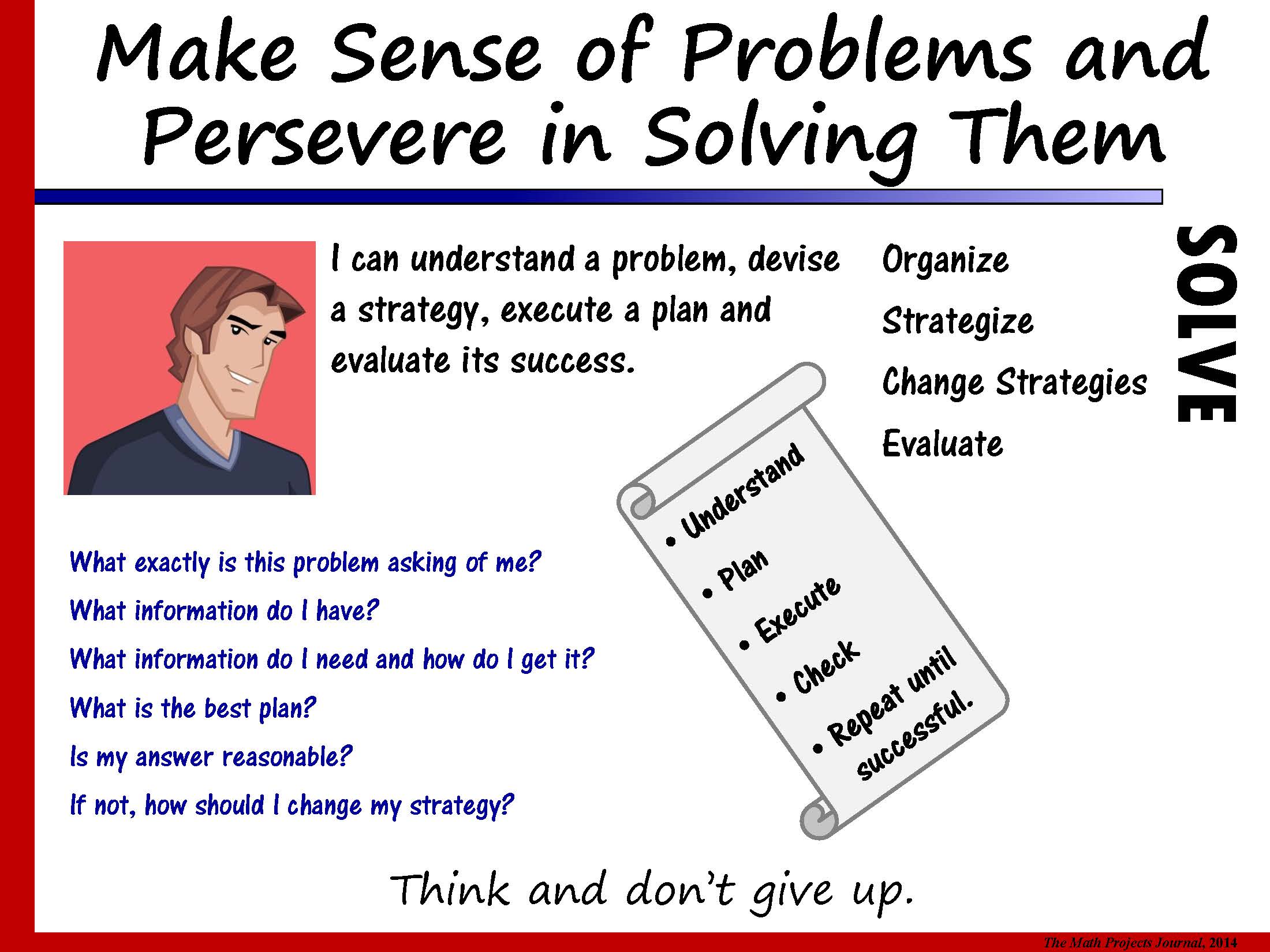
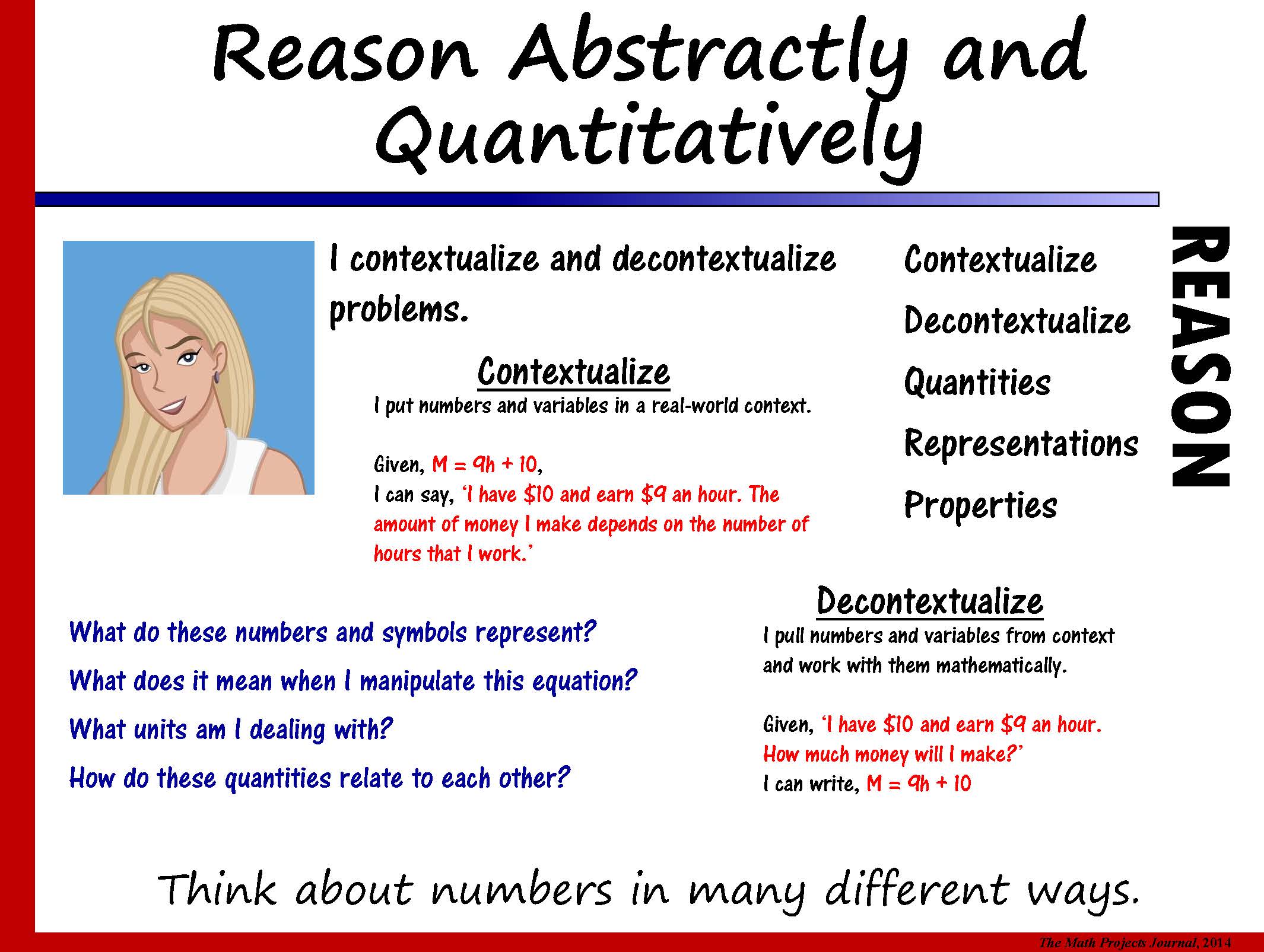
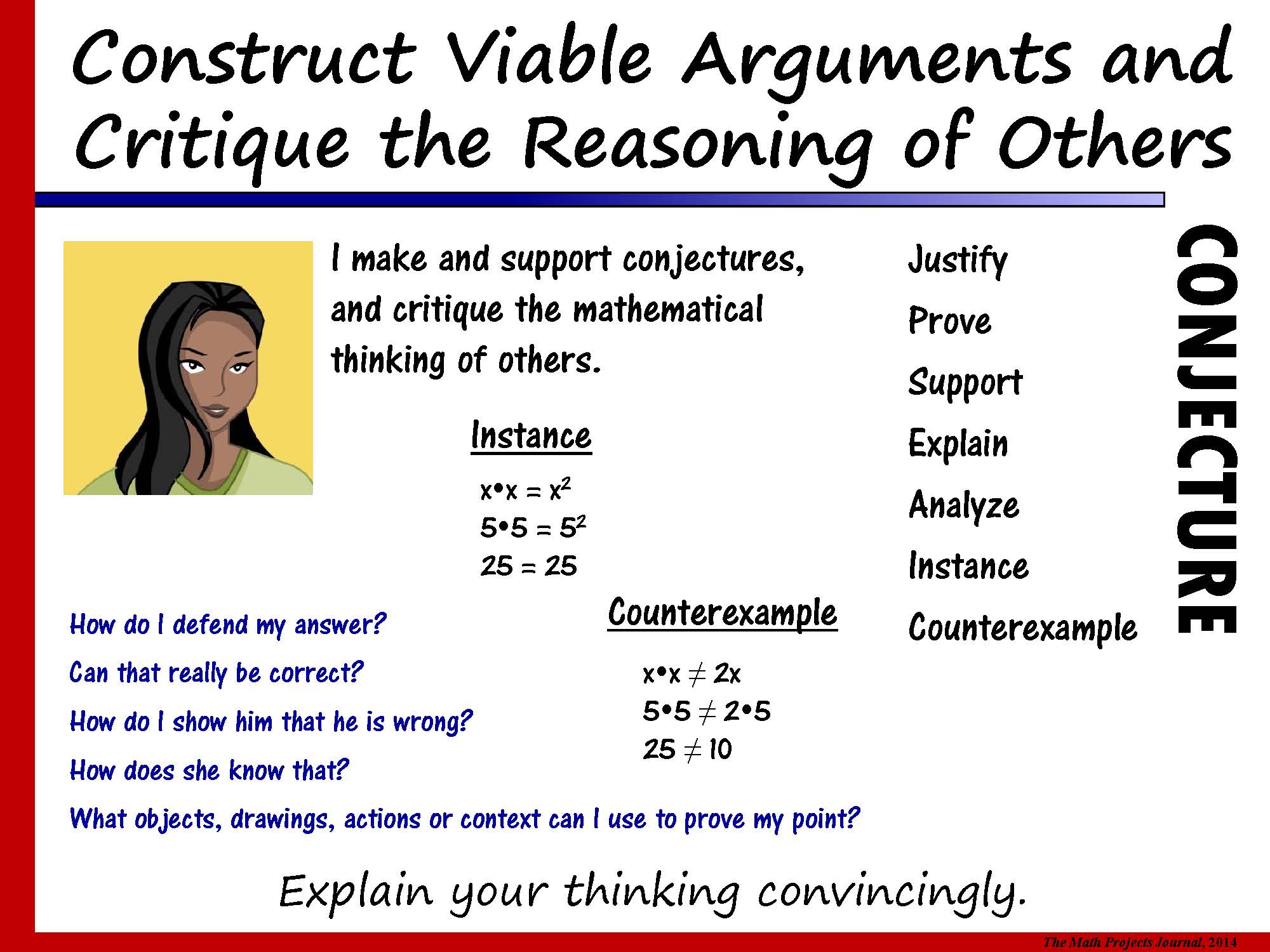
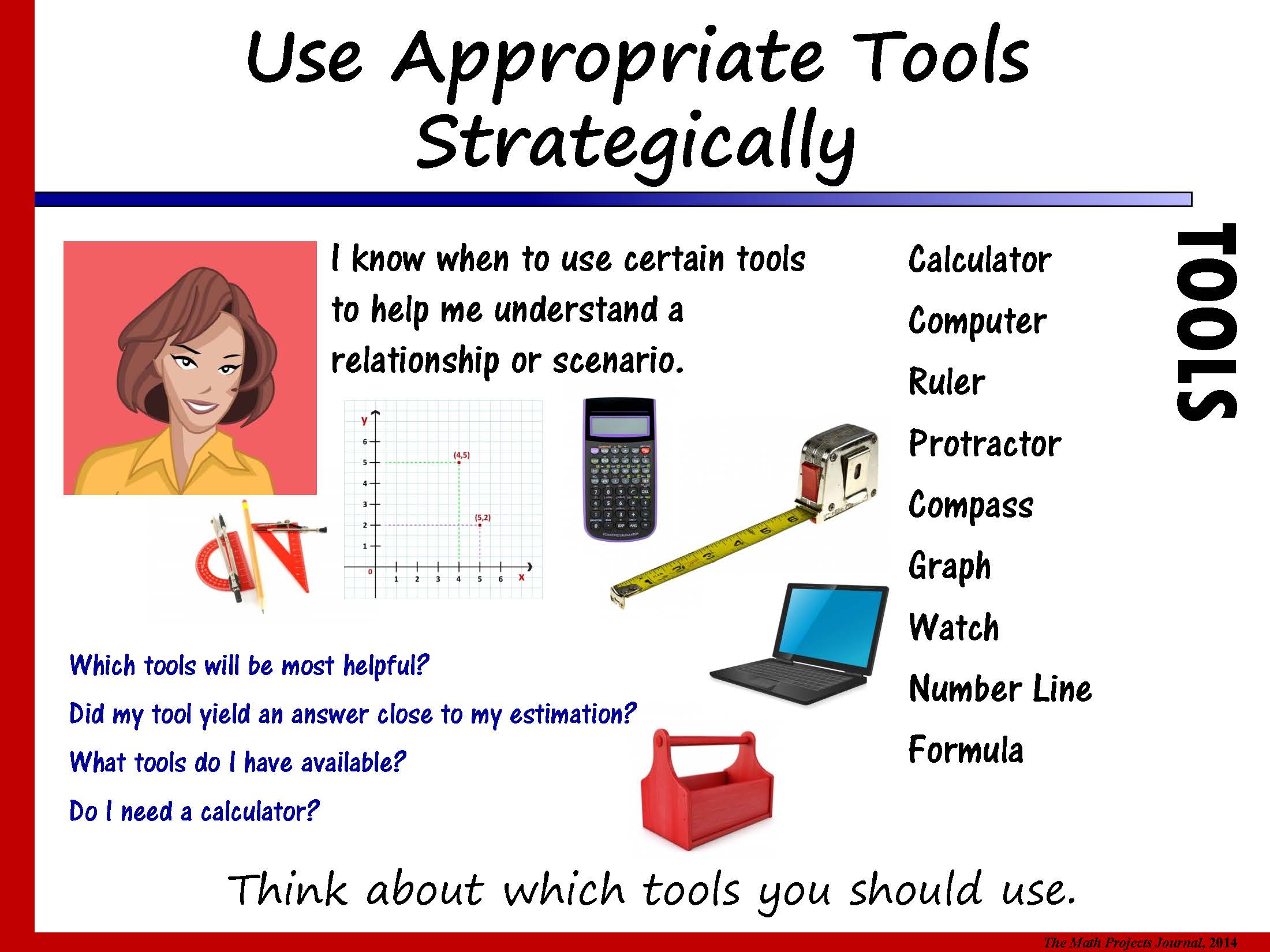
With that said, I offer MPJ’s SMP Posters for use in the classroom. (For JPEGs, click images below.) Each poster here has the following features:

The summary of the Practice straight from the Common Core documents, as listed in that famous grey box

SMP Posters Pic 1

The verbage of the Practice written in kid-friendly, first person language

SMP Posters Pic 2

A single word that embodies the particular practice

SMP Posters Pic 3

A diagram that displays an application of the practice, using Algebra as an example so as to span both middle and high school

SMP Posters Pic 4

A group of words that relate

SMP Posters Pic 5

A list of questions that pertain

SMP Posters Pic 6

A clip art image of a high school student to drive home the point that the practices are for them and not the teacher

SMP Posters Pic 7

An instructive statement that includes the word “Think”

SMP Posters Pic 8

A special shout out goes to the Jordan School District’s SMP posters for elementary schools which were the initial inspiration for this set. Other sources include: Eastern Bristol High School and Carroll County.

Kicking the Textbook Habit

Textbook FreeI have had several inquiries about an article I wrote many years ago titled, Textbook Free: Kicking the Habit. I am not surprised, because, in these days of Common Core roll-outs with few valid materials, teachers are having to create and find their own curricula. While the article is over a dozen years old, it could not be more timely, so I thought I would make it available again. I hope this helps encourage teachers that using textbooks as a resource instead of as scripture in the era of the New Curriculum can be easy and fun.

Textbook Free: Kicking the Habit

Originally printed in The Math Projects Journal in May 2001:

I kicked the habit! I am no longer a textbook junkie. I no longer rely on my daily fix of some publisher’s bloated curriculum. I am free of my addiction without the help of an arm patch, rehabilitation clinic or twelve-step program. I quit cold turkey. Here’s how.

At my school, the students are issued a math book that they leave at home and each teacher is issued a class set. I usually keep one underneath each desk. This year, however, the librarian informed me on the first day of school that we were out of Geometry textbooks. Our student population had grown so large that our library ran short. In fact, for two to three weeks many of my students would not have a book at home either. There was talk of teachers sharing class sets and photocopying pages for students. I decided to try a different strategy. I took this as a professional challenge to see how long I could teach without a textbook. I knew whatever happened would be a growing experience for me as well as my students.

Well, by no fault of the school library, two to three weeks stretched to seven. By that time, I was well into my “textbook free” strategy, so I just kept the ball rolling…for the rest of the year. I used only 12 assignments from the textbook in those 180 days. Here is how that unique experience of being textbook free has changed my teaching, forever.

Firstly, I am now much more focused on standards. Rather than leafing through the textbook, I looked at my state and district standards, and established my curriculum from those. After all, shouldn’t they be determining what we teach? From there, I grouped the topics into units, and then scheduled individual lessons. This process naturally pared down the number of topics that I taught and allowed me to allocate a full week of instruction to each concept, rather than one day to each section of the textbook.

The second big change that has occurred is the structure of my lessons. Everything from my homework to my instruction has radically changed. My typical textbook free lesson was comprised of three to six problems of various difficulty. Oftentimes, I began a lesson with one to three review problems from previously learned material which applied to the current lesson. This is similar to a traditional warm-up with the exceptions that the problems are very relevant to the new lesson, and not simply arbitrary review.

Sometimes, I began with THE big problem from the previous night’s assignment, and solicited student responses. It is not hard to see that my old practice of dedicating 20 minutes of class time to questions on how to complete the previous homework disappeared. The intent of the class slowly evolved from getting the answers correct to understanding the mathematical principles behind the question.

These introductory problems served as a terrific assessment tool, also. Previously, it was difficult to know how well the students were doing when only a handful of them were asking questions from a truck-load of exercises. However, when the whole class was engaged on the same few problems, it was easy to walk the room and evaluate their performance and understanding.

The introductory questions naturally lead to the main problem or small set of problems that would drive the lesson. The students were engaged in an investigation, project or activity relating to the concept. Each day my students came to class to solve problems, rather than take notes — a huge change from all the previous “textbook years.” This process of problem-solving and investigation consumed the full class period. Gone were the days of having the students start homework in class. I taught the entire class period.

The homework assignments were only one to three problems long and were typically extensions of the day’s topic, not just practice exercises. I had learned from the international comparisons that America is one of the few countries that pushes the drill-n-kill regime and yet we are at the bottom of the performance pile. So I tried to limit both the number and size of my assignments, and to make them more challenging and contextual.

By doing that, I firmly settled the argument regarding the quantity and frequency of homework that students need to be successful. For the skeptics that are still reluctant to abandon their practice of assigning 30 homework problems a night, I have some strong evidence. My class averages led the district on the district final. With this in mind, I can at least make a case that this new homework philosophy is not hurting my students in anyway.

Another significant change was my lesson planning. Rather than writing examples of how to complete an algorithm or creating cute acronyms to remember esoteric rules, I actually wrote lesson plans. I started planning each lesson by asking: “What do I want the students to know? What is their common misconception of the topic? How can I best get them to understand the topic? How can I challenge them within the context of the topic?” I would then try to create a story/context/scenario and a small set of problems that would best develop understanding of that topic. It was so much fun. This change in my approach to lesson planning was actually a reflection of my new attitude towards teaching. My job description truly shifted from covering material to uncovering knowledge.

Focused, standards-based curriculum; in-depth, problem-solving instruction; short, conceptually-based homework assignments. This experience was so exhilarating that I am now a junkie all over again. I traded my old addiction to the textbook, for a new one — creative lesson planning. This is one habit, though, that I never intend to kick.

Common Core and The Land of Oz

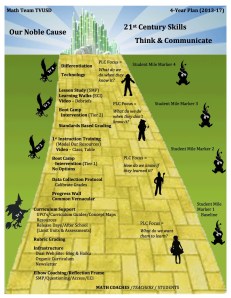
Oz FourThe Common Core is a noble cause. Who would argue that teaching kids to think and communicate their thinking is anything but a virtuous goal? It’s like the Emerald City in the Land of Oz, and standing between us and that bright shining city is a Wicked Witch and a bunch of Flying Monkeys. We know how the movie ends, though; we will melt that witch and make it down the Yellow Brick Road.

I made this comparison for a news reporter after my keynote address at the Idaho State Math Conference last fall. My analogy made NPG News at the same time that my math coaching colleagues and I back at Temecula Valley Unified were developing a four-year plan for professional development and student support in our district. So we wove the Wizard of Oz theme into our plan.

It turned out to be more than a catchy metaphor. The theme is actually quite symbolic to the trials and potentials of rolling out the common core.

4 Year PlanLet’s begin with the Emerald City. The Common Core claims to teach students 21st Century skills. In our district, we have summed up those skills as the ability to “Think and Communicate.” This, then, is our noble cause, our shining city.

Along the Yellow Brick Road is the infamous Wicked Witch and her Flying Monkeys. Our number one issue for teachers in Year 1 of the roll out was the lack of resources, and therefore, the demand upon them to find and create their own curricula. We did not anticipate this phenomenon, but it quickly consumed our role as math coaches. Our first year will end (hopefully), with Units, Pacing Guides & Model Lessons in place, and with an infrastructure to share them among the 130 secondary teachers in our district. Since this is by far the biggest obstacle facing us, and the ugliest work to overcome, establishing the content, scope and sequence gets the tag as the Wicked Witch. In Year 2 (the first of the Flying Monkeys) our primary purpose is to change our method of first instruction. The Common Core is calling for radical shifts in how we teach as well as what we teach, so that will be the focus of Year 2. Year 3 then focuses on what to do for those students who don’t get it (Tier 2 intervention). Finally, while we continue with the work that we laid out in the first three years, Year 4 will emphasize enrichment for students who easily learn the material and on implementing student use of technology.

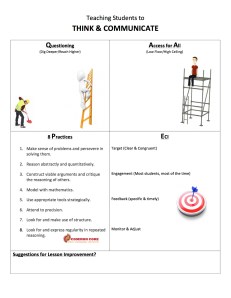
Reflection FrameWhile many of the obstacles listed above deal with the work of us math coaches, the work of the teachers is personified by the four main characters of Oz: Dorothy, Tin Man, Cowardly Lion and Scarecrow. Their training is structured around the four Essential Questions of a PLC (Professional Learning Community). Dorothy must go first, because she was all about direction (“There’s no place like home.”)  So she asks the question, “What do we want the students to know and be able to do?” The Common Core has defined this question very clearly for us, particularly when it comes to the Mathematical Practices. We summed up these practices on a Reflection Fame that we use to debrief with teachers after our elbow coaching sessions. Year 2 calls upon the Tin Man, because it takes a heart to care for those students who don’t get it, especially in secondary schools. We are now commissioned to deliver a “guaranteed and viable curriculum to ALL students.” Year 2 will focus then on Tier 1 interventions … reaching and teaching ‘those kids’ … within the classroom. In order to do this we must have formative assessment and data collection protocols in place to be able answer the question “How do we know if they know it?” The Lion personifies Year 3, because it will take Courage to deliver Tier 2 intervention in response to “What do we do when they don’t know it?” Then, to answer the question “What do we do when they do know it?,” the Scarecrow and his brain will be employed in Year 4, when all the mighty work of the first three years is in place, and we can focus on the needs of the advanced students and on teaching all students to Think with and Communicate through technology.

Finally, and most importantly, we turn our attention to the students results. These are personified by who else, but the Munchkins. We plan to establish Student Mile Markers. These will be Performance Task benchmarks that will be given each year with the Final Exams (but not necessarily counted in a grade) to be used as a gauge to our collective progress (that of students, teachers, coaches and administrators) down the Yellow Brick Road.

The Wizard of Oz gives us a nice frame to dialogue within, but it also offers an important lesson for all teachers. The Wizard gave Dorothy and her friends absolutely nothing, other than the realization that they already had inside each of them that which they had been seeking all along. As do we. Brains, Courage, a Heart, and a Direction Home.

Graph of the Week (New Site)

Kelly teensI am getting the word out on this awesome site: Turner’s Graph of the Week. My friend Kelly Turner did a presentation at the Great San Diego Math Conference last spring and I loved her idea of having students analyze graphs from magazines and newspapers. These are mostly one-quadrant graphs with a natural context. This ties in directly to the Common Core’s call for applications and for reading non-fictional text. I was so impressed that I encouraged her to go public with the idea. I am serving as her megaphone.

Kelly does this activity once a week with her students, thus the name. The site offers several features:

    • Graphs. You don’t have to find your own. Kelly has already posted 12, and will post more on the GOWS page of the site as the school year progresses.
    • Submissions. If you like the activity and have graphs of your own that would serve others, email them to turner_k@auhsd.us. Kelly will screen the submissions and build the online collection.
    • Templates.  There is a generic worksheet template with writing prompts to guide students in reading, interpreting and analyzing the graphs.
    • Samples. On the home page Kelly will offer the graph that she is currently using for the week. Directly below that will be a student sample of the previous week’s graph.

Try it. If you like it, share with your colleagues. The same graph can be used at multiple course levels, with the level of questioning being adjusted to the level of students.

Kelly thanks for all the work on this. You have made teachers’ work easier and students’ education better.

Making a Lasting Impression… Without Even Knowing It

Footsteps in the Snad

GUEST POST: Today’s article is written by Greg Rhodes, the co-founder, creative director, and overall tech guru for MPJ. Usually, he stays behind the scenes, but a recent email made such an impact on him that he just had to share it with our readers.

I’ve been out of the classroom for a long time now, over fifteen years. But prior to my career transition, I was a math teacher like many of you. During those years, I did my best day in and day out to help students think logically and solve problems creatively… and maybe even have some fun in the process. But did I ever think that any of my hands-on lessons or outdoor projects made any lasting impression on my students? Not for a second.

But all of that changed one day when I received an email from Andy, a former student of mine. It left me absolutely speechless.

Hi Mr. Rhodes!  This email is likely to be out of left field since I haven't seen you in about fifteen years (assuming this is the correct "you"), so I apologize for potentially appearing to be an internet stalker.

Background:  I took geometry with you at Trabuco Hills High School in 1996/97 as a freshman and then struggled with algebra 2 honors the following year.  I am currently (after a rather circuitous journey) in a single subject credential program for chemistry at a local state college.

I have found myself bringing up your geometry class over and over again in class discussions of late, and reflecting somewhat extensively upon that time in my life.  Now, as I write the TPA 2 that is due this Monday, I just wanted to take a moment to tell you that it was a good class, and that it made a lasting impression.

So, thank you.

Wow! Fifteen years later and he’s still thinking about my little geometry class… and even discussing it with his classmates. In my wildest dreams, I never could have imagined that my teaching would leave such a lasting impression on any of my students.

So, here’s a word of encouragement as you prepare to go back into the classrooms (or as already there): Keep pursuing great teaching. Keep asking yourself how to make your lesson better, how to help your students understand deeper.

You are making a difference in the lives of your students. Never forget that. Some will thank you with a card or an coffee mug on Teacher Appreciation Day, and others may never say a thing. But don’t let that stop you from being the teacher they remember with fondness fifteen years from now.

TMC13 Session Recaps

TMC DrexelIn my last post, I summarized the overall experience of Twitter Math Camp 2013 at Drexel University. Following is my recap of the sessions that I attended. This conference was unique in that I learned something significant in each session.

Geometry Break-Out #1, Megan Hayes-Golding @mgolding, GA & Tina Cardone @crstn85, MA

After the opening greeting, the first morning session was a choice of break-outs according to course (Algebra 1, Geometry, Stats etc). These were intended to be open-ended discussion/work sessions. In the Geometry session, there was an overwhelming need by the group to wrap their heads around the Common Core Geometry Standards. Megan & Tina wisely went with the flow, and had us jigsaw the standards in pairs and share out. It was enormously helpful for everyone. I was already very familiar with the standards, but I still learned something about the CC standards on constructions. Specifically, the standards not only call for the four basic constructions plus those involving parallel and perpendicular lines, but the students are expected to construct a square, equilateral triangle, and hexagon as well. This was time well spent, with the bonus of getting to know Edmund Harriss @Gelada, Jessica @algebrainiac1 and StephReilly @reilly1041.
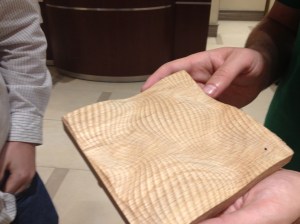
Edmund ArtThrough out the weekend, I had extended conversations with Edmund from which I learned a great deal. Mostly because Edmund is a math professor and as he spoke of his work with the mathematics of tiling patterns, I felt my IQ rise just by listening to him. Much of our discussions centered around the American education, though. Edmund had an interesting perspective, because while he teaches at the University of Arkansas and also leads special math programs for gifted children, Edmund is British. From that experience, he had a great deal to share about “how to run standards based education correctly.” I hope he blogs about that soon.

“I Notice & I Wonder,” Max Ray @maxmathforum, PA

Max Ray is the “Professional Collaboration Facilitator” at the Math Forum at Drexel. In essence, he teaches teachers how to teach problem-solving. I had heard before of starting lessons with “What do you notice? What do you wonder?” This phrase, which was originated by Annie Fetter @MFAnnie, is intended to initiate student thinking on a rich and robust task. That seemed pretty simple, so I wasn’t anticipating much new learning here … Boy, was I wrong! Max started with a picture of 3 glasses and the phrase “What do you notice? What do you wonder?”

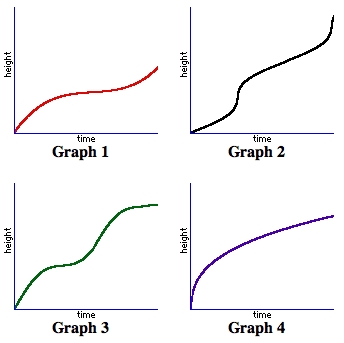
TMC glasses      TMC graphs

We were asked to ponder for a moment, then share our thoughts with our neighbors. (Think-Pair-Share).  “I notice they have different shapes. I wonder if they have the same volume. What kind of drinks go in each one?” Then he posted the picture of 4 graphs, and again posed the same questions: “What do you notice? What do you wonder?” The ensuing discussion resulted in everything from “I notice the graphs are different colors” to “I wonder if the graphs correlate with the filling of the glasses.” The thing that I noticed about this whole activity is that Max let us mull this over without offering a single number or formula. Nor did he offer a single answer to any of our wonderings. Two pictures and two questions occupied us for 15 minutes. In the era of rushing through content it was wonderful to be reminded that mathematics starts with an observation and a question. Speaking of questions, my group wondered what glass shape would correlate to the fourth graph… while Max stood at the front of room silently smiling.

“Practicing the 5 Practices,” Christopher Danielson @Trianglemancsd, MN

Christopher Danielson is a professor of mathematics at Normandale Community College and also teaches methods courses for elementary school teachers. He shared the research published in Five Practices for Orchestrating Productive Mathematics Discussions. In summary, the 5 Practices are:
5 Practices PicAnticipating, during planning, student responses to the lesson prompt
Monitoring students repsonses during the lesson activity
Selecting which student responses are to be discussed publicly
Sequencing those student responses chosen
Connecting the responses to each other and to the mathematical ideas

Chris emphasized that the first and last of these are the two most troublesome for teachers. Chris modeled all these principles by conducting a math lesson on fractions. He knew what the issues would be with the context. He called us specifically by name to present our responses in an order that allowed the discussion to develop from simple ideas to more complex. I was particularly impressed on how he asked us to compare and contrast the various strategies. This is where I personally saw that I needed to bolster my own efforts on connecting ideas in own my class discussions. I walked away with the understanding that while any class discussion is better than none, there truly is an art form to doing class discussion right.

“5 Ways to Boost Engagement,” John Berray, @johnberray, CA

I have to say that the number one way to boost engagement is to teach like John Berray. The joy that he has for the material and for his students was just bursting out of him. With that said, John had 5 other ideas on increasing engagement:

1) Turn the Mundane on its ear
2) Jump on the timely
3) Bring in the outside world
4) Unlikely objects arouse wonder
5) Spill some paint

Translation: 1) Make it fun, 2)Tie math to current events, 3) Use the internet, particularly video, 4) Be goofy, 5) Connect the material to kid’s lives.

The highlight of the session was John showing how to make a textbook problem more exciting (a textbook makeover). The sample problem asked how many ways are there to take a 10-question true-false test (assuming all 10 question are answered). John asked us, “Who wants a shot at the glory?” and offered $5 to anyone who can match his answer key exactly. We were all prompted to number our papers #1-10 and choose T or F randomly for each. Once we all had our answers to this hypothetical 10-question True-False quiz, we were all asked to stand up. He began to display 10 questions, one at a time, about the participants at the conference. This offered humor and another level of engagement, as we were all trying to guess correctly, even though we had predetermined answers. After the first answer was revealed, all those who answered wrong on the paper had to sit down. We were asked to notice how many were still standing. This routine continued as we went through the entire list. Nobody won. The obvious question is, “How many people would we have to do this with in order to expect a winner?” He had just turned the mundane on its ear.

Geometry Break-Out #2

Our group reconvened with a few new people joining in. It was especially nice to See Peg Cagle @pegcagle after so many years. While the first day was a working session, this day was all about discussion. The group really wanted to talk about how to teach all the standards we listed in the previous sessions, while instilling the CCSS Practices. Teachers shared their various ideas, experiences and techniques. There was also a question on grading practices that revealed the dark side of the MathTwitterBlogosphere … We can be a very opinionated bunch. The hot topic for us was standards based grading. This turned out to be a benefit to the new teachers in the room or to old teachers with open minds, because quite a variety of ideas and positions were shared. It was an engrossing conversation, because no matter the positions taken, they were all shared with a passion for teaching students rich mathematics. The end of session came way to soon.

“Still Keeping it Real,” Karim Kai Ani & Team Mathalicious, @Mathalicious, VA

Mathalicious offers engaging, innovative math lessons with a focus on “real-world” applications. Karim @karimkai led us through two Mathalicious lessons that were solidly based in mathematics and loads of fun. The first, Datelines, tied the age of potential dates to systems of inequalities. The age gap on a date becomes less of an issue as people get older. For example, a 24-year old dating a 20-year old is less awkward than the 20-year old dating a 16-year old. This is an engaging topic for teenagers that Mathalicious sets to a graph and poses critical questions according to a given rule on dating ages. Like I said … solid. The second lesson, Prisn, used Venn diagrams to analyze the probability of being wrongfully flagged by the governments PRISM program for mining data. This lesson was about as relevant as any can get. It allowed for rich non-partisan conversation on how much error the public will accept. As I told Karim, these lessons are sexy, but have a lot of substance. At the conclusion, he generously gave the TMC participants a free trial subscription to Mathalicious. I intend on checking out more of their work.

“Getting Students to Think Mathematically in Cooperative Groups,” Lani horn, @tchmathculture, TN
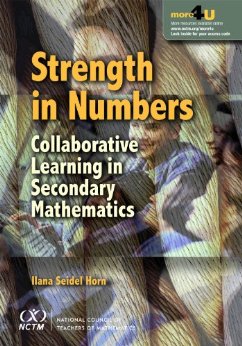
Ilani BookThis one was very special for me, because Dr. Ilana Horn was such an influence on the teacher collaboration model that we have implemented at my high school for the last 9 years. Back in 2004, I was about to be the Math Department Chair for a new high school and was speaking with Jo Boaler about collab models for teachers. She told me that the person to contact was Lani Horn at the University of Washington (She is now at Vanderbilt in Tennessee). A week later, I happened to be vacationing in Seattle, and Lani was kind enough to give up time to a stranger and talk about her doctoral research. She was gracious as well as knowledgeable.

So I was excited to see her again and share how her information helped lead my crew back home to be one of the highest performing schools in the county. She was pleased to hear the news. Her session this time was on student rather than teacher collaboration. The specific model she shared is known as Complex Instruction (CI), in which students are grouped heterogeneously, with intentional methods to have all students participate. The focus of Lani’s session was on how academic status affects student engagement during group work. She was very intentional in telling us that participation is hindered by this perceived status about smartness, which is too often defined in math class as “quick and accurate.” To help make it safe for everyone to participate, the teacher needs to redefine smartness by acknowledging and rewarding “good questions, making connections, representing ideas clearly, explaining logically, or extending an idea.” Lani shared a video of a group of students working on a math problem, and asked us our thoughts regarding each students level of participation. She also asked us to analyze the teachers interaction and prompted us for alternative responses. This analysis of the work done by each student debunked the conventional wisdom that non-participatory children are lazy, stupid or shy. I had learned as much from Lani Horn on this day as I did in our first encounter.

Due to another engagement, I had to fly home early from the conference so I did not get a chance to attend the last session on Friday or any on Saturday. I heard I missed some great stuff,  which I don’t doubt.

Twitter Math Camp (The Experience)

TMC_2013_PhillyIf I traveled across the country to see someone whom I met online, you might think I was nuts. So what would you think if I traveled across the country to meet 115 people that I met online? Well I did just that. I flew to Philadelphia to attend Twitter Math Camp 2013.

TMC is a unique conference for math teachers. Yes, it has your standard general session with smaller breakout sessions to choose from. What set this conference apart was that for the most part all the presenters, participants, and organizers (shout out to @lmhenry9 and @maxmathforum and company) knew each other … through Twitter. We all have been tweeting for various lengths of time. There was everyone from veteran tweeters to newbs. For me, it has been about a year. I am a moderate tweeter; I tweet some and I read some. For the most part, I still consider myself a novice Tweeter, but a veteran teacher (25 years). So did I why go out of my way to attend this particular math conference?

Because I suspected that this was a very special group of educators. I found that I was right. I spent two days with a large group of extremely intelligent, creative, sincere, committed math teachers. Actually, we were math ed geeks in the fondest sense. Between sessions and over meals and, of course, through tweets, we conversed about how “not to be sucky teachers.” I have never been around a group of people so hyper-focused on being nothing less than amazing at their craft, with the critical understanding that no one is.

What also drew us together was the desire to know the person behind the avatar and the handle, to make eye contact and have a conversation longer than 144 characters, and to party together in a basement bar in Philly (which is material for a post in and of itself). We were genuinely excited to meet those whom we follow, and follow those whom we met. The name on the presentation was as important as the name of the presentation. We wanted to learn about each other as well as from each other. And we did. And it was awesome.

I will recap the sessions that I attended in a subsequent post. For now, I want to impart a couple of thoughts.

1)  If you are not on Twitter, I strongly suggest you do so immediately. Just sign up and figure the rest out later. You can start by following me, @MathProjects, and then connect with the rest of the TMC community.

 2) If are on Twitter and aren’t sure whether TMC14 will be worth your time, let me answer the question for you… It definitely will be. I was skeptical until the first breakfast when I sat with a dozen fellow tweeps, and only became more convinced as the conference went on.

3) If you wanted to go this year, but couldn’t, I hope to see you at the next camp.

4) If I spent any kind of time with you in Philly, thank you for sharing your passions, ideas and friendship with me. I am already looking forward to next summer. In the meantime, may we all teach amazingly this school year.

Mr Cornelius’ Desmos Lesson

This lesson on graphing conic sections rocked on multiple levels. For the students, it involved concrete mastery of standards, conceptual understanding of several topics, higher order thinking skills, student autonomy and intellectual need. For the teacher, Mr. Cornelius of Great Oak High School, it was a week’s worth of experimenting with new software and pedagogy. The genesis of the lesson was a combination of an email and a diagram. I had sent to my Math Department a link to the free online graphing calculator Desmos.com; a mutual colleague, Michael White, shared the idea of having students use their knowledge of equations to graph a smiley face. Mr. Cornelius merged these ideas into a new 5-day lesson in the computer lab. That week produced a multitude of pleasant surprises.

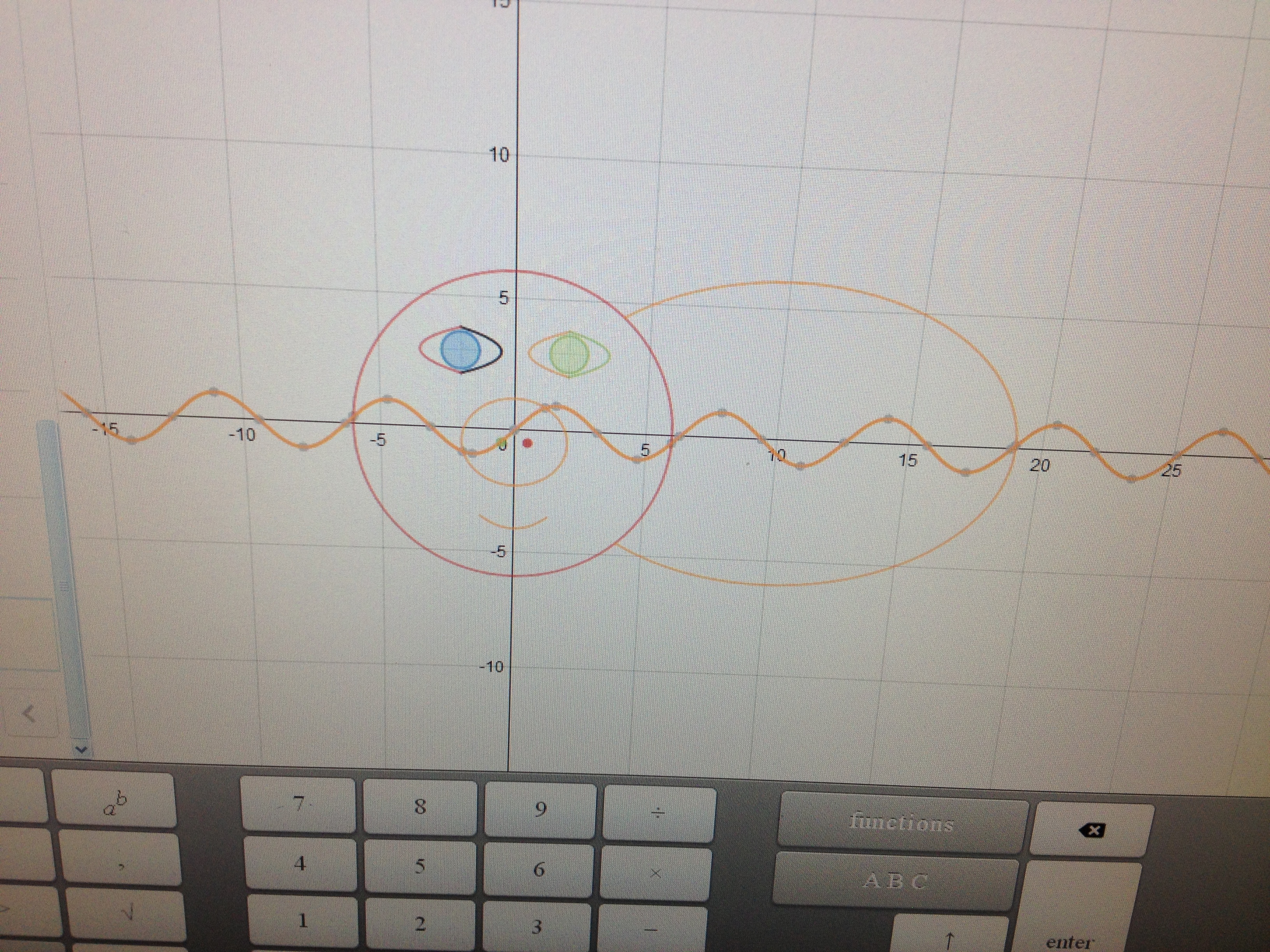
Desmos smile 2

Michael started with a whole-class demonstration of Demos at the end of the period on a Friday. He posed the Smiley Face graph (shown above) as the minimal requirement for passing the assignment. The strength of this lesson is two-fold: 1) There are a variety of equations involved (circle, ellipse, parabola, absolute value, as well as linear), and 2) repeated restriction of the domain and range.

Michael invited students to create their own designs for a higher grade. He expected only a few takers, but in the end only a few decided to produce the Smiley Face, and this is where the richness of the lesson was truly found. During the week-long lab session, I observed one of the days and took a few pictures of some works-in-progress.

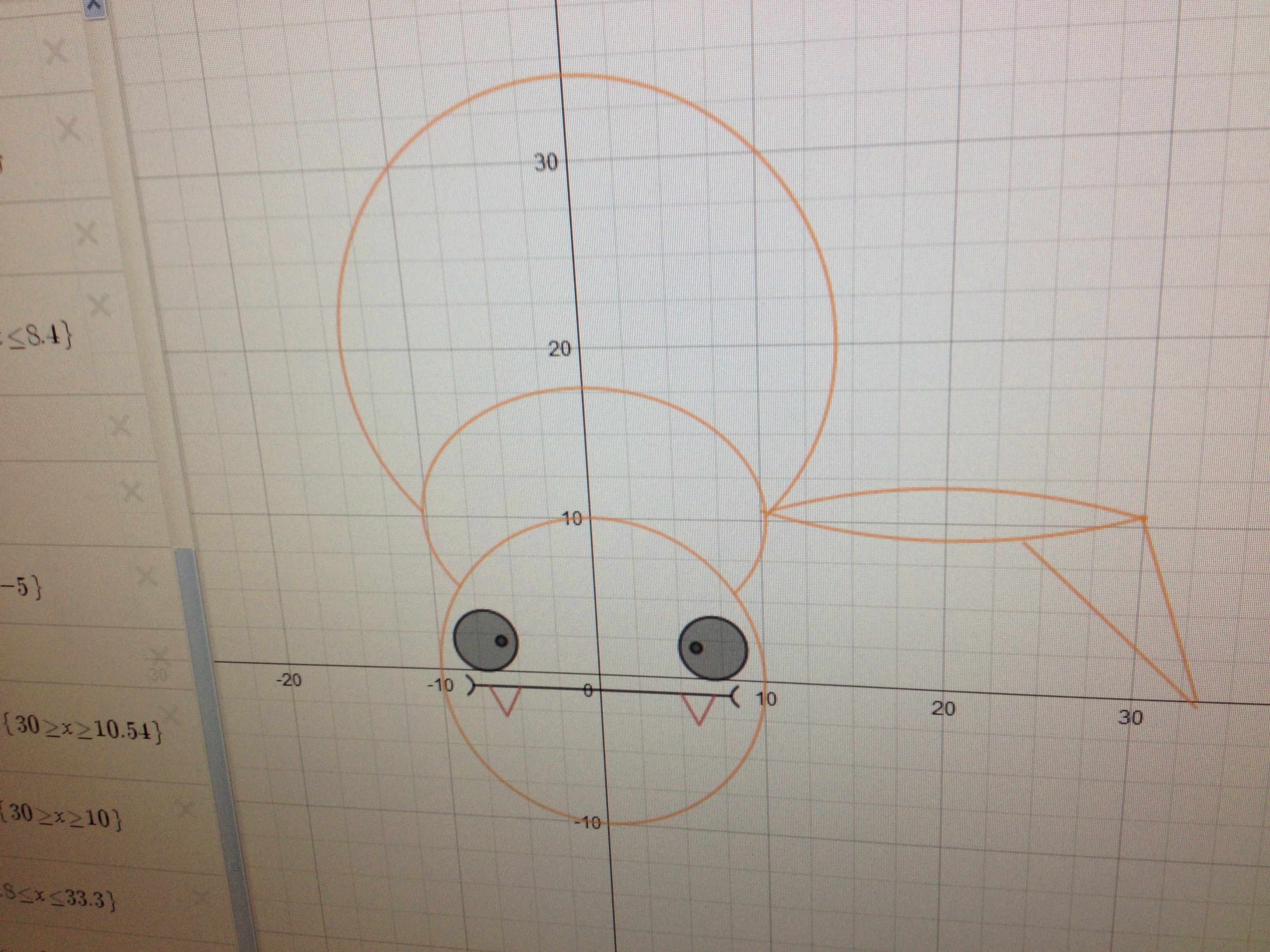
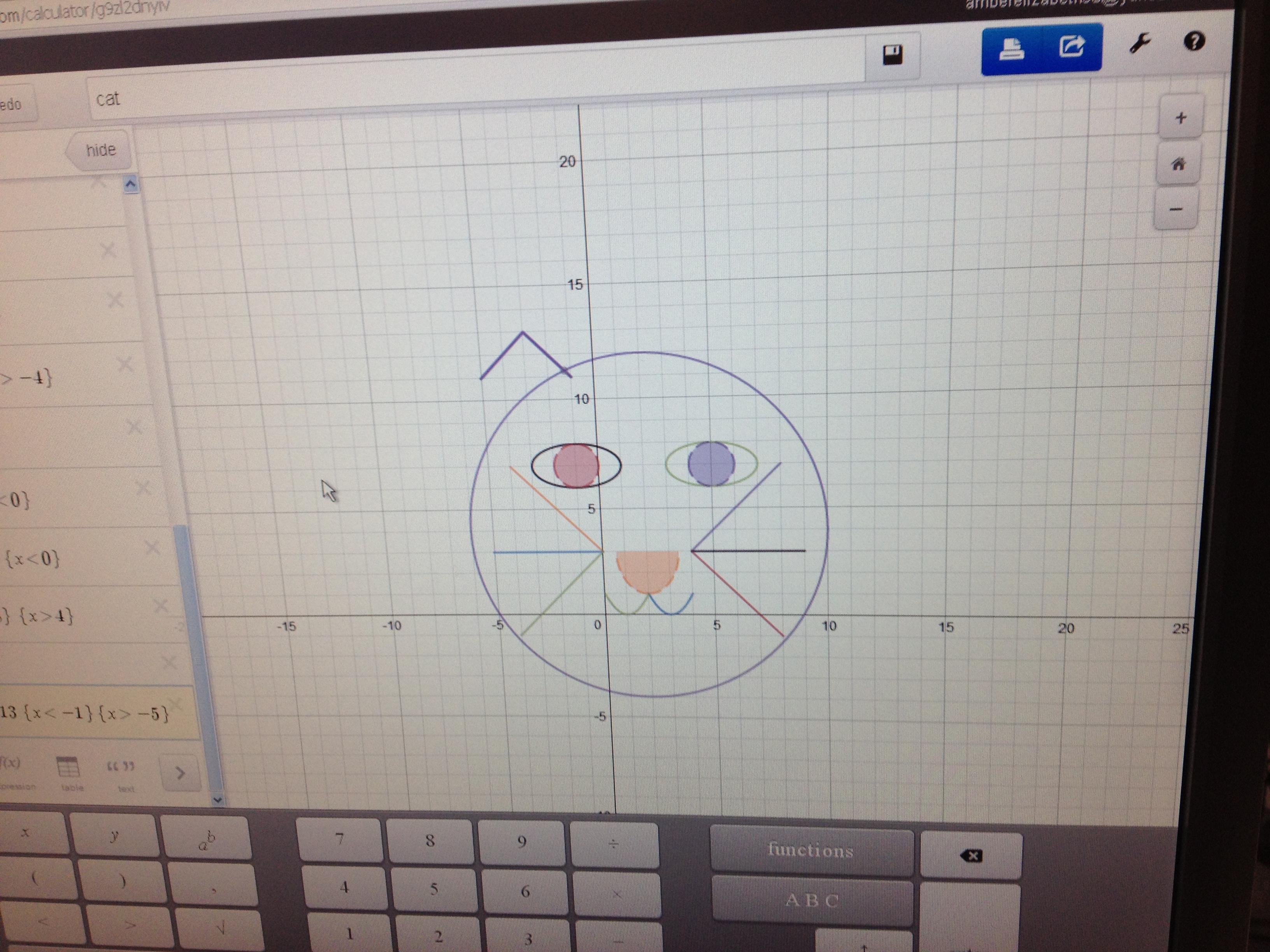
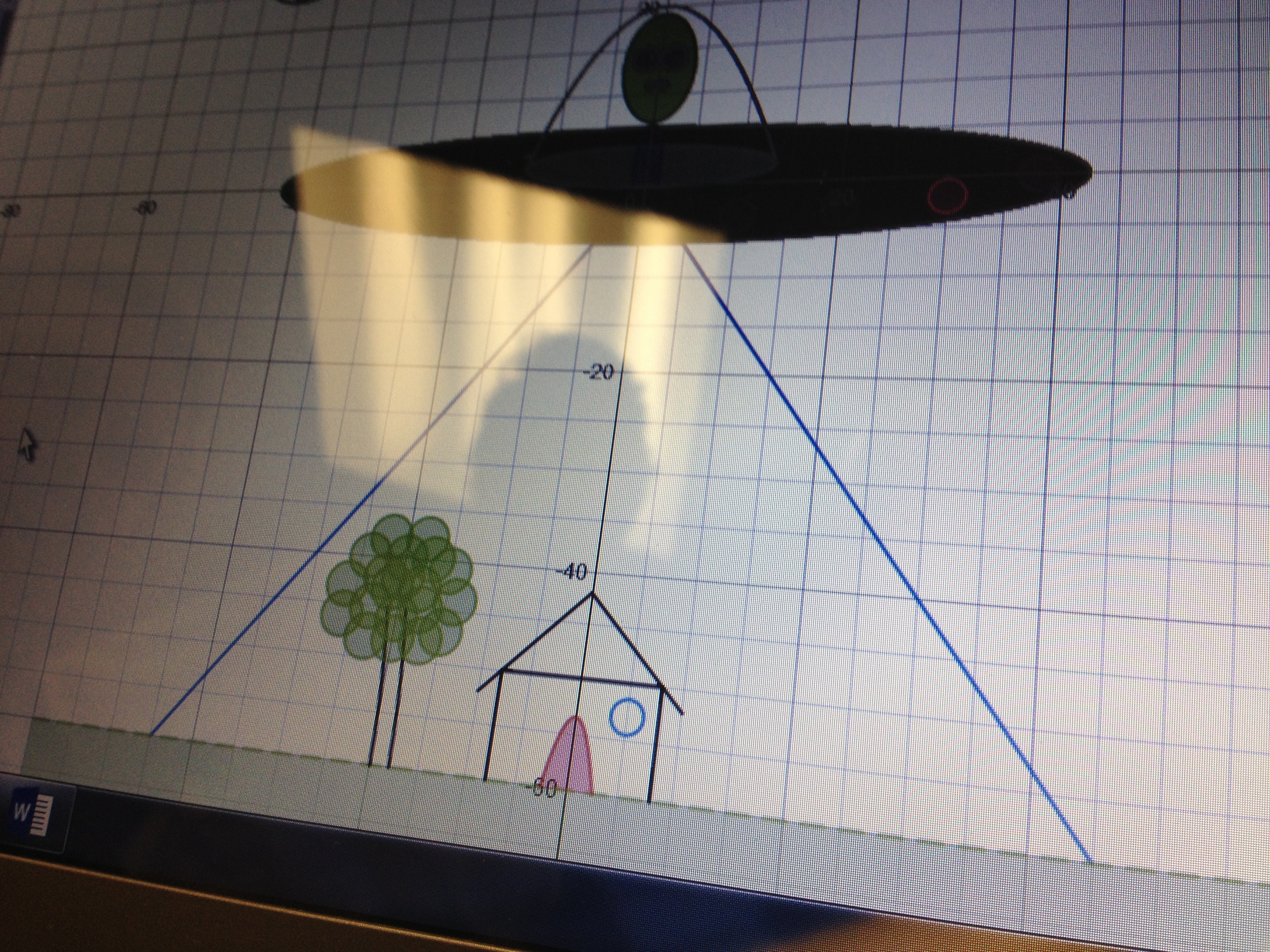
Desmos spiderDesmos MinnieDesmos CatDesmos House Alien
As you can see, the students independently chose to include inequalities in order to produce the shading. Here was my favorite use of shading.

Desmos Arnold

What really impressed me about the lesson was the examples of students who asked to learn something new in order to produce something they chose to create. In the example below, a student wanted a curly (wavy) tail for her pig. Mr. Cornelius taught her how to graph sine and cosine waves. Granted, this was a superficial lesson, but to see someone wanting to learn a skill from next year’s course was a treat.

Desmos Pig 1

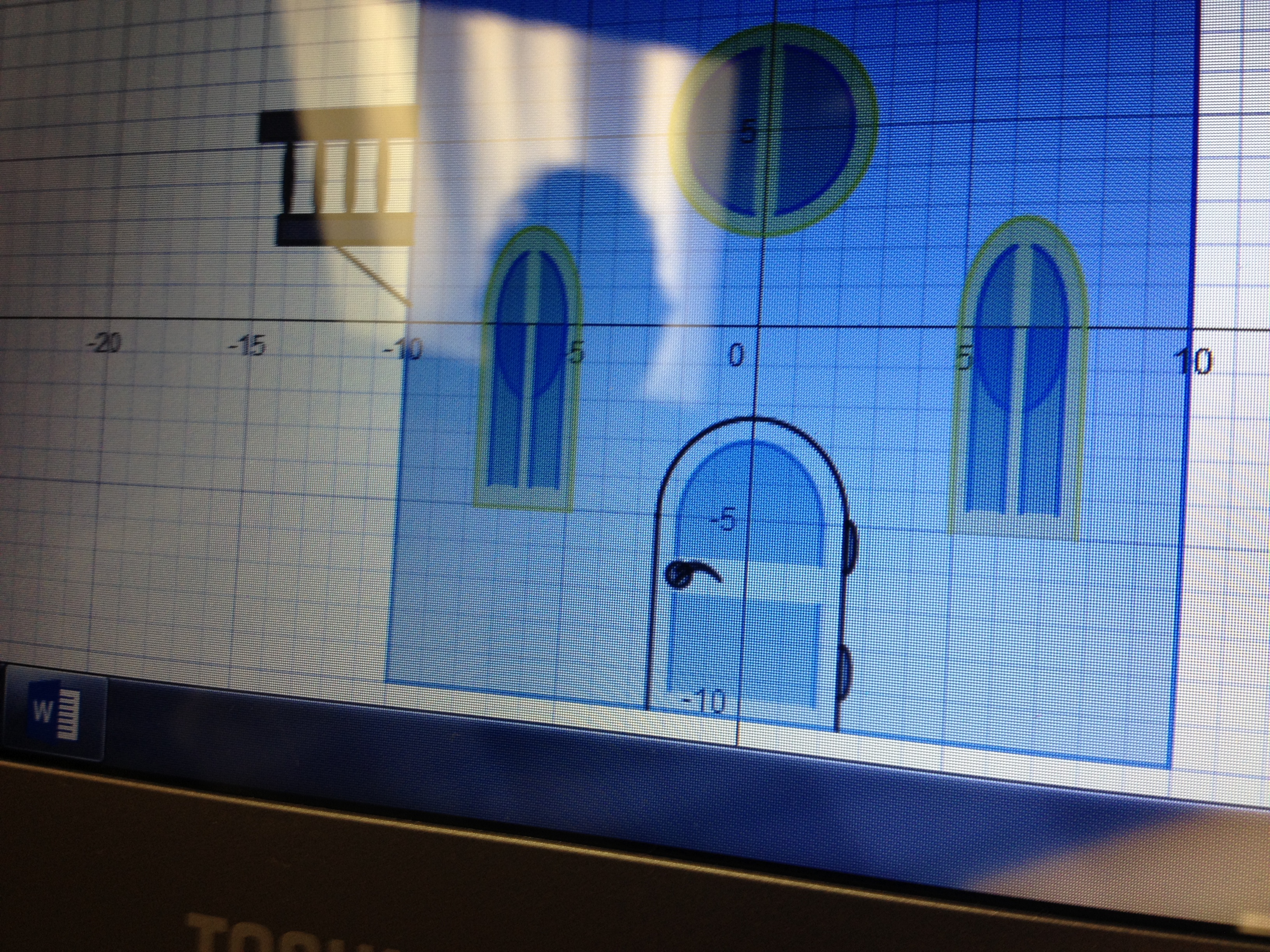
The rigor that the students imposed upon themselves, again as demanded by their creative idea, was remarkable. Look at the detail of the door handle on this house.

Desmos House Desmos Hinge

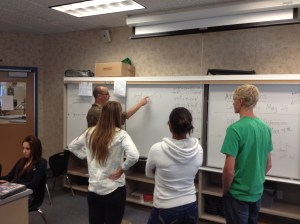
Desmos Lesson

My favorite moment was this one with Michael and a handful of students. It is not as sexy as the pictures that the students were producing, but it was far more significant. Three students all had a similar question, so Mr. Cornelius conducted a mini-lesson on the board while the rest of the class worked away on their graphs. The topic on the board was not part of Michael’s lesson plan. It was sheer improvisation. For me, this interaction was the treasured gem of the lesson experience: A teachable moment generated by an intellectual need.

This was the first run of Michael’s lesson and in a conversation that we had while he was grading the assignments he conceded that he needed a scoring rubric. We also discussed how this idea could be woven throughout both Algebra 1 and 2 courses. The idea of Graphing Designs could span linear, exponential, quadratic and conic equations. I smell a lesson plan brewing!

(P.S. For those of you that get hooked on Desmos, I suggest you also check out the Daily Desmos Challenge)

Common Core Pathways: Redefining Algebra

PathwaysI have fielded a great many questions lately regarding the creation of Common Core Pathways (course sequences), especially in regards to the big question: to accelerate or not to accelerate. I appreciate the curiosity, because in this last year I did a great deal of investigating in order to help my school district develop our own pathways. I recently had a request to share our pathways “with commentary.” This makes sense, since there are many misconceptions of the Common Core out there that I had to sort through, and the rationale for these pathways will help others decide if these will work for their system. So I share four things:

1) A primer for the Common Core Pathways, particularly in terms of Algebra content.
2) The needs of my district that led to the development of three pathways.
3) The actual Pathways that my district decided upon, with links to resources that helped us get there.
4) Student placement.

I hope this helps.

A Common Core Pathways Primer

The Common Core spells out clearly what students are expected to know at each grade level K-8. Then for high school it lumps the standards together in High School Domains (Number & Quantity, Algebra, Geometry, Functions, Statistics & Probability and Modeling). This is done in order to allow high schools to structure courses in a Traditional Model (Algebra 1, Geometry, Algebra 2) or an Integrated Model (Math 1, 2, 3). At first glance it looks like CCSS is now delaying Algebra until 9th grade, after years of states pushing it in the 8th grade. This is because CCSS does not define Algebra as a course, but rather a domain across grade levels. Understanding this is key to creating accelerated pathways.

Traditionally, an Algebra course is seen as starting with the arithmetic (integers & fractions) and the simplifying of expressions (which many consider to be Pre-Algebra), followed by solving of equations, then moving onto linear equations and systems by the end of first semester, with polynomials, quadratics and rational expressions rounding out second semester. In other words, we go from balancing a check book to racing cars to launching rockets in a single year. However, the Core spreads these concepts out over several years. Arithmetic, simplifying and basic solving is mastered in 6th grade. Solving multi-step equations and deeply understanding rates and ratios is the focus of 7th grade. The 8th grade standards focus on linear equations and systems. While Geometry topics like surface area, volume and transformations are spread throughout the middle school grade levels, along with probability & statistics, the key here is to see that the entire first semester of a traditional algebra course is covered by the end of 8th grade. This way, the students can be handed an exponential function when they walk in the door on the first day of their freshman Algebra class. So don’t get it wrong; students under the common core are still learning Algebra in middle school; they are just not finishing it. The Common Core does not delay the Algebra course for students; it simply redefines Algebra.

No More Than 3, Sometimes 4

Tim Kanold once shared with me the pathways created at Stevenson HS in Illinois. He claimed that they had two pathways… one pathway led to Calculus, another to Pre-Calculus. It was actually one pathway: Algebra 1, Geometry, Algebra 2, Pre-Calculus, Calculus. What made this sequence look like two pathways was the course that students enrolled in as freshmen (Algebra 1 vs Geometry). Stevenson HS offered a ride on a single train; the only variation was which boxcar a student boarded when arriving at high school. I ask Tim if every student graduated with a minimum of Pre-Calculus. He said that while 58% of the seniors graduated with Calculus, some only took three years of math. When I pressed for the pathway offered for special education students and the like, he conceded that those rare few were allowed to deviate from the given path. He stated, “Create only 1 path, no more than 2, and sometimes 3.”

My district embraced this idea, but we have one more level of need. My high school has an International Baccalaureate (IB) Program. In order for students to be able to reach its “Higher Level,” we need some students to come into high school taking Algebra 2 as freshmen. Furthermore, while California only requires two years of math, my district requires three, and the state still only requires Algebra 1 to graduate, not Algebra 2. Therefore, students on an IEP may take Middle School math classes through our Special Education Department, and anyone passing Algebra 1 may take Accounting to complete the third year.

With all that, my district adopted a “No more than 3, sometimes 4,” policy. These  3+ pathways are shown below.

The Pathways for Temecula Valley Unified

Pathways Math

Our district decided to stick with our traditional model. The scope and sequence of our “Common Core Pathway” is very similar to what the Dana Center of Texas produced. We also took some inspiration from Montgomery Schools in Maryland (scroll to the bottom of their page, and you will see a graphic very similar to ours) and Tulare County in California which beautifully laid out the scope and sequence for both the traditional and integrated models.

The Traditional Pathway allows students to reach Pre-Calculus or other similar 4-year college options. There are two keys to notice here. One, there is no remedial track. All mainstreamed students will be taking Algebra and Geometry. This is freaking out teachers who are anticipating having a significant number of “those kids” in college prep classes. They have told me that the kids won’t be properly prepared. I pushed back claiming that the kids will be ready, but I am not sure we teachers will be ready. (side note: Professional development training is imperative to make this work.). The second key to notice is that there are two types of Algebra 2 courses. Our Pre AP course was designed with the Common Core plus standards (+) included, for those students who intend to go beyond Calculus AB (Calculus BC or IB). For details on other courses shown in the diagram visit the Math Department at Great Oak High School.

The Accelerated Pathway was an easy adjustment. If we note the definition of Algebra explained above, then in 8th grade we teach a traditional Algebra course, substituting the Geometry and Stats topics for the Pre-Algebra topics. 6th and 7th grade remain untouched. Two years of math is condensed into one.

The Compacted Pathway was a bit trickier to create. In the past, students who wanted to take Geometry as 8th graders, simply skipped 6th grade math and got to Algebra 1 by 7th grade. That’s no so easily done now under the Common Core. So we have to compress 4 years of courses (6th, 7th, Algebra & Geometry) into 3 years as shown.

NOTE: Now that we have implemented these three pathways, I would only recommend the first two. Unfortunately, the Compacted Pathway is too much for both students and teachers. Since our high schools still need a means for students to reach Calculus B/C and beyond, it appears best to have that relatively small and uniquely talented population to accelerate in high school, through summer school, online options or Junior College courses.

Choosing a Pathway

The big question that follows after creating these pathways is “Which students are assigned which pathway?”  Or more to the point “Who gets to Accelerate?” We actually would like to see the majority of students follow the Traditional Pathway. For our upper level high school math programs to thrive, we need at least 20% of the middle school students on the Accelerated Pathway, and a little under 10% for the Compacted. Of course, we shouldn’t fit students to the needs of the school. The students are to be recommended by ability based on assessments and teacher recommendations. Our schools need to be watchful, though, because our community has parents who feel their child won’t be able to compete for a top college if they are in the bottom track. While some vigilance will be necessary, we also have an open access policy… students/parents may take any courses they wish. I am curious how these pathways portion out.

Furthermore on placement, another of Stevenson High’s policies that my district is adopting next year is the practice of moving students onto the next course … even if they flunk. I have also heard this same pitch from Bill Lombard. So, if a student flunks Algebra, the student enrolls in Geometry the following year, and makes up the class in summer school, online remediation or concurrently. Same thing is true when going from Geometry to Algebra 2. However, if a student fails Algebra 2, they may repeat, since these students have multiple options at this level (Trig, Stats, PreCalc, etc.). Needless to say, our teachers have a great deal to get done in terms of Intervention and Standards Based Grading to make this work.

I hope this helps those of you that are planning ahead. My district and its teachers still have a great deal of work ahead of us, so please share here what you learn in the construction of your own pathways.

Tiger Woods Gets a C- in Golf

Tiger FrustratedMy district is seriously looking into standards-based grading. I have dabbled in it and see both the value and the pitfalls. Interestingly, I wrote the article below in 2002, long before SBG came into vogue and before the Common Core started flirting with Performance Tasks. While Tiger may not be the top golfer in the world anymore, it speaks directly to my hopes and concerns. I invite some push back here from the SBG gurus.

***********************************************************
Earl Woods? Hello sir, thank you for coming to my classroom to speak with me about your son Tiger. Yes sir, I know that he appears to be doing well at home, but Mr. Woods, to be honest with you, Tiger is in danger of failing golf.

Currently his grade is a C-. I can show you the grade breakdown if you like. Certainly. As you know, there are approximately two hundred professional golfers. Each is ranked in various skill categories. Your son, Tiger, ranks as follows.

Driving Distance 2nd
Driving Accuracy 72nd
Greens in Regulation 1st
Putting Avg. 159th
Eagles 132nd
Birdies 2nd
Scoring Avg. 1st
Sand Save Avg. 4th

As you can see, Tiger does very well in most skill categories, but appears to perform poorly in two. Now, failing in two out of the eight leaves him with a score of 75%. There is a third category in which he is only slightly above average; therefore, he only gets partial credit. This diminishes his seventy-five percent to a 70%, and thus, he gets a C-.

My concern is that if Tiger were to falter in any one of these eight categories, he would surely fail golf. However, there is plenty of room for him to improve in these problem areas. He has an excellent work ethic, so I am confident that with a little more effort, Tiger will succeed. Mr. Woods, thank you for your support in this matter.

Can you imagine ever having this conversation regarding Tiger Wood’s ability as a golfer? How does the best golfer in the world get a near failing grade in golf? The answer is in the assessment.

The rankings given in the previous scenario are true. Furthermore, from this list, the All-Around Rankings of each professional golfer is determined by adding the golfer’s relative rank in each category. The lower the score, the better. Adding Tiger’s categorical rankings places him 10th in the “All-Around Rankings.”

In other words, there supposedly are  nine other golfers in the world better skilled than Tiger Woods. Being in the top five percent of all golfers in the overall skill category would certainly raise his grade in golf to at least a B, if not an A. However, he still does not rank as the top All-Around player in the world.

If we change the assessment, though, Tiger fares much better. For instance, Tiger is the richest golfer in the world. He is number on in season earnings and is the all-time career money winner. His is also number one in the World Rankings. The World Rankings are based on how well a golfer finishes in tournament play in comparison with the strength of the field. In other words, how well does the golfer compete?

Tiger Trophy

Tiger wins the most tournaments and wins the most money. In my mind, and that of many others, that makes Tiger the bets golfer n the world. Yet, I am basing my opinion on his performance as a golfer rather than his skill as a golfer. Analyzing two other golfers can show the difference between the value of skill and that of performance. Do the names Cameron Beckman or John Huston ring a bell to you? No? Me, neither, and I am an avid golf fan. The reason that you do not know these names is that these two people are average golfers in the World Rankings. (They don’t win much.)  Yet, they both outrank Tiger in the All-Around (2nd and 9th respectively). According to certain forms of assessment, Beckman and Huston are better than Tiger Woods.

Beckman Q2

We can see this scenario being played out in our classrooms. The Beckmans and Hustons get higher grades than the Tiger Woods, because too much of our assessment is based on individual skill rather than on mathematical ability. The Tigers excel in the performance assessments that we occasionally offer, but these are so out weighed by itemized tests that the All-Around Ranking (skill) wins out over the World Ranking (performance),

A more appropriate balance of skills, testing and performance assessment in our classes may send our most underachieving mathematicians to the head of the class.