Recap: NCTM 2015, Boston

NCTM Boston CropI had the wonderful opportunity of spending a week in Boston for the 2015 NCTM & NCSM conference. I am recapping the NCTM sessions here, and the NCSM sessions in another post.

Since there was so much information, I have summarized each session with some simple (•) bulleted notes and quotes to encapsulate my major take-aways, and occassional a brief italicized commentary.

This was an enormously worthwhile trip. I highly recommend that you get yourself to San Francisco in April 2016, if you can.


NCTM President’s Address: Five Years of Common Core State Mathematics Standards — Diane Briars

  • Diane Briars“College and Career Readiness” in math calls for Statistics, Discrete Math & Modeling.”
  • Standards are not equal to a curriculum.
    We need to pay more attention to the tasks & activities through which the students experience the content, rather than simply focusing on the content itself.
  • 75% of teachers support Common Core, but only 33% of parents support it, and 33% of parents don’t know anything about it.
    So we have to get the word out.

What Decisions — Phil Daro (1 of 3 writers of CCSSM)

  • Phil Daro“Don’t teach to a standard; teach to the mathematics.”
    This was the most challenging statement of the conference for me, mostly because I’m still struggling to wrap my mind around it. I get what he means, but I have been so trained to state an objective on the board and bring closure to that lesson. He shared that Japanese lesson plans are simply descriptions of the math concepts of the unit rather than the typical American model of objective, examples and practice sets.

The Practices in Practice — Bill McCallum (1 of 3 writers of CCSSM)

  • MCCallumStudents understanding what WILL happen without doing the calculations is an example of Using Structure.
    I took this back to my classroom and immediately applied it in the students’ graphing of quadratic functions. One of the more practical things I took from the conference.
  • “A student cannot show perseverance in 20 minutes. It is done day after day.”
  • Noticing & Wondering applies to teachers looking at student work as well.
    Dr. McCallum was referencing an instructional practice made well-known by Annie Fetter of the Math Forum through which students are asked to closely analyze mathematical situations. He was calling on teachers to focus on and analyze student thinking (not simply answers) just as closely.

Five Essential Instructional Shifts — Juli Dixon

  • DixonShift 1: Students provide strategies rather than learning from the teacher.
  • Shift 2: Teacher provides strategies “as if” from student. “When students don’t come up with a strategy, the teacher can “lie” and say “I saw a student do …”
  • Shift 3: Students create the context (Student Generated Word Problems)
  • Shift 4: Students do the sense making. “Start with the book closed.”
  • Shift 5: Students talk to students. “Say Whoohoo when you see a wrong answer, because we have something to talk about.”
    I felt that I do all of these, but that I have been ignoring Sgift #3 this semester. Dr. Dixon compelled me to give this more attention again. 

Getting Students Invested in the Process of Problem-Solving — Annie Fetter & Debbie Wile

  • AnnieTeachers must stop focusing on answer getting before the students will.
  • Honors Students are used to a certain speed and type of outcome, so they need a different type of scaffolding when it comes to problem solving.
  • “If you are focused on the pacing guide rather than the math, you are not going to teach much.”
    This was one of several comments, including Dr. Daro’s, that bagged on the habit of being too married to a pacing guide of standards.

Motivating Our Students with Real-World Problem-Based Lessons — Robert Kaplinksy

  • Kaplinsky CroppedTo students: “I will only give you information that you ask me for.”
  • Chunking tasks (Teacher talks — Students Think/Pair/Share — Repeat) was demonstrated to allow student conjectures, critiquing reasoning and high engagement.
    Robert modeled his “In-n-Out” lesson. I have seen this several times, but I never get tired of it, because it is awesome. Every time I have witnessed this lesson, teachers cheer when the answer to the cost of a 100 x 100 Burger is revealed. I have never heard this from someone looking up an answer in the back of a textbook. Also, Robert expertly demonstrated how a lesson like this should be facilitated in class by chunking and by getting the students to think of what they need to know.

Getting Students to Argue in Class with Number Sense Activities — Andrew Stadel

  • vQWJdnFF“As the teacher, I feel left out if I don’t know what my students are thinking and discussing.”
  • Discussion techniques
    Andrew is known as Mr. Estimation 180.” In this session, he showed how to bring SMP #3 into a number sense activity. The new one that I learned from Andrew here was having students stand up … those that choose A face left, B face right, C face forward. Then find someone near you who agrees and discuss. Find someone who disagrees and discuss. That’s Bomb!
  • Calling for Touch Time with the Tools
    In other words, let’s get the kids measuring with rulers, constructing with compasses, building with blocks, graphing with calculators.
  • Chunking tasks to allow student conjectures, critiquing reasoning and high engagement, as I saw with Kaplinksy.

Using Mathematical Practices to Develop Productive Disposition — Duane Graysay

  • duaneDuane and other educators of Penn State created a 5-week course with the intent of developing a productive disposition in mathematical problem solving.
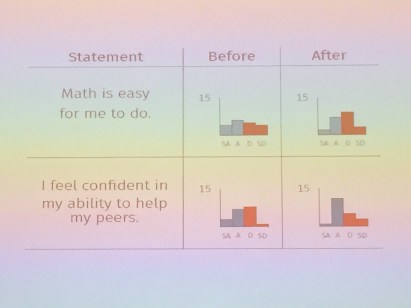
    There were a lot of data showing the effectiveness of this program which focused on teaching the 8 Math Practices. The most amazing and provocative result was shown by this slide in which student felt that the math was actually harder than they thought before the course, but that they felt more competent.

2015-04-18 08.46.25

(SA = Strong Agree, etc)


Shadow Con — A Teacher Led Mini-Conference

  • Michael pershan-219x181There were six worthy educators from the Math Twitter Blogosphere (#MTBoS) that each offered up a brief 10-minute presentation. The uniquely cool aspect of these talks is the Call to Action at the end of each. In other words, you have to do something with what you learned.
  • Michael Pershan’s talk: Be less vague, and less improvisational with HINTS during a lesson. Instead, plan your hints for the lesson in advance.
    This one resonated most with me, because I once heard that Japanese teachers have a small deck of cards with hints written on them. To draw a hint card, students have to first show effort and progress, then they may draw a hint card. They must use each hint before they may draw another. I accept Michael’s call to action.

 Ignite — Math Forum

  • IgniteThese were a series of 5 minute/20-slides mini-presentations that were more inspirational than informational. Apparently they are part of a larger movement (Ignite Show), but the folks at Math Forum have been organizing these Ignite Math Sessions at large conferences for a few years.
    If want to get fired up about teaching math, these sessions definitely live up to their name. 

Can’t wait for next year!

A Call to Substance, First Interview with Dr. William Schmidt

Schmidt BookcaseIn March of 1998, during the inaugural year of The Math Projects Journal, we had the unique opportunity to publish our interview with Dr. William H. Schmidt, of the University of Michigan. At the time, Dr. Schmidt was the National Research Coordinator and Executive Director of the U.S. National Center which oversaw participation of the United States in TIMSS. The results of the TIMSS report directly led to the developement of the Common Core 20 years later, which is why Dr. Schmidt is nicknamed “the Godfather of the Common Core.” He is also widely published in both journals and books on mathematics education.

We had the opportunity to interview Dr. Schmidt again about the rollout of the new curriculum. Before we post the current interview, we thought it would be valuable to reprint what Dr. Schmidt had to say in the early years of the research. He emphasized focusing instruction on conceptually understanding and higher order thinking skills, rather than on methodology. This is an important message now more than ever with so many untested techniques and ideologies being promoted widely on the internet. This message heavily influenced the trajectory of MPJ‘s lessons and my own classroom teaching. I hope it does the same for yours.
*************

MPJ: Can you give an example of a model lesson from one of the top achieving countries, either Germany or Japan, which are the focus of the videos?

Dr. Schmidt: If you look around the world, there just isn’t a single way to teach that is dominate among the top achieving countries. Some of them are very didactic, lecture-oriented classes. Some of them are like the kind that you see in the Japanese tapes. If teachers know their mathematics well, they can be just as engaging through a lecture format, as they can teaching as the Japanese do. It is very clear to me that there isn’t one way to do this. Instead, the more analysis that I do, the more I believe that there are some principles involved here that just might go across countries.

MPJ: What is the common thread?

Dr. Schmidt: I think the common thread that makes for the top-achieving countries is pure, honest-to-goodness mathematical substance. If the teachers really know and understand the mathematics, then they bring that to the students, through whatever means they know best. Also, a large part of this idea is to develop this stuff conceptually and not just algorithmically. I think many people misunderstand the Japanese videos. It is not so much the methodology, as it is the mathematics. You watch those lessons and the instructor really understands the mathematics, engaging those students in more ways than we do in this country.

MPJ: So, if a teacher were to do a dog-n-pony show lecture with drill-n-kill practice, and do it well, would it work?

Dr. Schmidt: The dog-n-pony show lecture, yes; the drill-n-kill, no. That’s what I said about there being some principles. I think the common element is a clear understanding of the subject matter and then going through it much more conceptually than algorithmically.

MPJ: Can you give us a model to how to teach math conceptually rather than algorithmically?

Dr. Schmidt: A U.S. lesson typically starts out with the algorithm. For instance, there is the example in the videos of a guy teaching geometry. He says to the kids, “Here are two supplementary angles, one is thirty, how much is the other?” A student says, “a hundred and fifty.” And the teacher says “Good, now why is it that?” And her response is, “Because they are supplementary.”

Instead, conceptually, you could show them that if they measure a straight line, it’s always one hundred and eighty degrees. Then they realize that if they put a line anywhere its going to cut it into two parts. That’s conceptual; you start with understanding why, so if you forget the stupid name, supplementary, and you see a line with an angle you’ll know what the other one is. That’s the difference.

MPJ: How is a strong conceptual understanding of the mathematics developed among teachers?

Dr. Schmidt: It comes from two sources. In some countries, they must major in these fields. The other thing we don’t think about is that they are products of their own systems. For instance, Japanese teachers don’t necessarily take more mathematics at the university level than we do. But look at what they already know before going to the university. They are already ahead.

MPJ: In regard to the things that our readership is looking at, active learning, projects, manipulatives, do you have any models from these other countries, or that you think could be done here?

Dr. Schmidt: You don’t find very much of that anywhere else. They seem to be uniquely American inventions, especially the cooperative learning. We asked teachers how much they use groups, and it’s pretty much nonexistent. We are too much into the methodology in this country, and we miss the substance. We start talking about small groups and manipulatives and it just becomes process. Therefore, the substance behind it gets lost in the shuffle. And for a lot of these ill-prepared teachers, that’s what they grab onto because that’s what they understand.

MPJ: We hear that the US teachers assign more homework and spend more class time dealing with homework than the top achieving countries.

Dr. Schmidt: The dominate activities in the U.S. lessons were reviewing homework and doing seat work. One thing that was startling is that the typical American lesson had only 10 minutes or less of instruction.

MPJ: What role does homework play in other countries?

Dr. Schmidt: It varies a lot. Japan doesn’t give a lot of homework, but the kids study for the next lesson. There’s a difference, of course. Studying is what you do at the university, and homework is what you do in grade school. But Japan is unique. Worldwide, homework and seat work are still the dominate activities. I think if you do that and you do it well, and develop the topics conceptually, it can work.

MPJ: Is this a curriculum issue instead?

Dr. Schmidt: It is the core issue, but just putting that in place by itself wouldn’t work. You have to help teachers teach in ways that engage kids.

MPJ: So, that is something that teachers could start doing today. We could focus on engaging students and developing topics conceptually?

Dr. Schmidt: That is my point. We must start paying much more attention to the subject matter and teach it more conceptually and less algorithmically. And that is why we are in a catch-22. The Japanese teachers grew up in their system seeing math developed conceptually, no matter what they learned at the university level. For our teachers it is a lot more difficult; they have to break out of a mold that they’ve been put into. But I think that is something that teachers can do — Get off the algorithmic side. Don’t just give an equation and when a kid asks why say, “Because that’s the equation.” Try to get them to understand what lies underneath some of this stuff.

MPJ: It seems that, chronologically, you are suggesting a lesson should move from concept to algorithm to application.

Dr. Schmidt: A lot of the lessons that we’ve seen, like in France and such, start out with an application as a motivator. An example is a science one about transformers. They started out by looking at a map of the city and looking how electricity would flow. This got them hooked on the issue, then they hit them with some good hard science about the transformer. That’s very often how it happens: hook them with some kind of application, then take them into it conceptually, let them flounder — that’s where I think what the Japanese do is a good idea — let them talk about some of their ideas, then give them an algorithm, a formula and a few examples. Whereas we typically start with the formula with a few sentences about it, and then have them do worksheets.

MPJ: The report states that American textbooks cover too many topics, yet they typically have only fifteen chapters.

Dr. Schmidt: That is mistaking the notion of what a topic is. The definition of topic has to do with the substance of the mathematics, and when we defined it that way, the measurement across all these topics is not how many chapters are in each book.

MPJ: Can you give us an example of four or five topics?

Dr. Schmidt: Congruence and similarity, three-dimensional geometry, linear equations, and fractions. We actually tested 44 topics and determined how many of these topics were in any given textbook. Our 700 page books address about 35 topics. The Japanese, on the other hand, spend half of the eighth grade year on congruence and similarity alone, and their gain in that year is higher than in any other country. The dilemma I have in telling you what to do is that the teacher shouldn’t decide which five to ten topics should be studied in a year. It only works if somebody coherently lays this thing out as to what needs to be done.

MPJ: Do you have any last things to add?

Dr. Schmidt: People still think that there are general things a teacher should do, like cooperative learning. That’s what people push. We push all the things that have nothing to do with subject matter. I’d like to challenge the notion that there is a single way to do things. If you listen to the ideological left, they say that there is only one way to teach. And the data just do not support that. Among the top achieving countries you cannot find one dominate way of teaching. On the other hand, the ideological right are calling for “the basics.” Yet, the latest analysis shows that the United States, through 8th grade, does average or above average in all the standard arithmetic skills. This is not the place were we are hurting the most. That is all we teach. That is what’s wrong, we never go beyond the basics.

If I wanted to become rich and be an advisor to schools to jack their scores up, I know how to do it. We have certain areas of math that we have the international comparisons on. I can tell you the seven items that we are the weakest on, and if schools just did something in those areas, we’d go up in the international rankings. None of those areas is anything that we would consider the basics.

MPJ: What are those area of weakness?

Dr. Schmidt: Measurement, error analysis, geometric shapes, perimeter, area and volume, congruence, similarity, vectors, geometric transformations, and three-dimensional geometry. These are not the basics.

MPJ: Tomorrow, our readers will not be able to change the textbooks or create national standards. What can a teacher do in the classroom today that will model the type of change that you and the TIMSS report call for?

Dr. Schmidt: That’s a tough question, because most of what I have argued is, based on the data, these really are systemic issues. However, the data also shows that how we teach is as important as what we teach. Teachers should challenge students with more mathematical substance and develop the ideas more conceptually rather than algorithmically.

Stats Are Like A Fist Full Of Worms

wormsAlgebra is like an ox. It does a lot of work for us, obeys our commands and remains very predictable.

Geometry is like a puppy. It’s fun to play with, doesn’t ask for anything other than your attention, and doesn’t promise anything other than that in return.

Calculus is like a horse. It is gorgeous to watch when it runs, exhilarating to ride and takes us places we have never been before.

Statistics are like a fist full of worms. They wiggle around and are hard to get a hold of. They live underground, so you always have to dig deep to find them. Once you get one, you don’t know what to do with it other than stick it on a hook and cast it out into the ocean in hopes that it brings you back something useful.

Get to the Core of The Core

apple coreThe Common Core curriculum can basically be summed up in the following sentence:

Teach your students to THINK and COMMUNICATE their thinking.

Thinking and communicating are the 21st Century skills. Many people believe that the skills of the future involve the competent use of technology. While it is true that using digital tools in school and the work place is the new reality, it is actually the proliferation of technology that makes thinking and communicating imperative in the information age. When all the knowledge of humankind is available at anyone’s fingertips, memorizing information becomes far less important than being able to construct, evaluate and apply it. You can Google information; you cannot Google thinking.

So the core of the Core truly is Thinking & Communicating.

To make my case for this, I would like to pose that the following equation

6 + 4 + 4 + 8 = 22

be adjusted to

6 + 4 + 4 + 8 = 21

Before you start shouting that everything you have read on Facebook about the Common Core is true, let me declare that I am using this equation simply as a teaching device, not a true mathematical statement. You will understand what I mean after I present my evidence.

6 Shifts

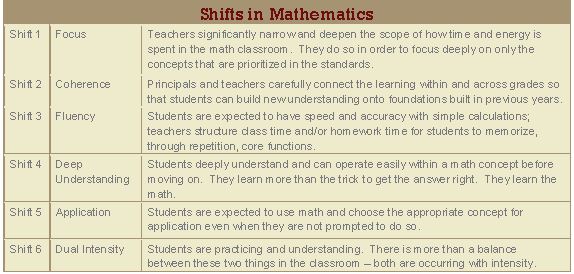
Let me start my case that the core of the Core is Thinking & Communicating with the 6 Shifts, which are best represented by the following document found at Engage NY.

6 Shifts

In essence, these shifts are redefining rigor. Old school rigor was defined as sitting quietly taking notes, and completing long homework assignments in isolation. The new school definition of rigor envelops the last 4 shifts on the list: Fluency, Deep Understanding, Applications, and Dual Intensity. The rigor is now placed on the students’ minds instead of on their behinds.

The shifts are also calling for balance. Dual Intensity insists on both procedural fluency AND critical thinking by the students at a high level. It is not about dual mediocrity or about throwing the old out for the new, but a rich coupling of both mechanics and problem solving.

Therefore, I make the case that:
                     6 Shifts = 21st Century Skills,
which are to
                     Think & Communicate.

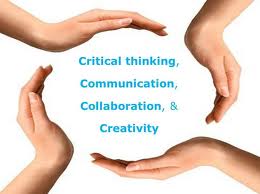
4 C’s

Another list that is framing much of the Common Core dialoge is the 4 C’s. Resources for this list can be found at Partnership for 21st Century Learning (p21.org).

4 C'sThese C’s redefine school…

The old school definition: A place where young people go to watch old people work.

The new school definition: A place where old people go to teach young people to think.

… and they redefine learning.

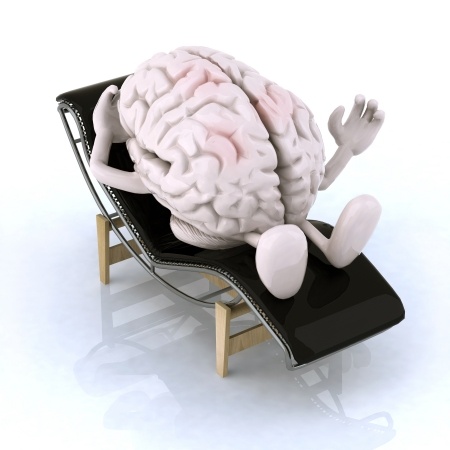
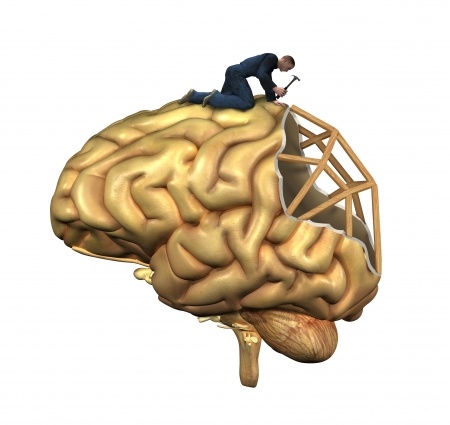
The difference of old school vs new school learning can best be contrasted by the following images of the brain.

Brain Chillin   Brain Build

The image on the left shows a passive brain that just hangs out as we stuff it with esoteric trivia. The image on the right shows a brain being built, symbolizing its plasticity. We now know that when the brain learns, its neurons make new connection with each other. In other words, learning literally builds the brain. The 4 C’s  claim that this building involves the capacity of the students’ brains to Critically Think, Communicate, Create and Collaborate.

Therefore, I make the case that:
                     4 C’s = 21st Century Skills
which are to
                     Think & Communicate.

4 Claims

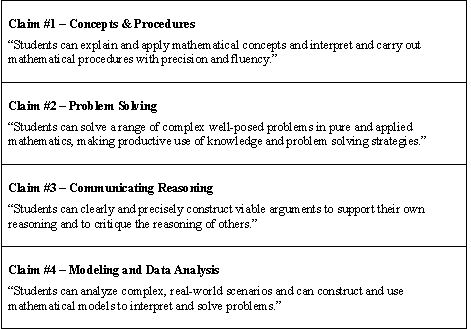
Smarter Balance creates it’s assessments based on 4 Claims. (I teach in California. PARCC has 4 Claims that closely align to those of SBAC.)

SBAC

4 Claims

Notice that Claims #2 & 3 are explicitly stated as Thinking & Communicating, which also overlaps with two of the 4 C’s. Mathematical modeling is #4, which will be discussed later. I want to point out here that Claim #1 reinforces our idea of Dual Intensity from the 6 shifts.

There are two important notes for teachers about this first claim. 1) It says Concepts and Procedures, not just procedures. The students need to know the why not just the how. 2) The Procedures alone account for about 30% of the new state tests, so if we continue to teach as has been traditionally done in America, we will fail to prepare our students for the other 70% of the exam which will assess their conceptual understanding as well as their abilities in problem solving, communicating and modeling.

Therefore, I make the case that:
                     4 Claims = 21st Century Skills
which are to
                     Think & Communicate.

8 Practices

If you open the Common Core Standards for Mathematics, the first two pages of the beastly document contain a detailed description of the Standards of Mathematical Practice. Then at the beginning of each of the grade level sections for the Standards of Content you will find 8 Practices summarized in the grey box shown below.
8 practicesWhat do you notice about the list? Indeed, these habits of mind all involve Thinking & Communicating. While the content standards change with each new grade level, the practice standards do not. With each year of school the students are expected to get better at these 8 Practices. Notice that the first half of the list has already been included in the ones discussed previously: Problem Solving, Communicating Reasoning, Constructing Viable Arguments and Modeling. A case is often made that the other four are embedded in these first four. However one might interpret the list, “Memorize and Regurgitate” is not on there.

Therefore, I make the case that:
                     8 Practices = 21st Century Skills
which are to
                     Think & Communicate.

The Sum of the Numbers

So, as you can now see, the 6 Shifts, the 4 C’s, the 4 Claims and the 8 Practices are all focused on the 21st Century Skills of Thinking & Communicating. Therefore, I can finally, explain my new equation …

Since,

    6 Shifts
    4 C’s
    4 Claims
+  8 Practices
= 21st Century Skills

then 6 + 4 + 4 + 8 = 21!

None of these numbers represents a list of content, because the content changes brought on by the Common Core, while significant, are actually no big deal in the long run. A few years from now we won’t remember all the fuss regarding Statistics and Transformations, but we will all spend the rest of our careers learning how to teach kids to Think & Communicate.

I rest my case.

4-Digit in Algebra 1

Day 3, Fri Aug 15, 2014

The Brain Surgeon: My third Growth Mindset Vehicle (after the Drumroll and the Wrinkle Sprinkle) is the Brain Surgeon. I purchased a soft foam model brain (it comes in two hemispheres). Each day, I give it to the next student in line and that student is the Brain Surgeon for the day. The Brain Surgeon has two Primary responsibilities: To lead both the Drumroll and the Wrinkle Sprinkle. The two secondary duties are to make sure that materials (portfolios, whiteboards, chromebooks, graphing calculators etc) get disseminated and collected properly.

Our First Brain Surgeon:(Jasmin)

Target: We will use Order of Operations and Quantitative Reasoning to write expressions for a given value.

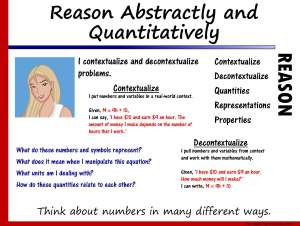
SMP #2, Reasoning Quantitatively: I intend to use my MPJ Practice Posters to introduce each of the 8 practices within the first few weeks of school. I’m not obliged to go in numerical order; rather I choose the practice that best suits the activity for the day. So today, I gave the students a black-n-white copy of the SMP Posters.

SMP Posters MPJ 1_Page_2

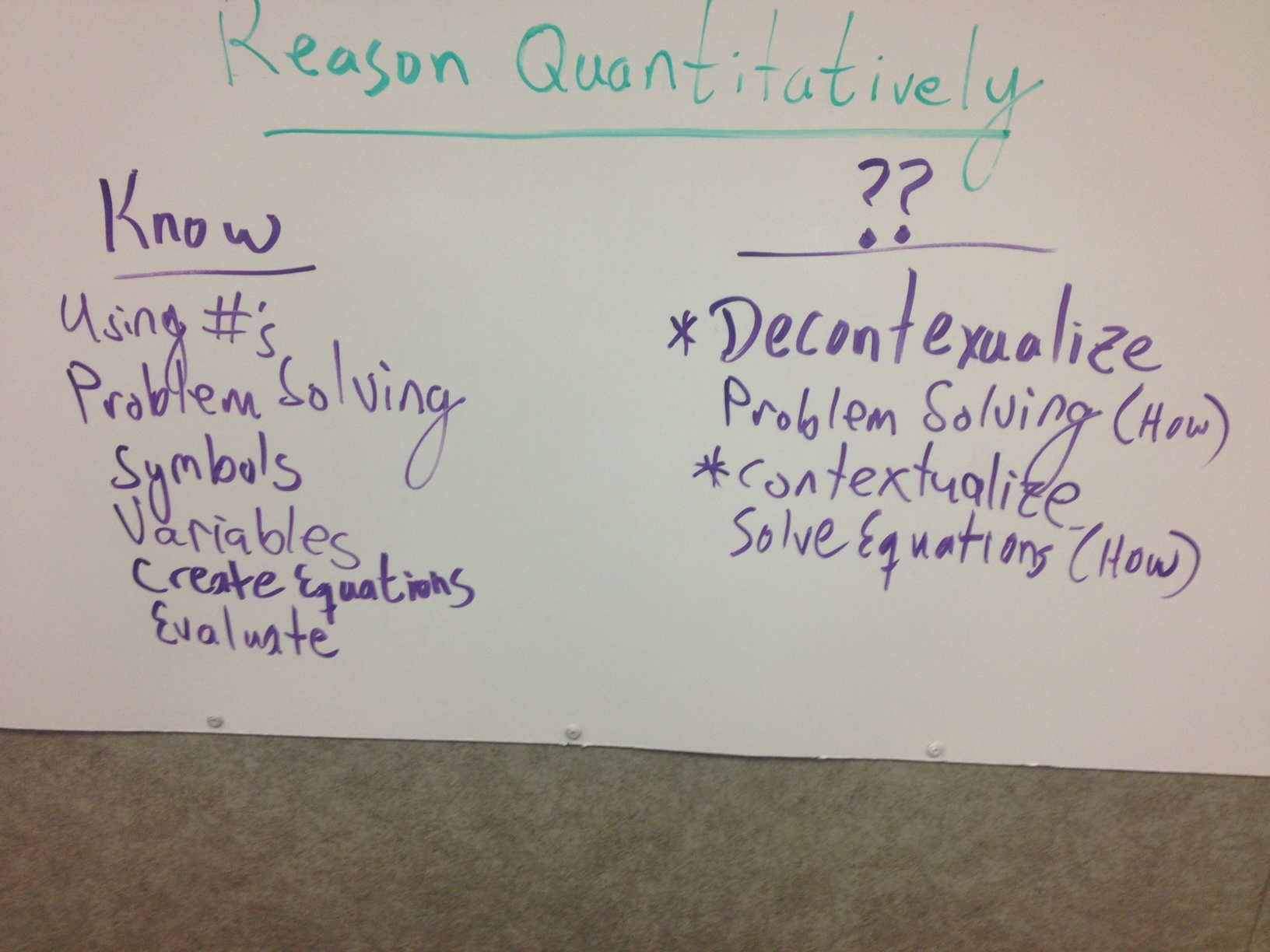
I asked each student to read through the poster quietly. The groups were to have each member share, “Something you already know about the practice, and something that you don’t know.” As a class each group shared out one of each, which I wrote on the board.
Decont

Decont 2

While I used the example at the right to describe the difference between contextualize and decontextualize, I let the students know that today we wouldn’t be doing that. Instead, we would being doing a lot of the things that they already know (using numbers, problem solving, evaluating). I found it very interesting that the class conceded to knowing what problem solving meant, but that they did not know how to do it.

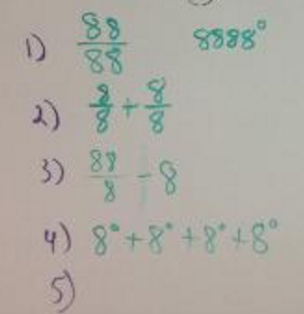
The 4-Digit Problem: I shared the rules of the 4-Digit problem, plus the 2 examples, and asked them to create the value 19 with four 8’s. They struggled which resulted in statements like “I feel stupid,” which I was trying to illicit so I could nix that thinking quickly. I shared that they would not have gotten this far if they were stupid. “I believe that you are all smart; I am paid to make you smartER.” I continued, Since they claimed to not know what problem solving looked like, I asked for problem solving strategies.” I just got blank stares. OK, everybody give something with four 8’s, I don’t care what the value. We threw a few up on the board, and discussed some that were close. I shared the hints given in the lesson plan, and let them go at it again. When I revealed the answer, I got a lot of “That’s cool.”

So I asked them to produce values 1-5. They sputtered again, so I asked for just #1. When I showed one example, they all laughed with “It’s that easy?” They were good to go from there…

4 Digit 5


Wrinkle Sprinkle:

  • 8^0 = 1
  • It was hard, but fun
  • To see it in different ways

First Day in Algebra 1

Day 1 & 2, Thurs Aug 14, 2014

{My school has a special tradition of activities on the first day in order to promote our school motto at Great Oak HS: S.P.I.R.I.T., Scholarship, Passion, Involvement, Reflection, Integrity, Teamwork. Teachers do not officially see their new students until Day 2}

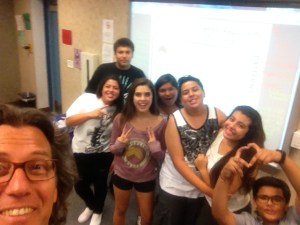
Selfie

The Drumroll: I have been pondering Carole Dweck‘s Growth Mindset findings, and came up with a couple of vehicles. The first is the Drumroll. I told the students that since this was my only class of the day (I am a math coach in the mornings), I will need their help getting in the right mood for class everyday with the drumroll. It goes like this.

Leader at the Front of the Room (today that was me): “Drumroll, please.”

{students drumroll on the desks);
Leader: “Are you ready to learn?”   

{Leader points as students all hit loudly once on the desk and point back}
Class: “Are you?”

{Everyone fist pumps}
All: “Yes”

The students bought into it more than I anticipated, but they will need some practice coordinating the routine. We will get there. The most important thing was setting the tone that we are going to be about learning in this class.

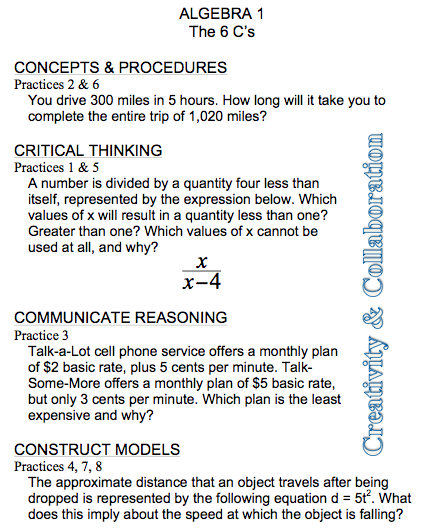
Opening Quiz on the 6 C’s: I always start every year by answering the transformation question: “How will you (the students) be different in June than you are now, because of my class?” In the past, I answered with the 4 E’s, and structured my Portfolio’s as such. This year, to better align with the Common Core, I answered with the 6 C’s which are the 21st Century 4 C’s and the 4 Smarter Balance claims. Since two overlap, there are only 6. I structured my grade book and my portfolios around these 6 learning categories.

  • Conceptual Understanding & Procedural Fluency
  • Critical Thinking
  • Construction of Models
  • Communication of Reasoning
  • Creativity
  • Collaboration

I gave the students the blank copy of the quiz below, and told them this was not to be graded nor was it a test of their previous knowledge. It was like a movie trailer of things to come, but I still wanted them to give me their best shot. I then gave them my standard 3-response speech.

As a mathematician I cannot always give an accurate response; I can not always give a complete response; I can always, always, always give an intelligent response. Blank is not intelligent.

I pressed them to give me something… numbers, equations, drawings … anything intelligent.

I was waiting for the “I feel stupid comment,” and sure enough I got it. I responded with the “if you made it this far, you are already smart. I am here to make you smartER. As long as you are putting something down on the paper, you are building a wrinkle on the brain.” Then I explained how learning is filling your head with stuff, but making your brain cells reach out and make connections with each other. My new crew responded better than expected for the first day.

Pic Opening Quiz

I posted on the board several of the responses that I saw on the student papers. I shared that these are the 6 C’s of the course. That these 6 things are really what they are here to learn. So I didn’t even answer the questions… that will come later in the course. I just wanted to highlight & explain what the first 4 C’s meant, and the other two would be woven throughout. I said that these things are what mathematicians really do, and that I am paid big bucks to get them all thinking like this in 10 months.

Introductions: I have each student stand up one at a time. They are to briefly state their name and something interesting about themselves. I use the time that they are talking about the point of interest to review the names in the class, so at the end, I can recite all the names in class. 100% this year! I then introduced myself. Good bonding day.

I then shared that the reason that we did math first is because that is what we all about.. learning math … not collecting points. I also assume they can read the grading policy if I gave to them I didn’t have to bore them with it. Since this is the last class of the day, they all thanked me profusely, for that’s much of what they experienced their first day.

Wrinkle Sprinkle: This is another vehicle that I created to promote the Growth Mindset. I explained to the students that when they learn, they don’t just shove stuff in their brain, but that the brain cells actually grow and connect to each. I joked that it was like getting a new wrinkle on the brain, and that we were into growing our brains in this class. Therefore, at the end of each class, we will debrief what we learned and write it on the board… thus a “wrinkle sprinkle.” My favorite for the first day…. “You will make us into mathematicians in ten months.” Yes! Glorious first day.

Interview: Dan Meyer on Using a Ladder to Clear a High Bar

Pic MeyerDan Meyer is as close to a celebrity that a math educator can get. We all owe him a debt of gratitude for making math nerds look cool. He deserves his rock star status because he is an amazing presenter, a thought-provoking writer, and an ingenious creator of math tasks.

Behind all the hype, though, is some serious substance. Dan’s ideas are akin to the spirit of MPJ’s lessons in that they seek to engage students in meaningful mathematics, and aspire to teach them high-level cognitive skills. Dan’s methods, though, have a unique twist that challenges teachers’ thinking. I know he has given me a great deal to think on. I hope he does here for you as well.

MPJ
From what we read on your blog, you are about two things: 3-Act Lessons and the Ladder of Abstraction. Let’s start with 3-Act Lessons. Give us the gist of what they are and why they are an effective tool in teaching math.

Dan Meyer
We make huge promises to kids about the power of math in their world. But then we give them these problems that don’t do justice to that power or to the world they live in. Three-act math uses photos and videos to show students a more faithful reproduction of their world and a more faithful reproduction of the practices of applied mathematicians.

MPJ
MPJ has preached for over a decade the need to have students create their own mathematical models (abstract generalizations). Describe your Ladder of Abstraction and how it applies to teaching mathematics.

Dan Meyer
The process of abstraction is extremely powerful and also not something I understood intuitively until I was a long way out of my secondary math education. Basically, whenever we turn the world into a table or an equation or a graph, we LOSE something. People don’t run at a constant rate. The Earth isn’t a perfect sphere. But we abstract a runner into a linear equation and the Earth into a sphere because those abstractions are perfect ENOUGH to help us answer questions. That’s an important part of modeling. Asking, “Is this model perfect enough?”

MPJ
With so many teachers reliant on teaching from the textbook, do you have any ideas on how to get these practices used more regularly in classrooms?

Dan Meyer
I tell teachers what I tell myself: whatever you’re going to teach today, whether it’s pure math or applied math, make sure students have some NEED for it. A better need than “I don’t want to fail this class.” And I offer them techniques for provoking that need. I also offer teachers a homework assignment, an exercise like push ups, to get better at provoking that kind of need: take a photo or a short video and ask people what questions they have about it, if any. If they don’t have any questions, retake the photo or video in a way that provokes more questions. That homework assignment has been incredibly helpful in my own growth.

MPJ
How well do your theories mesh with what is coming down the pike as the Common Core?

Dan Meyer
The modeling practice of the CCSS gets focused treatment in high school. I encourage all of your readers to study high school modeling (it’s only two pages) and ask themselves, “Are the ‘real-world’ problems I assign preparing students to clear this high bar?” Then Google “three-act math” and see if my work can help.

MPJ
What do you intend to prove with your PhD research?

Dan Meyer
I’d like to understand how any or all of this translates to online education.

Playing With Math: Stories from Math Circles, Homeschoolers, and Passionate Teachers

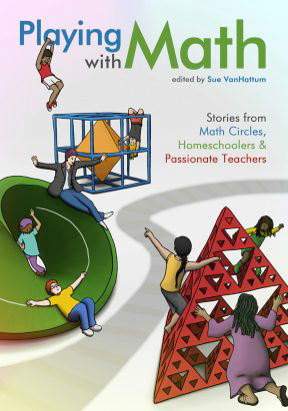
Sue bookcoverPlaying With Math: Stories from Math Circles, Homeschoolers, and Passionate Teachers is being published by fellow math blogger, Sue VanHattum of Math Mama Writes. In her book she “brings together the stories of over thirty authors who share their math enthusiasm with their communities, families, or students. After every chapter is a puzzle, game, or activity to get you and your kids playing with math too.”

Sue was kind enough to include an article I wrote, Textbook Free, as one of the chapters. I am honored to be included in a body of work that is best described by one of the authors as …

a collection of love stories because the authors, including yours truly, want to share something we’re pretty crazy about.  — Fawn Nguyen

In order to raise money for printing costs, Playing With Math has started a crowd-funding campaign. Contributions of any size are welcome, but $25 gets you a copy of the book. If you are interested in supporting the cause, please visit incite.org.

Sue VanHattum has assembled a marvelously useful and inspiring book. It is filled with stories by people who don’t just love math, they share that love with others through innovative math activities. Playing With Math is perfect for anyone eager to make math absorbing, entertaining, and fun. — Laura Grace Weldon, author of Free Range Learning

Let’s all help Sue make this terrific resource happen!

Dr. Jon Star Speaks HOT Heresy

Pic StarDr. Jon Star, of Harvard University, gave a mathematically blasphemous speech at the 21st Century Mathematics Conference in Stockholm, Sweden last year. The presentation was titled, Neuroscience and Cognitive Psychology of Mathematics. His heretical statement was that mathematics does not teach higher order thinking skills; only the teaching of problem solving actually teaches problem solving. The Math Projects Journal has always preached the teaching of mathematical substance, or what is now commonly known as higher order thinking skills (HOTS), so we reached out to Dr. Star regarding his research.

The belief that just by learning math one gets critical thinking skills is also not well-supported by evidence.

MPJ
You must know that your claim stating that math does not inherently teach critical thinking is very unnerving to the math education community.

Dr. Star
Just to be clear about my goals in the Stockholm talk, I was trying to argue the following:

First, the belief that math plays some sort of special and relatively unique role (as a discipline) in promoting what you refer to as HOTS (Higher Order Thinking Skills) is not well-supported by evidence.

Second and related, the belief that just by learning/understanding math, one gets critical thinking skills as well (e.g., two for the price of one, without explicit or even implicit attention to developing HOTS), is also not well-supported by evidence. Certainly in some instances this does happen, but it does not appear to happen in any widespread way for ‘typical’ students.

And third, given that we do want students to develop HOTS, rather than expecting/hoping that these just emerge as a natural by-product of learning/understanding math, it is essential that we think about how to explicitly promote critical thinking and problem-solving in what we teach and how we teach math. With respect to this last point, arguably generations of math curriculum and pedagogy reformers have sought this same goal – teaching math such that higher order thinking skills develop. But evidence and intuition suggests that this is very hard to do. But certainly we should continue trying…

MPJ
Is it math, per se, that does not impart the HOTS, or is it the way we teach math that is inept in imparting these skills?

Dr. Star
I would say that both content and pedagogy are important, but it seems that pedagogy plays an especially important role. If we want students to be able to transfer knowledge to domains outside of math class – apply reasoning skills that worked in math class to other kinds of problems – it seems necessary to teach with such transfer goals in mind. There are many different (at times competing) pedagogical visions for how to teach math such that this kind of transfer is possible. Some feel that the best approach is to engage students in certain kinds of reasoning and communication that are believed to facilitate application of knowledge to novel situations, and others feel that a certain amount of practice in applying concepts and skills is necessary for future transfer. I can see potential merit in both of these approaches, although empirically there isn’t a lot of good evidence to point us in the right direction.

I would say that both content and pedagogy are important, but it seems that pedagogy plays an especially important role.

MPJ
The 8 Common Core Standards of Practice imply that habits of mind can be taught. In your view, do these practices have value?

Dr. Star
I think that the Common Core practice standards are admirable goals. However, as noted above, I think we are still struggling to determine the best ways to achieve these goals pedagogically.

MPJ
Anecdotally, educated people think, communicate and behave differently than uneducated people. I believe research bears this out as well. Is this then simply a non-associated correlation (people who already have educated traits get an education), or does a quality education truly transform an individual?

Dr. Star
Certainly some people do develop problem solving skills merely by learning math. Some of these people developed (or would have developed) both math understanding and HOTS even if they didn’t have a classroom or a teacher – they could have done so by themselves on a desert island, so to speak. Most people, though, definitely need math training to learn math content, and they need explicit instruction in critical thinking to develop higher order skills as well.

Most people, though, definitely need math training to learn math content, and they need explicit instruction in critical thinking to develop higher order skills as well.

MPJ
What advice do you have then for classroom teachers in the quest for teaching higher order thinking skills?

Dr. Star
Try to identify the places in your lessons where you hope students are developing higher order thinking skills, and consider ways that you can be more deliberate and explicit in your pursuit of and assessment of these goals. For example, ask your students about any broader connections they are making from the mathematical content of the lesson. Give students opportunities to apply what they have learned in a lesson to other mathematical and non-mathematical topics. Let students know what you mean by phrases such as “critical thinking”, “problem-solving”, and “logical thinking”; give students examples of what these practices look like as well as tasks that allow them to develop and experience these important competencies.

Let students know what you mean by phrases such as “critical thinking”, “problem-solving”, and “logical thinking”; give students examples of what these practices look like as well as tasks that allow them to develop and experience these important competencies.

**** Dr. Star may be reached at jon_star@harvard.edu
****For more of Jon Star’s thoughts on Math Education, see this Scholastic video on YouTube.


Enduring Cosmic Power

Today, I received one of the greatest compliments from a former student in the following post:

Jorge Post Border

This one-time middle schooler, enrolled in my high school Geometry class seven years ago, is referring to my consistent overt effort to have students understand and appreciate the true potential of math. Ultimate Cosmic Power in an Itty Bitty Thinking Space goes beyond the cognitive easter egg hunt that the “answer getting” routine too often reduces math to. I don’t know how to respond to knowing that most students think it is stupid or crazy at the time, but Jorge’s words of enduring impact have me smiling today.

Hey Georgie,
I remember you as a bright, happy young person. Though I am pleasantly surprised that my teaching has lasted with you, I am not surprised that you have chosen a mathematical career path. Build a new world, young engineer!