{I am new to Chaparral High School, having transferred within my district as a Math Specialist.}
Opening Quiz Alg 2 on the 6Cs: After greeting each student at the door with a high-5, I started the year by answering the transformation question: “How will you (the students) be different in June than you are now, because of my class?” I am still answering that question with the same 6Cs that I launched 2 years ago. My Claims-Based grading system and the students portfolios are structured as such also.
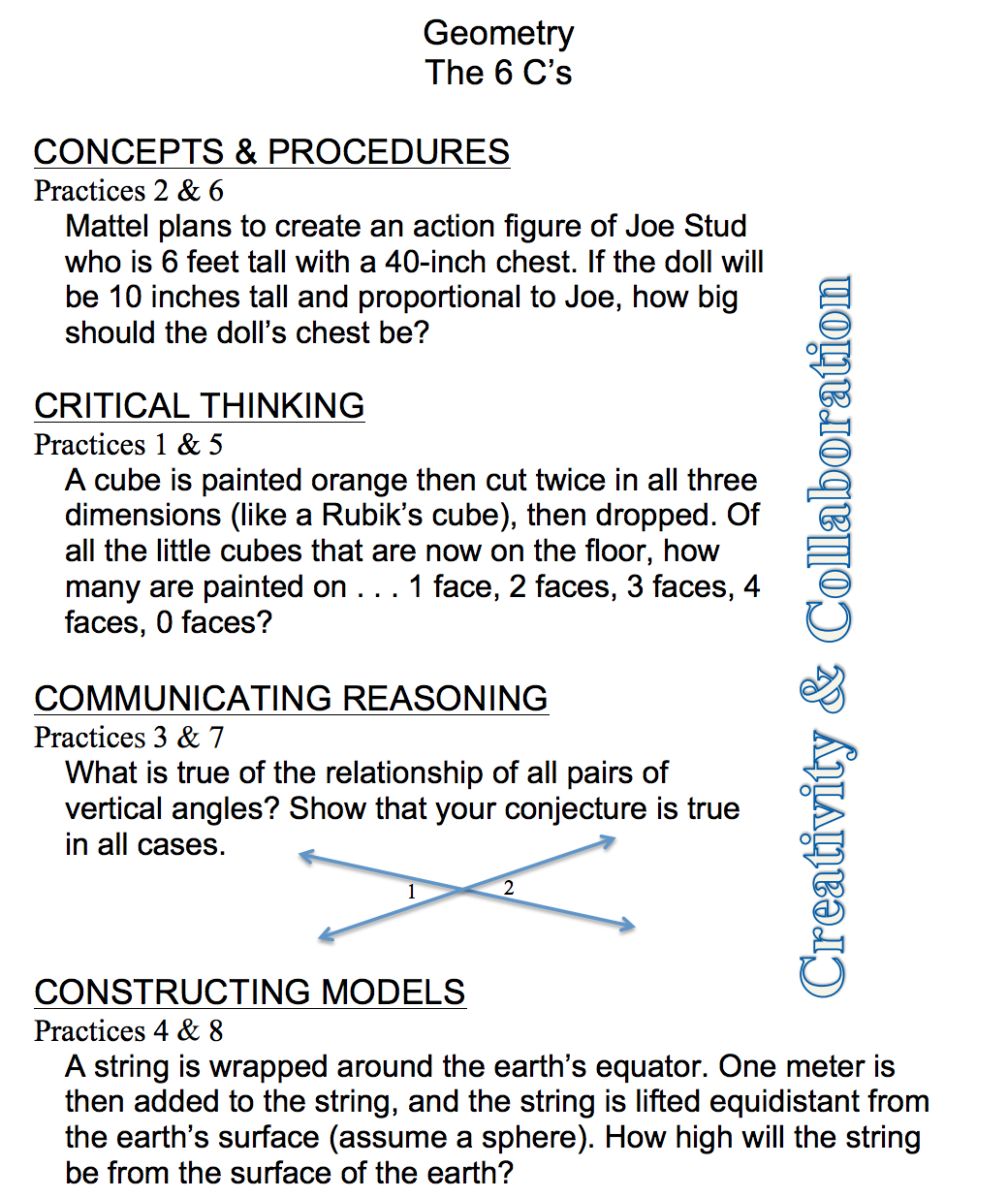
As I do with all classes each year, I gave the students the blank copy of the quiz below, and told them this was not to be graded nor was it a test of their previous knowledge. It was like a movie trailer of things to come, but I still wanted them to give me their best shot. I then gave them my standard 3-response speech.
As a mathematician I cannot always give an accurate response; I cannot always give a complete response; but I can always, always, always give an intelligent response. Blank is not intelligent.
I pressed them to give me something… numbers, equations, drawings … anything intelligent.
They worked on these independently, then in groups, then as a class, followed by my summary. I wanted to model this process of “gradual reel-in” (as opposed to gradual release) right away, because I use it often.
During the class discussion, one senior claimed out loud, “This is the 5th time that I have taken this class!” (She had failed two semesters as a junior, then 2 semesters in summer school.) I told her that this year she will pass because, “You are that smart, and I am that good.” I had the students repeat this:
Me: “You are that …” Class: …smart!” Me: “I am that …” Class: “…good!”
This was a set-up for the Growth Mindset discussion that was coming over the next few days. In the meantime, I hope I sent the message that I believe in them, and that I believe in my ability to teach them (The 3 Growth Mindsets).
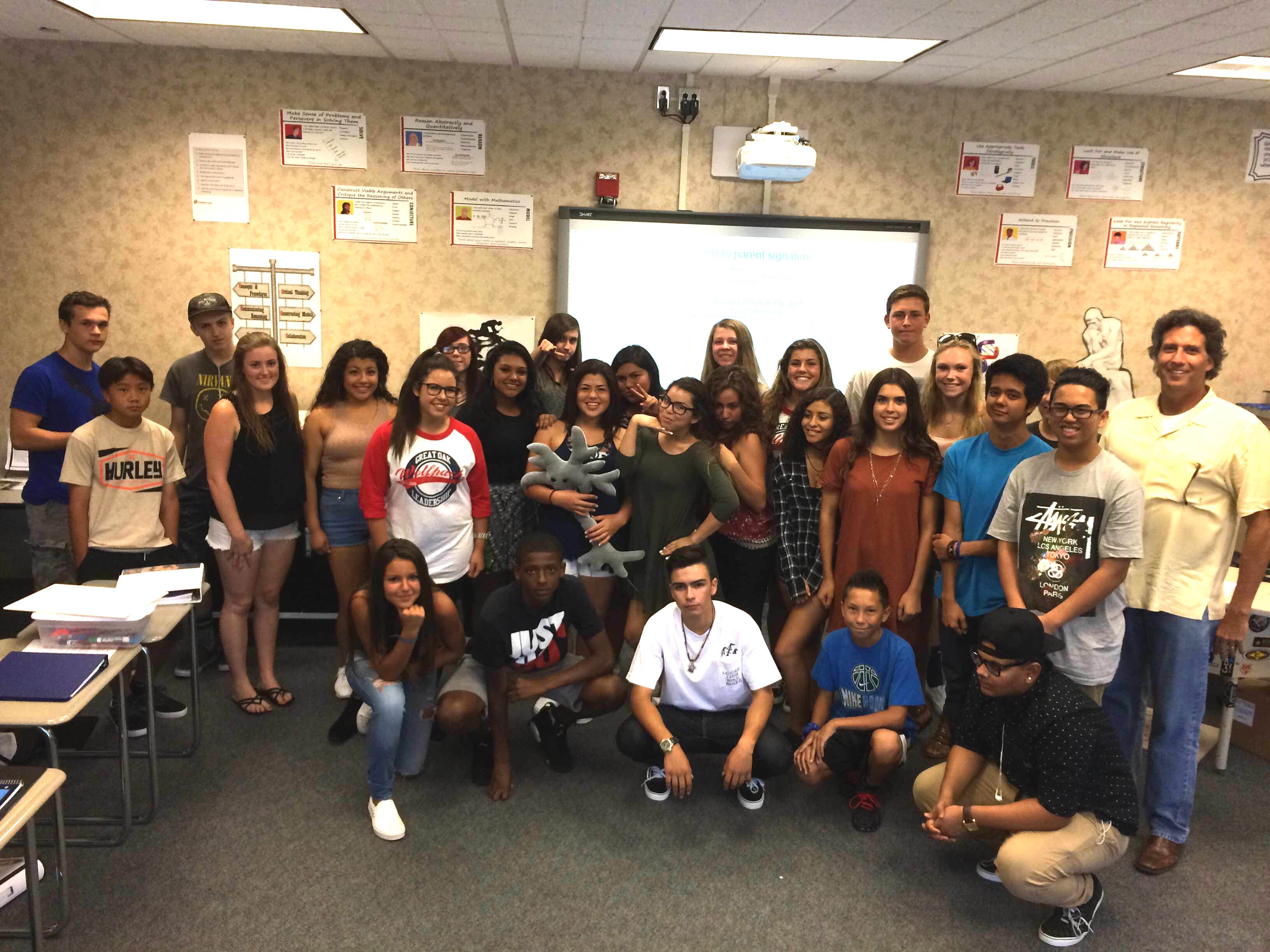
The students brought some terrific energy. I’m so looking forward to my first year as a Puma.
The annual Twitter Math Camp is always amazing. This summer’s conference in Minneapolis, at Augsburg College. was no different. My great disappointment was only being able to stay for one full day this year, but the one day did not disappoint.
As always, portions the Math Twitter Blogosphere (#MTBoS) rallied from around the country in genuine excitement to see and learn from each other after another year of digital friendship and collaboration. Thanks go out to Lisa Henry (@lmhenry9) for being the lead on this terrifically special event.
A packed room on the topic of intervention was surprising to both me and the presenter, because the MTBoS dialogue mostly revolves around first instruction. The large audience is a testament, though, to the need for reaching ALL kids in the era of 21st Century Standards. Michelle is leading a very successful intervention program in Canada which is focusing on some basic premises:
Differentiating for All Students is like Cowboys Herding Cats, but “it’s a good feeling having the herd [of students] arrive on time without losing a one.”
Early Intervention on the Pre-Requisite Skills(Readiness) that are required to be successful in the current curriculum is the first and most important intervention move. Pre-Assessments on prior content are then necessary to help improve students’ chances for success. Back at home we call this Boot Camp. Michelle affirmed that this work is good, and also inspired me to go back to my site and push to make it a priority.
Unpacking Standards Collaboratively serves two purposes. (1) It allows you to throw out material that is not in the standards, which buys you time for intervention/differentiation (Grade Level) and (2) It helps you focus on the pre-requisite skills needed for students to learn the new material (Readiness).
Intervening on Readiness = Differentiated Content Intervening on Grade Level = Differentiated Product
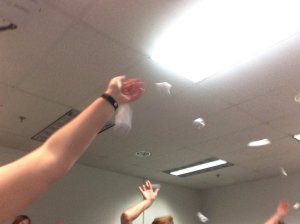
I also saw an interesting take on the Snowball Activity. Students write down one comment and one question about a topic (notice and wonder), then wad up their papers and throw them around the room. Each student picks up a “snowball” and adds another comment and question. This is done again, until there are three of each. After the fourth toss of the snowballs, the students do not write, but instead debrief publicly as the teacher summarizes the comments and questions on the board. This is a strong way to have ALL students reflect on learning.
KEYNOTE: RACE, MATH AND WHAT WE’RE NOT TALKING ABOUT
Jose Vilson (@TheJLV) educolor.org
Jose’s most solid point was that public conversation on math education reform often does not include educators, especially those teaching the marginalized. He accurately stated that if the medical system in America were being discussed on cable news, there would be a doctor on the show, but you never see a teacher on TV talking about education.
In many ways, Jose was calling us out to be activist on our campuses for the changes that we in the Blogosphere write so much about, particularly for students of color. He made a claim that really stuck with me: “We say that we teach math to all kids, but students of color are taught a different type of math than white students.”I know this is true on my campus, While my school is relatively diverse, the lower-level math classes are disproportionately populated by students with Hispanic surnames.
I asked a question of Jose, preluding it with a statement that prejudice on my campus tends to run more along income lines than racial lines (although, racism exists everywhere). Students are accepted and succeed as long as they behave like ‘these kids.’ So I asked, “How do you get teachers and staff to be more accepting of ‘those kids,’ so that they can remain authentically themselves and still learn?” Jose’s response was, “Teach the adults to recognize ‘different types of genius.'” I love that phrase! He went on to explain that kids in poverty are often times going to bring the norms of their own sub-culture to class, which is many times in conflict with the rigid, quite, patient, controlled environment of traditional school. If we can respect that and honor ALL students’ intellects, while also teaching proper social behavior, schools will break down a lot of walls and reach more marginalized students.
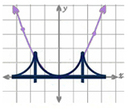
Audrey showed samples of student work from her classes, in which she has students BUILD activities and graphs in GeoGebra and Desmos. The best example was Sticky Points. I love how the challenging of students to create the special points for a function like the x-intercept(s), the y-intercept, and the vertex demands that the students do some algebraically manipulation. The graph offers an immediate feedback loop until students do it correctly. This builds their algebra skills and conceptual understanding simultaneously. I’m using this idea in my class this year for sure.
WHAT IS MATHEMATICAL MODELING? Edmund Harris (@Gelada) and Myself (@MathProjects)
I thought Dr. Harris asked for “mathematician modeling!”
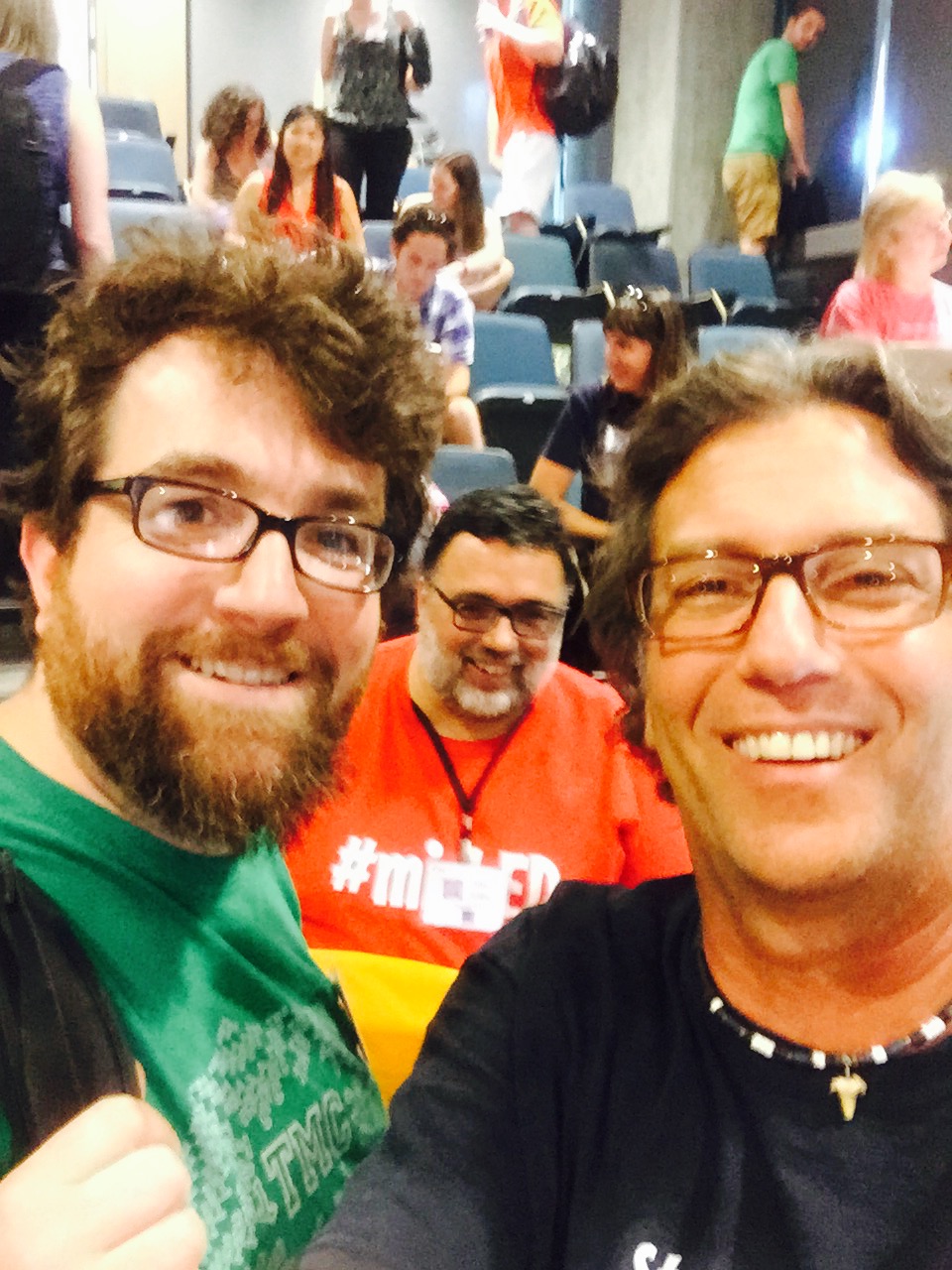
I was honored when Dr. Harris, of the University of Arkansas, asked me to present with him on Mathematical Modeling. Edmund and I have been friends since our first Twitter Math Camp (TMC13), and I always look forward to our laughs and deep mathematical conversations. Edmund wanted to share the theoretical meaning of mathematical modeling, and he asked me to add my take on how the teaching of it manifests in the classroom.
We started by surveying the audience on Pear Deck, prompting for their definitions of mathematical modeling. The vast majority of the responses fell into two categories:
Representing a Real-Life Situation
Applying the representation to make Predictions.
It turns out that these are quite accurate if we include them BOTH, but the two are not necessarily a comprehensive list, as Edmund explained.
The professor started by claiming that shepherds in the field used to count sheep by using stones in their pocket by which a small stone represents one sheep and a larger stone represents 20 sheep. This, he asserted, is an example of abstract modeling. (Leave it to the Brit to bring sheep herding into a math discussion.) Then he drew this diagram on the board:
He explained that you start with “something to be modeled,” (noticed he did not say a real-life situation) and then you create an abstract representation of it. This is a back-and-forth process of verifying the accuracy of the model’s description of the something as well as the “thing” that we want to do with it. (Use rocks to keep track of the sheep). So the audience was responses were spot on… collectively. Yes, modeling is Representation AND Application, but not necessarily just Representation OR Application. Furthermore, Edmond wanted to make it clear that modeling does not have to apply to only “real-world” examples. He claims that when we discuss the transformations of a family of functions, we are also modeling… using an abstract representation to “do something” to the original parent function.
In my investigating of what is expected of school teachers when it comes to modeling, I studied the common core documents and found very persistent, clearly defined attributes of Mathematical Modeling:
Modeling is a process.
Modeling is a verb.
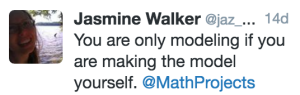
In other words, using a model that is already provided is a good and healthy step in the learning process of modeling, but it is not modeling itself unless the students are generating the model themselves.
Thank you, Edmund. It was a pleasure working with you, my friend. You always make math appear so joyful.
THE SIDE TALKS I had several conversations throughout the Camp, but two that stood out were with …
The first night of TMC16 was a huge social event by Desmos. Edmund, Brian, Alex and I had a beer-laden discussion about modeling that proved quite passionate (read as: table pounding, finger-pointing, and all in good fun B.S. calling). It was such a blast to throw ideas around with people of high intelligence, strong convictions and the deep desire to get this thing that we call teaching right. Cheers to changing the world one math lesson at a time.
Intellectual Need for Vocabulary
Dr. Dan Meyer (@ddmeyer): Dr. Meyer completed his dissertation last year. Knowing how much those with a doctorate enjoy talking about their research, and being truly curious about it, I ask him to share his findings with me. He joyfully did, including some of the back story behind it. In essence, Dan studied the effectiveness of giving students the academic vocabulary after first posing a task that required its use, rather than front loading the terms. He called this method Functionary. His study showed that the both Functionary (using the vocabulary to communicate) and Traditional methods (making flash cards to memorize definitions) were equally effective in teaching students academic language found on traditional assessments. The Functionary method, however, showed superior results when students were asked to communicate their thinking using the vocabulary terms or to complete less traditional (more CCSS-like) tasks. You can listen to the Defense of his Dissertation on Dan’s Blog.
As always, I highly recommend this event to any math teacher. I hope to see you all at Twitter Math Camp in Atlanta, July 27-30 2017.
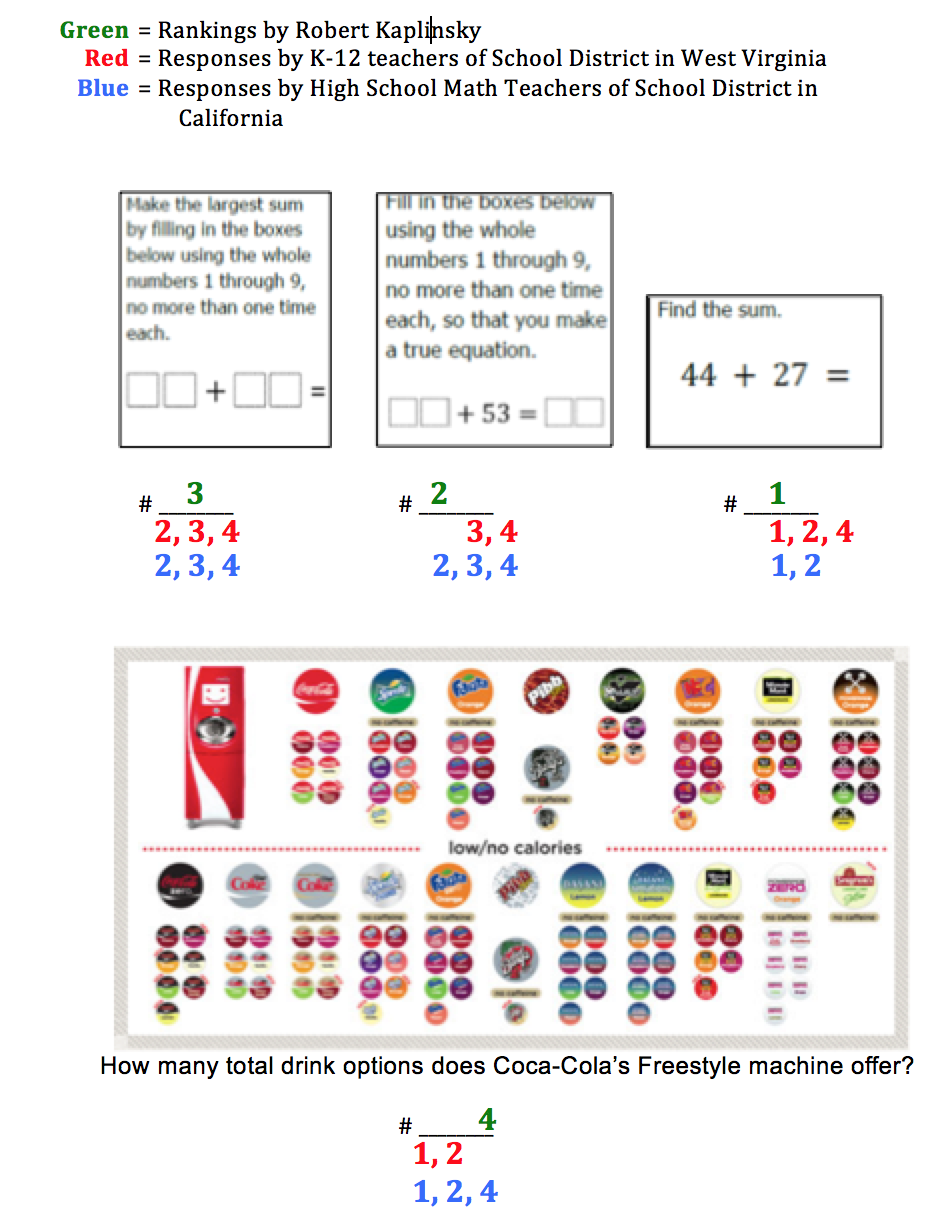
Recently, I conducted a training with a school district in West Virginia. It was for new teachers (1st-3rd Year) in all subjects K-12. There were approximately 75 participants and 20 mentors. One of our activities dealt with Depth of Knowledge. I showed the typical D.O.K., but I wanted them to have a more meaningful experience with D.O.K. levels in mathematics.
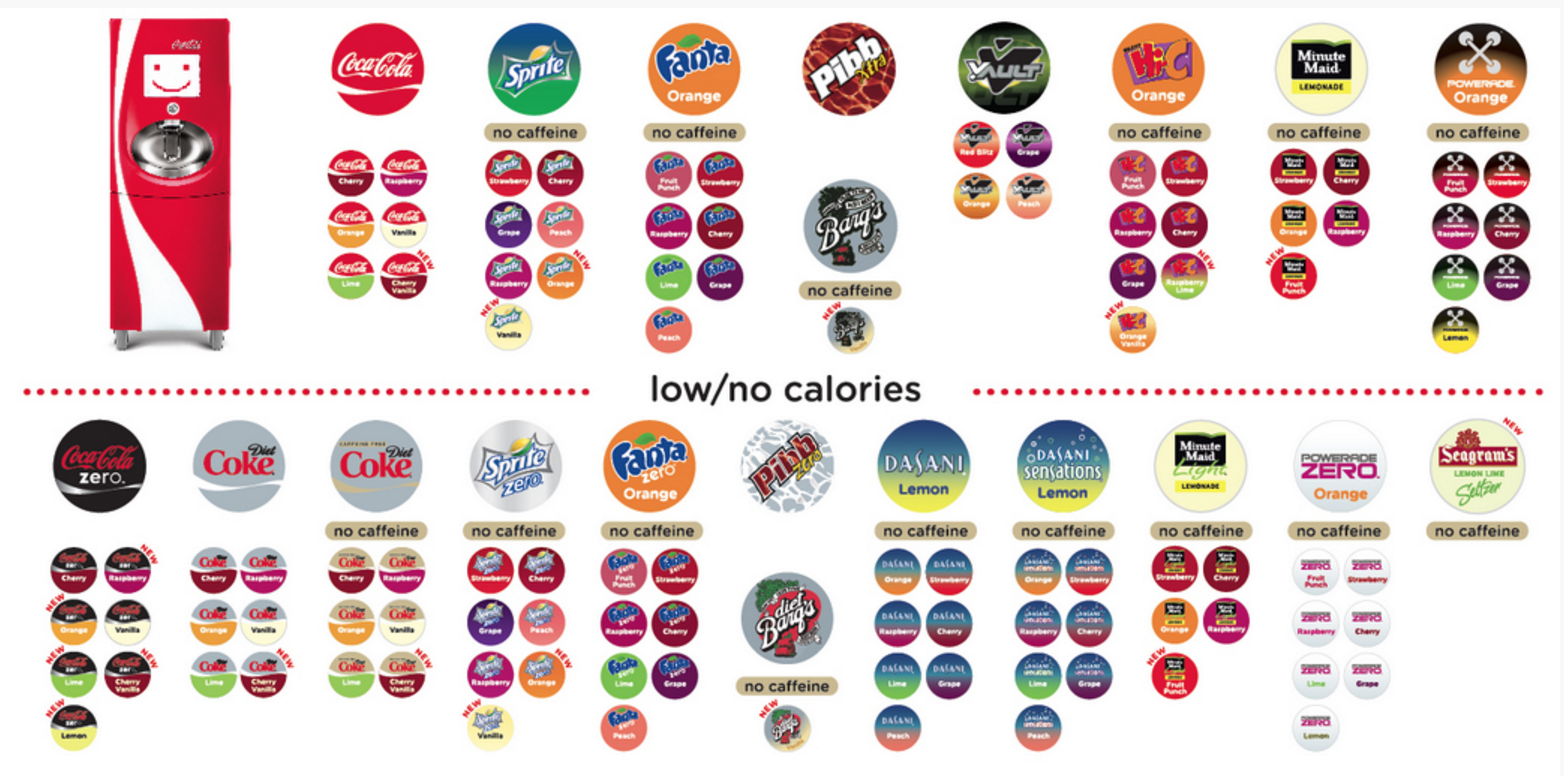
Perfect! I compiled these four into one document, scrambling the order, and asked the teachers to discuss the problems in their table groups and to assign a D.O.K. level exclusively to each one. I was intrigued at how different their responses were compared to what Robert (and myself) considered the problems to be. I noted that the group was a broad range of grade levels and subject areas, so I thought I would conduct the same activity with a collection of high school math teachers that I was scheduled to train in California the following week. I was very curious if math teachers would view the problems differently than non-math teachers. Indeed, they did. However, they also disagreed with Robert and me. Below, are the all responses from the groups at each training, as well as Robert’s determination. Notice the variety of responses that was generated within each training.
The choices that earned the most votes looked like this.
Notice that there is not a single example in which all three parties agree. I have no profound analysis of these results; I am simply sharing this very curious experience. I am still pondering the outcomes and their meaning many times over. So much so, that whenever I hear the phrase “D.O.K.,” I smirk and scratch my head.
I have summarized each session with some simple (•) bulleted notes, red underline quotes to encapsulate my major take-aways, and occasionally a brief italicized commentary.
Game-Based Learning: The Hype is Starting to Give Way to Some Surprising Substance — Keith Devlin (Stanford)
Big Take-Away = Start with the thinking (which is the more important), then follow with the notation.
The “Symbolic Barrier”: Symbols are a terrific way to use mathematics, but a horrible way to learn them.
The vast majority of our population is taught symbolic notation, yet most need mathematical thinking.
Students using Dragon Box Algebra learn the Algebraic thinking needed for solving equations in 90 minutes. However, this ability did not transfer to paper/symbolic test, therefore, both are needed.
We teach students to play music, before we teach them to read it. The same should be true of mathematics.
Personal note: I’ve had Dr. Devlin’s book, Goodbye Descartes, for almost 20 years; after his talk he signed it for me.
Big Take-Away = Use “structured” student collaboration to enhance student reflection, and thus student thinking.
Good collaboration needs to be: Regular, Brief, Prepared, Open-Minded.
3 Teacher Moves (Phil Daro)
Student thinking made visible (to other students, not just the teacher)
“Everyone Ready” (ALL students individually prepare themselves to share thinking.)
“Make an Expert” (of a students who has viable strategy) then have the rest of the class “Turn and Talk” when productive struggle weakens in order to focus on targeted math topic.
Revoice (The teacher rephrases what the student just said.)
Restate (Student(s) rephrase what a student just said.)
Add-on (Student(s) extend or challenge another student’s conjecture.)
Apply (Students apply their own reasoning to someone else’s reasoning …” just try it on.”)
I’ve seen the two techniques of revoicing & restating demonstrated a great deal lately and have now been challenged to bring these into my class more often.
The San Francisco USD Mathematics Teaching Toolkit: Changing the Practice Along with the Content — Glenn Kenyon & Kathy Bradley (SFUSD)
Big Take-Away = Established Vision, Beliefs and Goals before building district curriculum…
Vision
“All students will make sense of rigorous mathematics in ways that are creative, interactive, and relevant in heterogeneous classrooms.”
Beliefs 1. All students can and should develop a belief that mathematics is sensible, worthwhile, and doable.
2. All students are capable of making sense of mathematics in ways that are creative, interactive, and relevant.
3. All students can and should engage in rigorous mathematics through rich, challenging tasks.
4. Students’ academic success in mathematics must not be predictable on the basis of race, ethnicity, gender, socioeconomic status, language, religion, sexual orientation, cultural affiliation, or special needs.”
3 Goals 1. Help students express, expand and clarify their own thinking. 2. Help students to listen carefully to one another and negotiate meaning.
3. Help students deepen their reasoning.
“The teaching strategies in the SFUSD Math Teaching Toolkit are designed to support an inquiry-based approached to learning mathematics, with an emphasis on classroom discourse. This approach reflects the shifts of pedagogy required to promote the Common Core Standards for Mathematical Practice.”
1) Math Talks (SMP#3. “Math Talks”, instead of Number Talks, so discussion can broaden {e.g. strategies for computing area})
2) Three-Read Protocol (Model for close reading of complex math text) First Read (Teacher Read Aloud) = What is the Situation? Second Read (Choral Read) = What are the Quantities & Units? Third Read (Individual Read & Think) = What question can be asked? This only runs 10-12 minutes. Take away the question to create a rich task.
3) Participation (Group) Quiz A technique to give public feedback on group work. Lists ways a student can contribute (“You can help your group if you can…. create a table, draw a diagram, listen to people’s ideas and ask questions, etc) Also publicly list teacher expectations (e.g. How groups … us shared space? ask question? explain thinking? etc)
Video Exemplars & PD modules are available on district web site.
SFUSD has a PHENOMENAL math web site chalked full of resources for supporting teachers implement the vision and the curriculum. Check it out!
The description of their Group Quiz speaks to the need to explicitly teach students how to productively collaborate.
This was the first of three sessions that spoke about the importance of vision. It will be the predominant point that I take home with me from this conference.
Beyond Relevance and Real World: Talking with Teachers About Engagement in Mathematics? — Dan Meyer
Big Take-Away =‘Real World’ does not have to be real, just accessible and engaging.
62% of teachers surveyed : Greatest challenge is “unmotivated” students. Interesting that they didn’t say motivating students was the challenge.
Question: Why don’t teachers spend more time developing good questions?
Teacher Response: “Because we don’t have the time.” (True that.)
Real Issue: “Lack of creativity. Giving the answers does not require creativity.” (True that, also, but ouch!)
A stronger option than the typical “engaging images or context” in a textbook: Redefine Real World. A situation is in the process of becoming real to you if you are able to …
1. Ask a question about it.
2. Guess about it .
3. Argue about it.
High School Coaching Model: Building Bridges Between Coaching and PLC Culture — Kris Cunningham & Jeanette Scott (Phoenix UHSD)
Big Take-Away = Roll out PD through PLC teams.
New initiatives first unveiled during PLC team meetings.
Most powerful change agent was a lesson study. (1st day by 1 teacher, next day by all teachers)
Most teachers took 3-4 years to show change; 4 of 5 teachers showed significant change within 5 years.
There exists a Common Lesson Plan format for lessons studies and co-planning.
Professional Development certificates tied to evaluations. (i.e. Professional Growth affects evaluation outcome.)
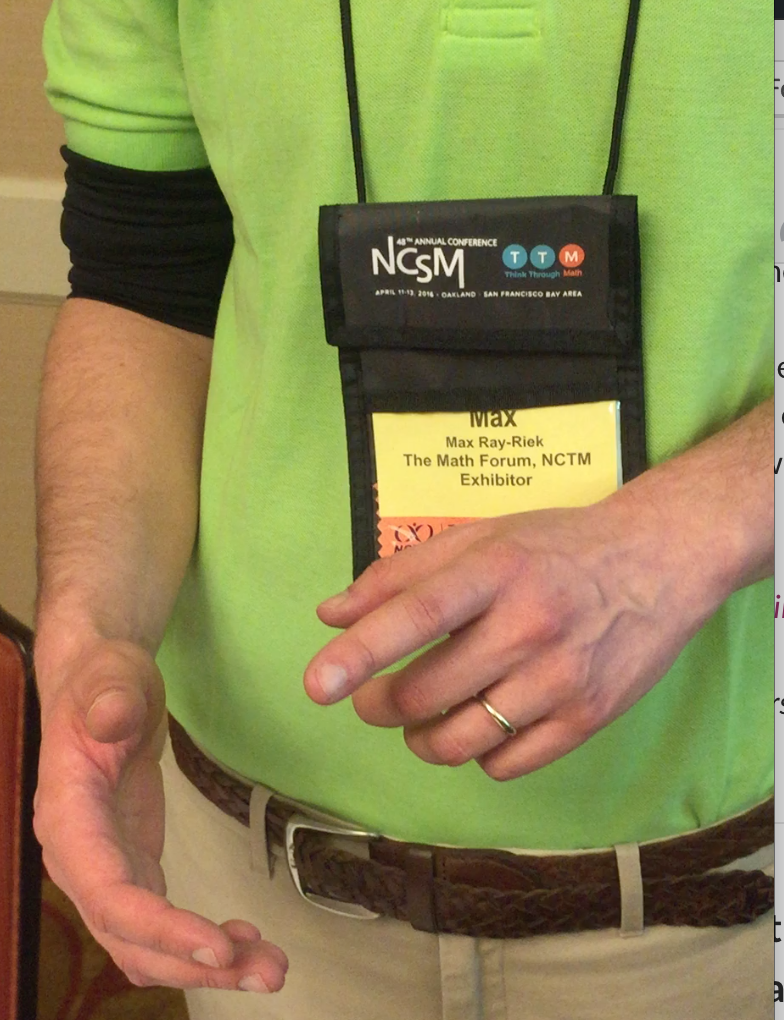
Practicing the Five Practices: Coaching Teachers to Use Student Work in Planning — Max Ray-Riek (Math Forum)
Big Take-Away = Walk teachers through the 5 Practices of Discourse with student work samples.
Max shared with us the Teddy Bear’s Banquet pattern problem. He had us determine the Math Goal for the lesson, and then Anticipate the student responses.
Max then offered 16 samples of true student responses (Monitor) and then had us Select and Sequence some of the responses for classroom discourse and share why. We were then asked to Connect the responses to the Math Goal.
This is a great training tool that can be brought into any PLC structure.
I also witnessed Max slyly counting on his fingers. This was his way of giving is all wait time on his prompts.
Smarter Balance – Making Connections: Eliciting to Acting on Evidence — Judy Hickman (Director of Mathematics, SBAC)
Big Take-Away = When the scoring focus is on Reasoning, students can still score full credit with a minor calculation error, if they show understanding.
Do NOT put too much emphasis on Interim Assessments. As “snapshots” they will give you good information, but it will be an incomplete assessment.
The authors of the exams were shocked that students answered so few questions correctly.
Big Take-Away = Vision needs to be created by ALL stakeholders
The Four Keys:
1. Establish a Clear Vision for Mathematics Teaching & Learning
2. Support Visionary Professional Learning for Teachers and Teacher Leaders
3. Develop Systems for Activating the Vision
4. Empower the Vision of Family and Community Engagement
This was the second of three sessions that spoke about the importance of vision. This one stressed the need to have all stakeholders (admin, teachers, classified staff, parents and the business community) in on the creation of the vision. Mona & Bill then asked, “If you were ask 10 people on your campus, ‘What is our vision,’ how many answers would you get?”
Big Take-Away = Set the Vision, Help people advance the Vision, Celebrate Evidence that the people are advancing the Vision, and take Action on the feedback towards the Vision.
Sustainable change requires evidence that the change is bigger than their opinions.
Is the work you are doing formative? Meaningful feedback must be followed with results in action by the teacher or teacher team.
Meaningful Feedback = F.A.S.T. Action: Fair, Accurate, Specific, Timely. Action from your feedback is required.
Mary Beth call. Dr. Kanold told a story of when he was Superintendent of Stevenson HSD. He called a secretary at one of the schools, restated that ‘engagement’ was part their district vision, and asked “What does engagement look like in your job.” That’s keeping the vision in front of the people!
This was the third of three sessions that spoke about the importance of vision. The story of calling the secretary is tattooed on my brain. Dr. Kanold stressed that the vision should be posted visibly during every PLC meeting, and that any unproductive dialogue can be redirected with the simple statement, “How does this conversation advance this vision?”
My colleagues and I presented the framework for developing a comprehensive math program. The details of each of the 8 components will be posted as separate posts.
San Francisco, CA , April 2016
I have summarized each session with some simple (•) bulleted notes, red underline to encapsulate my major take-aways, and occasionally a briefitalicized commentary.
Big Take-Away #1 = College failure rates are 55% higher than for more active forms of instruction.
Big Take-Away #2 = The math ed reform movement is now reaching the post-secondary level.
Big Take-Away #3 = The change must be institutional.
Scott Freeman at the National Academy of Sciences: Meta‐Research of 225 studies of Active Learning vs Lecture: “Active Learning is the empirically validated teaching practice in regular classrooms,”… In college STEM courses as well as K-12!! Active learning is defines as “engages students in the process of learning through activities and/or discussion in class, as opposed to passively listening to an expert. It emphasizes higher-order thinking and often involves group work.”
The National Science Foundation has funded The Common Vision Project, backed bythe Mathematics Association of America plus 4 major professional organizations, calling for introductory undergraduate math courses to:
1) updated curricula,
2) clearer pathways driven by changes at the K–12 level and the first courses students take in college,
3) use of evidence-based pedagogical methods,
4) removal of barriers at critical transition points &
5) establishment of stronger connections with other disciplines.
The challenge facing the Math Ed Community (the dismal stats)
1) Only 50% of students earn A, B or C in college algebra.
2) Women are twice as likely as men to not continue past Calc 1.
3) While 20% of all Bachelors Degrees are awarded to Blacks & Hispanics, only 12% of Math Degrees are.
4) Math is the most significant barrier to degree completion in ALL fields.
Innovation does not affect normative practice. Out of 81 different projects (2-3 yrs) connected to a grant or leader, NONE replaced normative practice, because they were based on faculty development, not institutional change. Dr Treisman, “Institutional change is a bitch.”
Historically, school system does change when necessary.
Build Belonging through effort & engagement, not talent.
Positive Belonging Mindset = Assume they belong.
Negative Belonging Mindset = Need to be invited in.
Paper Cup + Gust of Wind = Yearlong Rich Task — Peg Cagle
Big Take-Away = Revisiting the same task through-out the year emphasizes math as reasoning not simply answer-getting.
Peg had us roll a paper cup on its side. She then left us to our own devices to answer several questions, each of which addressed a different mathematical topic throughout the school year.
Day 35 Question: How can you convince a skeptic of the shape that the cup traces out as it rolls?
Day 70 Question: How can you locate the center of the shape that the cup traces out as it rolls?
Day 105 Question: How can you use a cup’s dimensions to determine the area of the shape it traces out as it rolls?
“Efficiency is overrated: That is a concern after you learn something.”
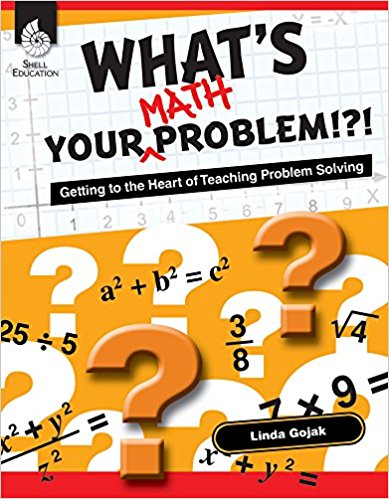
I conducted a product promotion for Teacher Created Materials. The session was on Problem Solving and Linda Gojak’s What’s Your Math Problem Anyway? My presentation focused on the following questions about the teaching of problem solving, each of which I will answer in its own post:
What is problem solving?
Why teach problem solving?
Who should learn problem solving?
When should we teach problem solving?
How should we teach problem solving?
Where do we find resources for teaching problem solving?
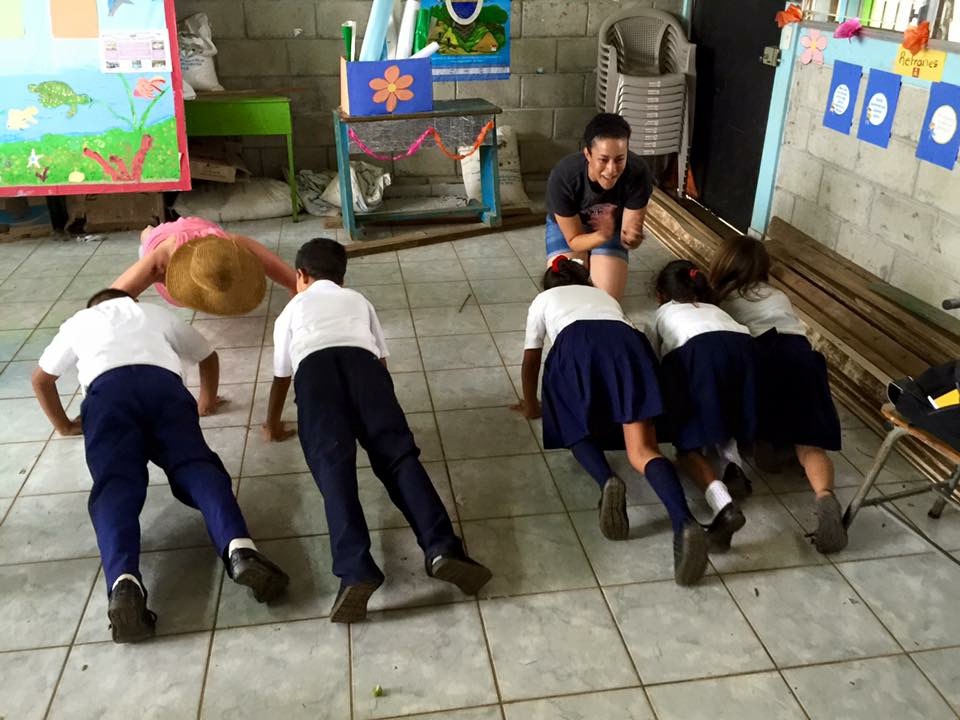
In June of 2015, I was privileged to join my wife and several other swim school owners on a service trip to the island of Roatan, in Honduras. The purpose of the trip was to provide much-needed toys & supplies to some of the public schools there, and to raise physical fitness awareness.
Of the nearly fifty swim school owners, instructors and family members that made up our group, I was the only school teacher, therefore, I viewed the experience through a different lens than the others. I also made several connections with the teachers and was able to observe one do an outstanding job of teaching 1-digit subtraction. Watch the video below and you will be as equally impressed. The surprise for me was learning later that the class was 4th grade (in the U.S. this topic is taught in 2nd).
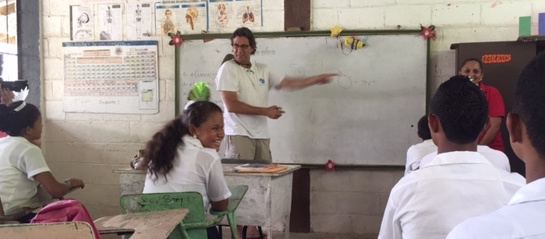
I also had a unique opportunity to teach a brief high school math lesson. I could see on the board that the lesson was about the surface area of a sphere. The teacher had written the formula A = 4πr² and there was an example showing how to calculate the area given the radius. I saw the students doing guided practice in their notebooks. The teacher learned that I also taught math and offered to have me show something on the board. From her limited English, the teacher translated for me. I kept it simple, checking for understanding via head nods after each step… I drew a sphere, then a hemisphere, then the Great Circle. I asked how many of these circles would it take to cover the surface of the sphere. We took a finger vote. Most of the class claimed “2.” I claimed that the teacher already showed them… in the formula … 4 circles (πr²). I then applauded the teacher for knowing that. (You can see me building her up to her students, in the picture below. They all applauded her.)
Schools in Roatan
25% of all Roatan children do not have the means to attend to school. Of those that do, 30% do not continue beyond the 6th grade. This will change as the economy improves. Thirty years ago, there was no electricity and no paved roads on the island. Progress on Roatan has a strong upward trajectory that can be accelerated with a little bit of help.
Our 2015 Visit
We visited six schools:
Victor Stanley West End School
Froylan Turcios School
Escuela Juan Lindo
Garby Nelson
Thomas McField
Isidro Sabio
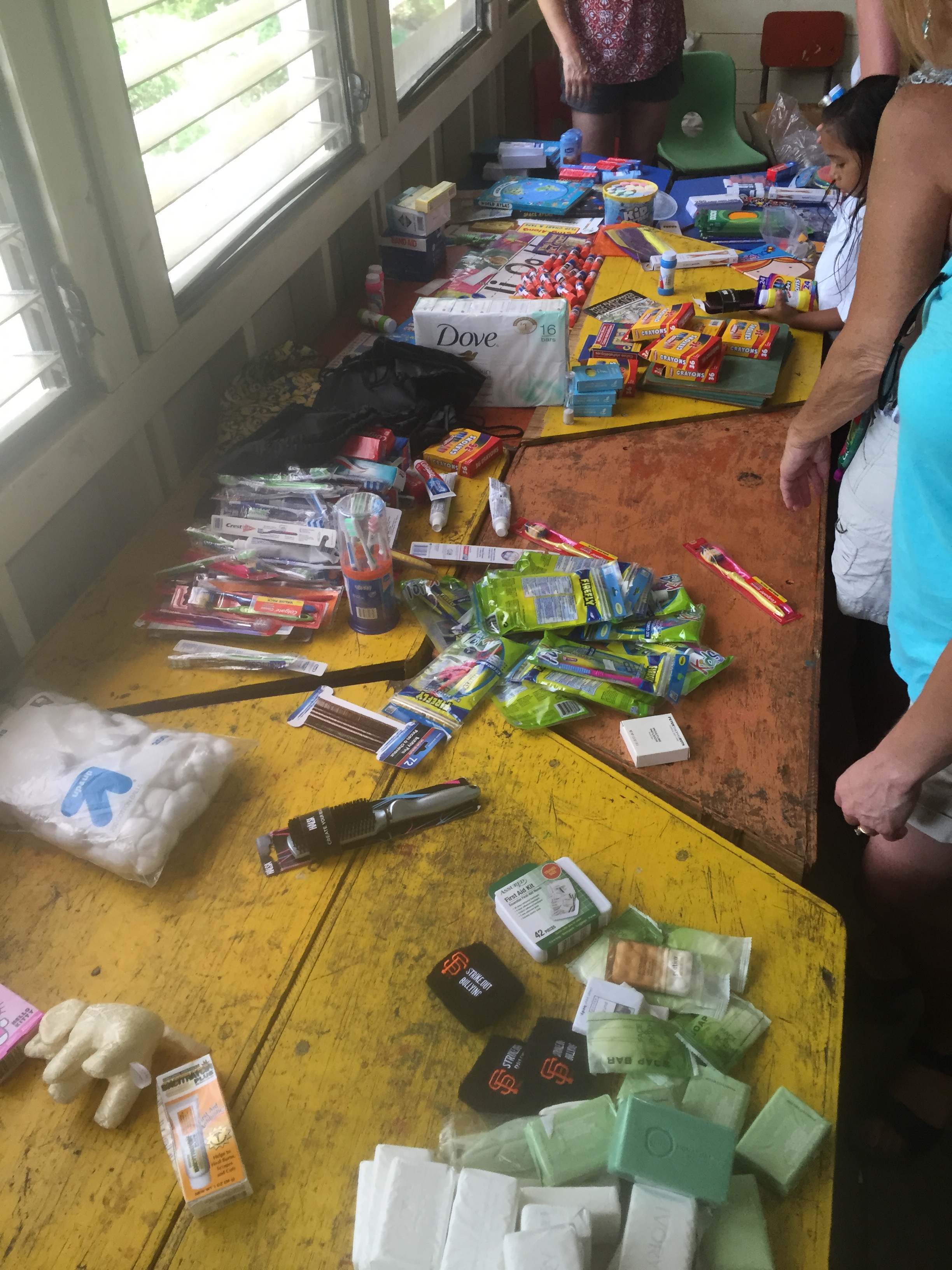
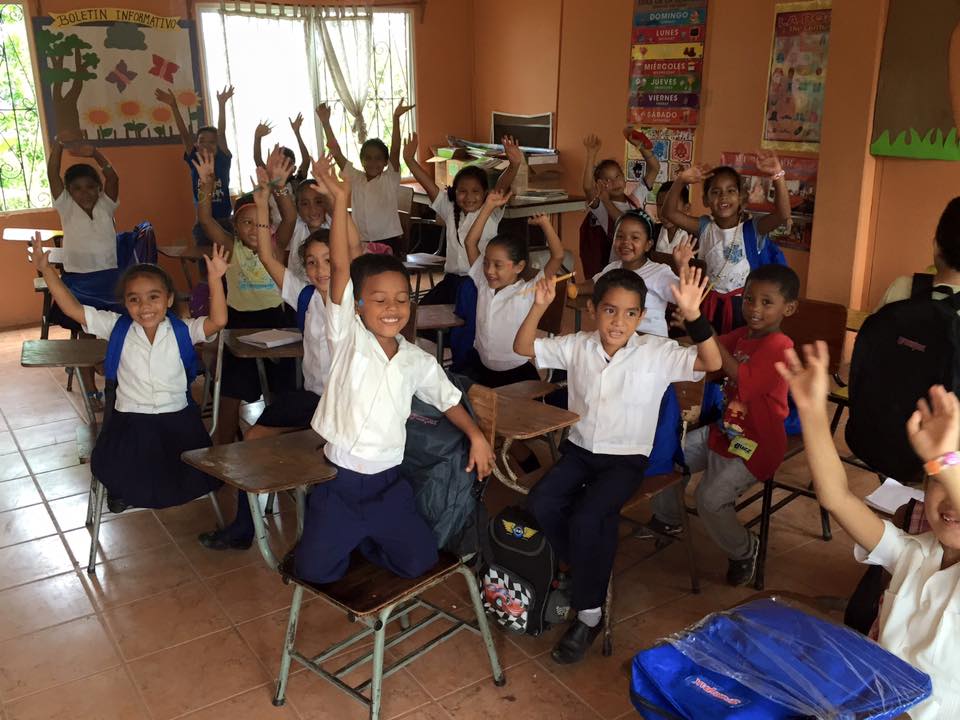
We provided donations from the swim school owners and from the clients of the schools.The outpouring of generousity was amazing. The supplies ranged from desks to soccer balls to toothbrushes to backpacks.
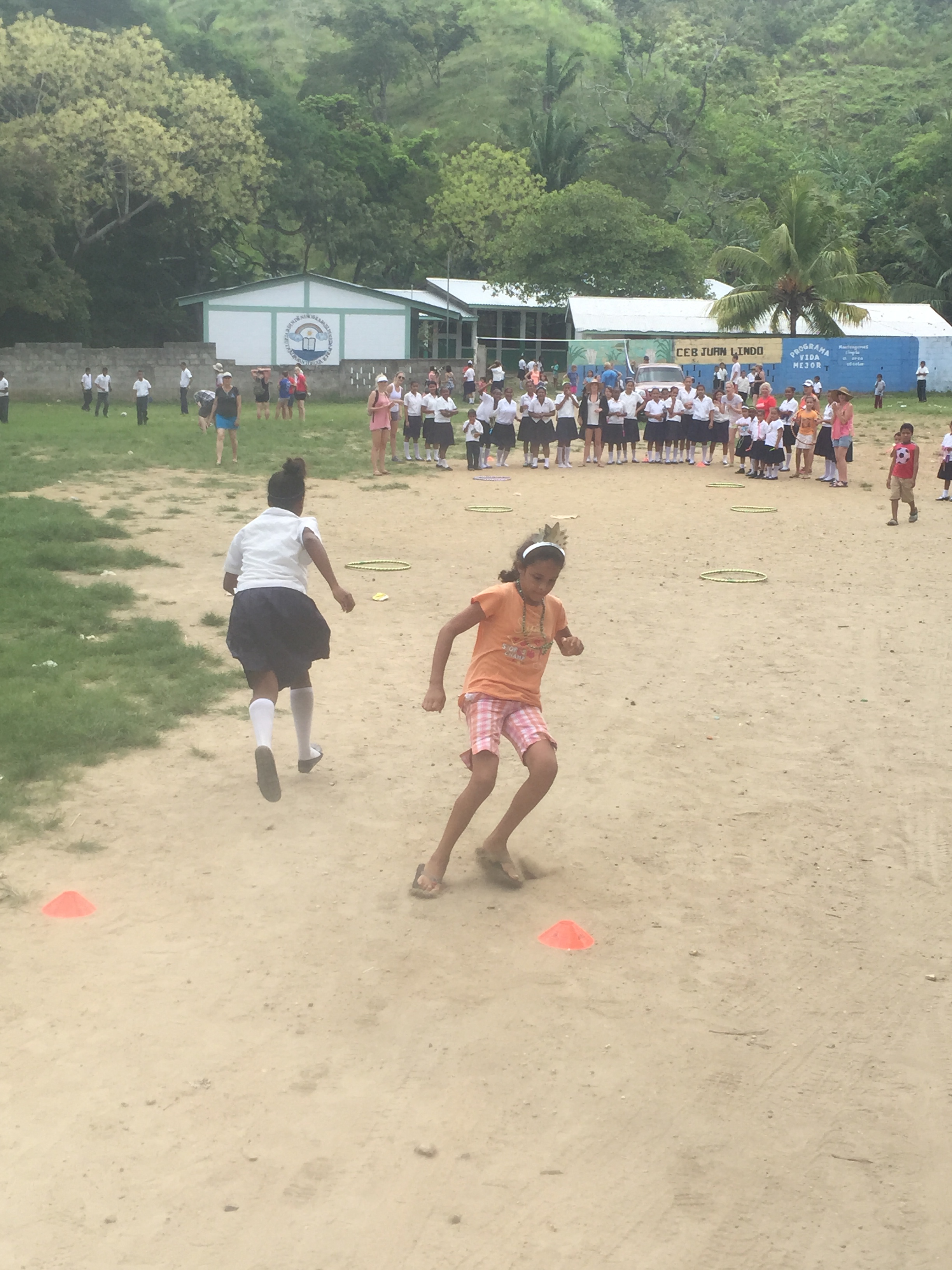
Another intention of the trip was to provide physical fitness awareness. The kids had a great deal of fun with both the new exercises and the activities.
Many of the students greeted us warmly. We learned that many kids had not seen pictures of themselves, so they got a kick out of us showing them their images on our phones.
The trip ended with the Swim Celebration on the beach at Half Moon Bay in the West End. I was surprised on an island how children didn’t know how to float. The lessons were readily accepted, as was the swimming gear (swim suits, intertubes and goggles). As you can see, my wife fell in love with the Honduran children.
Our group will be returning to the amazing land and people of Roatan in the summer of 2017.
What happens at Twitter Math Camp never stays at Twitter Math Camp!
How can it? We all met through Twitter, speak through blogs, ride a communal wave of a passion, ache to change the world through math education, and respond to the annual call of Lisa Henry (@lmhenry9) to gather each summer for the most exhilarating, unique and educational professional development event that any of us have ever experienced. Collectively, we form the universe know as the Math Twitter Blogosphere (#MTBoS). With this kind of excited learning and a vehicle to share it loudly with the world, there is no way to keep TMC a secret.
So in this passionate, collaborative, spirit, here is my Re-Cap of TMC15.
The “Morning Sessions” of the Camp consisted of 2-hour sessions that ran each of the first three days. Each 3-morning session was based on a topic. I attended the one on Desmos, the premier, free, online, graphing calculator. This was an enormously productive time that inspired me to SCHEDULE in advance, where and when to use Desmos in my curriculum this year. Here’s what I learned about Desmos ….
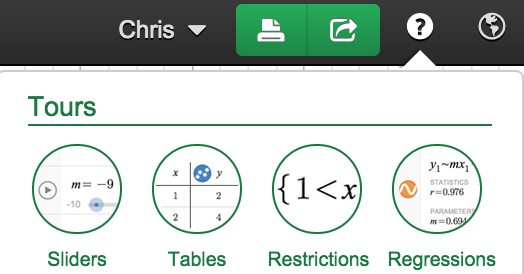
Tours: These are built-in tutorials that walk you through the Desmos basics of Graphing Equations, Creating Tables, Lines of Regression, and Restrictions (domain & range). Just click the question mark in the upper-right corner.
Desmos Bank: A communal site where teachers can share Desmos ideas and activities.
Activity Builder: Eli Luberoff (@eluberoff), the founder and CEO of Desmos made a guest appearance at our session to announce the launch of the Activity Builder. In essence, this allows teachers to create lessons, constructed of a sequence of Desmos activities. Trust me, YOU WANT TO CHECK THIS OUT.
Student Accounts: If students have a Google account (which all of mine do), they can log into Desmos through Google, which allows them to save their work and send their products to the teacher. That’s going to happen in my class this year.
GEOMETRY, Not an Island
Jasmine Walker, (@jaz_math), Burlington, Vermont
Jasmine started her session with a statement that I very much agreed with: “Even if your school or district has not adopted an integrated curriculum, you should still teach geometry as if it has. Geometry is not an island; we should not leave algebra behind.”
She then posed the question, “How do you start the year in Geometry?” for which the room had a very uniform answer … with vocabulary. This led the conversation on how to start the year with rich math tasks that link algebra to geometry. There was not a great deal of time for solutions, but the conversation brought me back to the Desmos activity builder. Geometry, Algebra & Vocabulary can all be brought together with a Desmos activity in which students need to generate geometric shapes on a coordinate plane, with restricted equations.
WHAT DO YOU THINK AND WHY? Supporting Students in Sharing their Ideas
Dr. Ilana Horn (@tchmathculture)
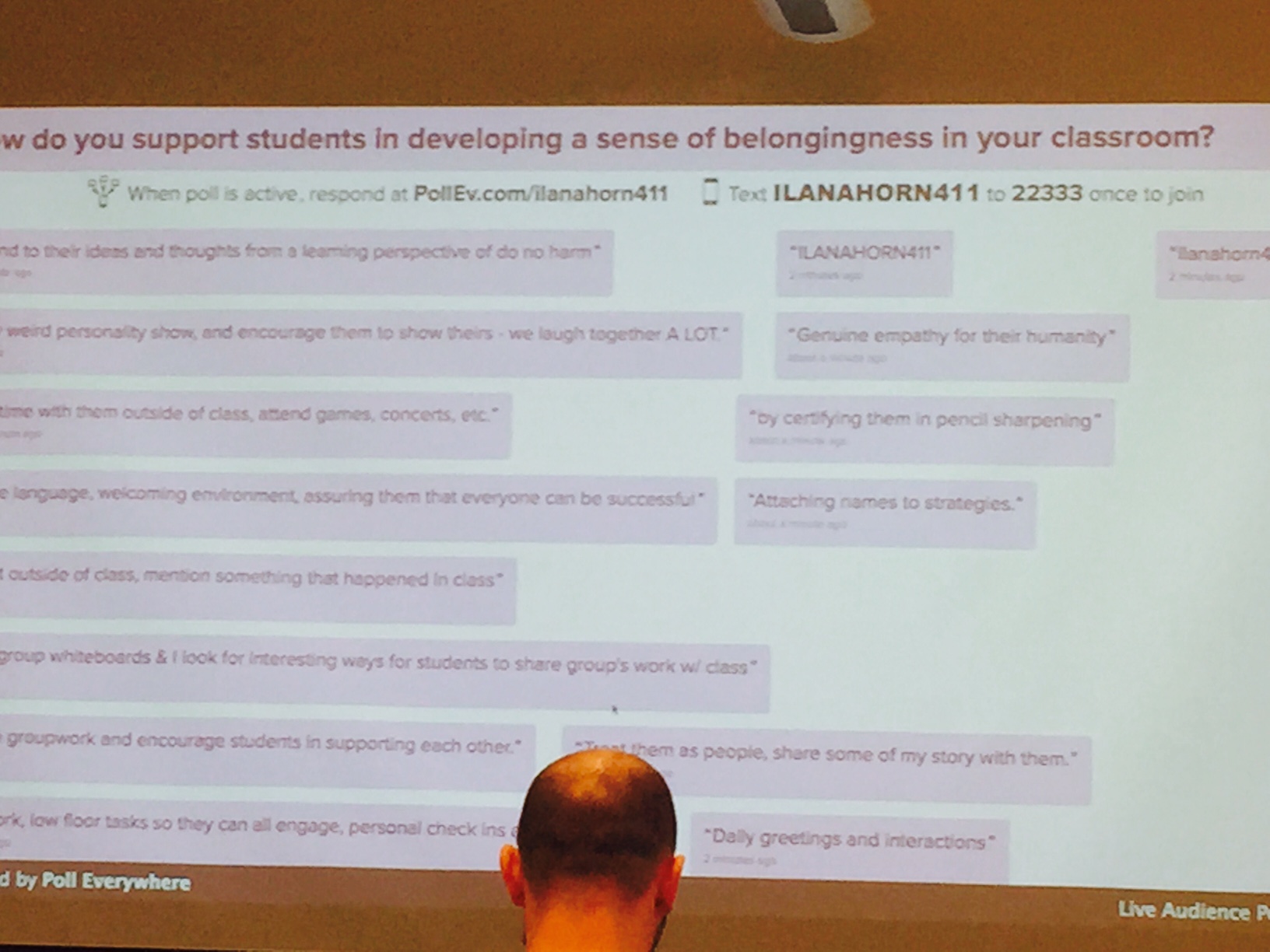
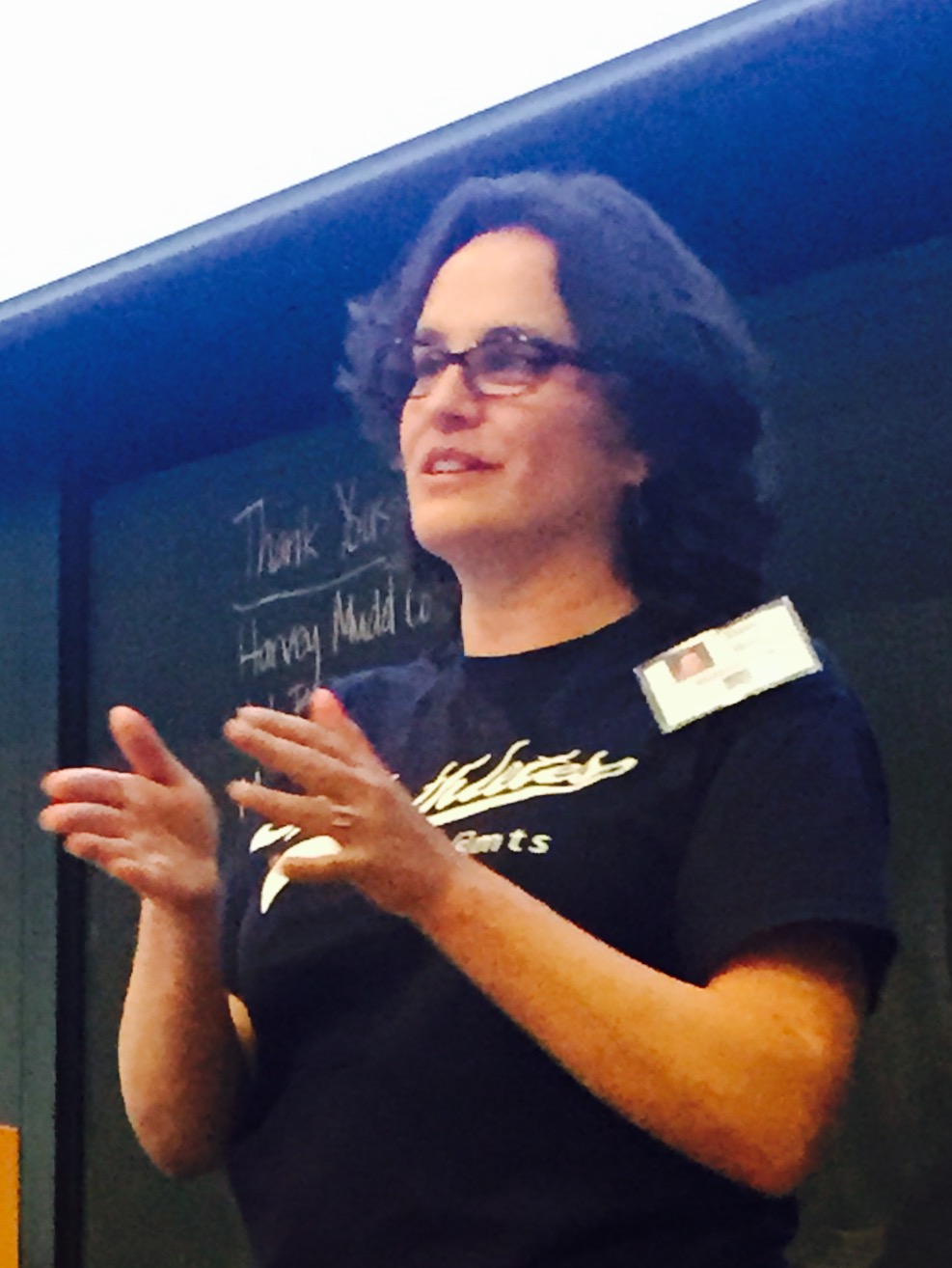
Dr. Horn spurred a terrific conversation among a large audience about how we, the various teachers in the room, support students in the sharing of their thinking in math class. The class had some wonderful ideas, however, what struck me most was not anyone idea, but the fact that so many ideas existed in a collective body of teachers. It truly is not a matter of knowledge, but a matter of will in getting students to work together and discuss their ideas. I was also impressed in Dr. Horn’s use of Polls Everywhere. I saw the power of the simulataneous viewing of the classes’ thoughts. I have been contemplating the use of Pear Deck (a similar platform) in my class.
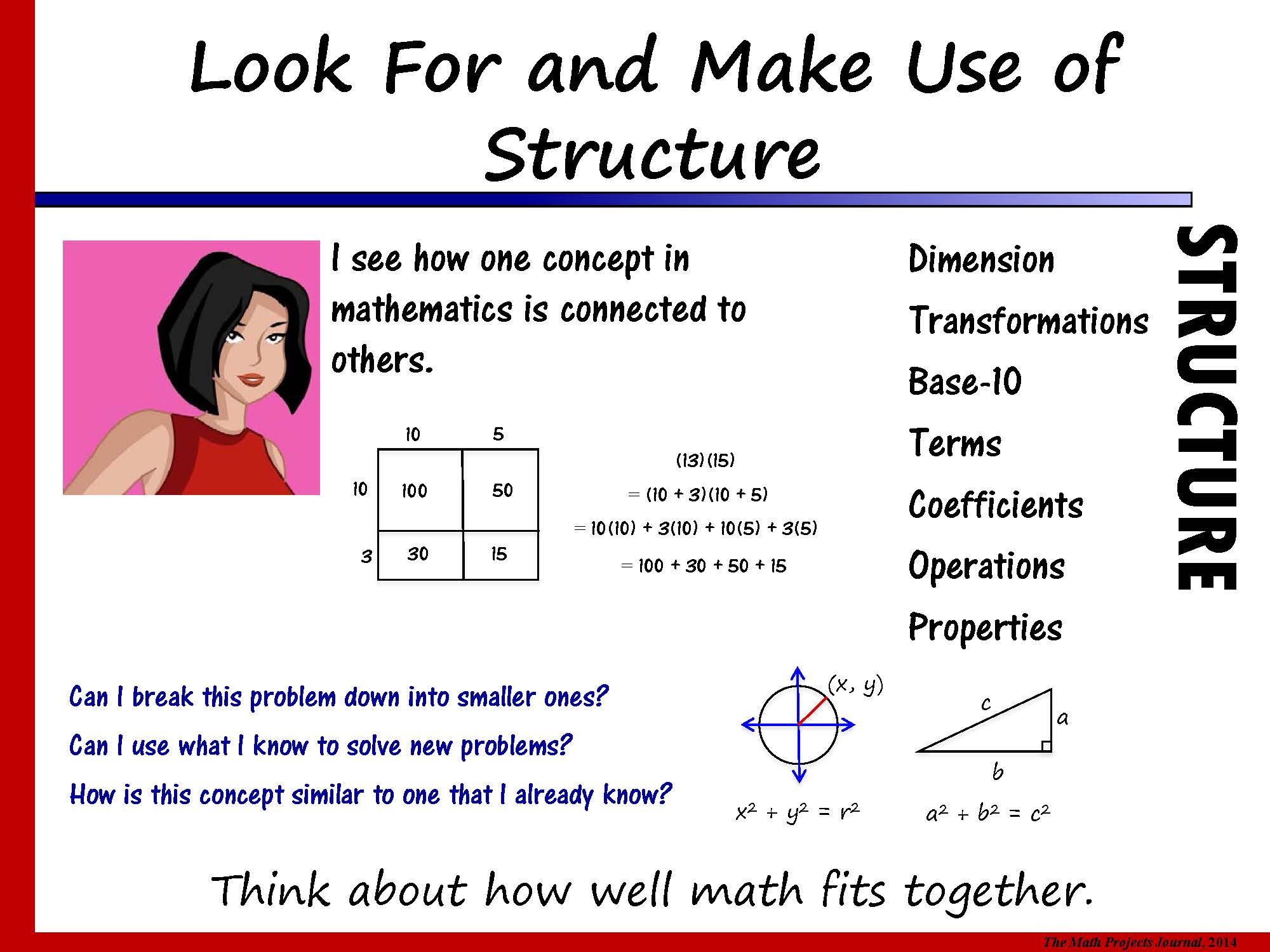
I taught a session on teaching the 8 Standards of Mathematical Practice, in which I shared my SMP Posters, their corresponding Wordles, and the explicit teaching of the practices through “Dual Targets.” (my blog post forthcoming) Meg Craig (@mathymeg07) posted about the implementation of #SMPTargets in her own classroom.
Dr. Horn is well known for studies on teacher collaboration as well as student collaboration, therefore, she often talks about how teachers think about teaching. She once again delivered on that point through the lens of how teachers’ perspectives affect their professional growth, parsing out the difference between good teachers and great teachers into three key qualities:
Problem Frames
Representations of Practice
Interpretive Principles
The great teachers have …
Problem Frames that are actionable,
Representations of Practice that include more student voice and perspective, and
Interpretive Principles that focus on connections among teaching, mathematics and student understanding
In other words, great teachers do not spend a lot of time and energy discussing things they have no control over; rather, they ponder how students think about and interact with mathematics, and what how the lessons and activities affect their learning. So Dr. Horn called for …
Teacher Agency
Empathic Reasoning
Ecological Thinking
This resonated throughout a room full of people bent on “growing their practice.”
Math From the Heart, Not the Textbook (Keynote #2) Christopher Danielson (@Trianglemancsd)
(video Part 1, Part 2)
Christopher laid down the inspirational challenge: “Find what you love. Do more of that.” He shared with us how he loves ambiguity and, therefore, was OK with playing the game of Which One Doesn’t Belong? For example, what students would choose and why in the set of four figures below, will offer up multiple answers. Christopher is also the author of Common Core Math for Parents for Dummies. A much needed resource in responding to the darkside of social media.
“Find what you love. Do more of that.” — Christopher Danielson
Fawn did here what Fawn does best: She made us all feel wonderful about being teachers. She humorously poked fun at the tweets that many of us sent her, but also seriously shared her personal trimphs and tragedies. In the end, our diminutive twiter celebrity grew huge with inspiration. She tearfully read a complimentary letter from a grateful student, and then told us of her sister who is an engineer. An emotional Fawn, claimed “She makes more money than me, but she doesn’t have that letter!”
“She makes more money than me, but she doesn’t have that letter!” — Fawn Nguyen
My Favorites
Several times throughout the Camp, there is time given for people to share a 5-10 minute presentation of a technique, activity or routine that they love. There were nearly two dozen amazing ideas.
Two of them I have already implemented in my class …
High 5’s, Glenn Waddell (@gwaddellnvhs): Glenn was right. Offering the High 5’s at the door does more for my mood and mental preparation for the class than it did for the kids.
Music Cues, Matt Vaudry (@MrVaudrey): Playing Mission Impossible at the beginning of class and the Benny Hill Theme song at the end has drastically improved the time spent retrieving and cleaning up materials.
and two others I intend to use in the future …
Egg Roulette, Bob Lochel (@BobLoch): This looks to be a very engaging activity on probability and on making and critiquing conjectures.
Student Videos, Princess Choi, (@MathPrincessC): Having students make videos on math concepts, and then post them to a place where they may “like” and “comment” on each others is cutting edge.
Rally for Roatan: A pitch for the altruistic effort to bring textbooks and instructional supplies to the school district of Roatan, Honduras, and the roll-out of my new web page to support it.
We eight math coaches had a wonderfully transparent roundtable discussion of what was working and not working at our sites. I was helpful to hear about so many successes, and to know that we shared many of the same issues. Listed below are the bulleted notes from that exchange.
“How do I move teachers along the WHY train?” — Nanette Johnson
Successes
100% Handshake Introduction
(Introduce self to every math teacher with a handshake)
Modeled Number Talks in 150 classes in 2 months
Acceptance of math coach at 16 schools
Teacher input (What do you think?)
Liaison/Advocate for teachers with District
Teacher invitation and openness
Self-Growth
Started Math Coach Network
Led Textbook adoption
Model Lessons (Geogebra, Desmos)
Teacher understanding of Common Core as teaching students to “Think & Communicate”
#k12mathcoach: 2nd & 4th Wed 6pm Pacific
(starting in August 2015)
#elemmathchat: Thurs 6pm Pacific
Issues
Dismal lack of content knowledge in some cases
Missing teaching in the classroom
Coaching is more about psychology than math.
Drinking from a firehose, but only able to spit it back out
How do we collect data on effectiveness
(Woodruff scale: 10 things)
Burning Questions:
How do I move teachers along the WHY train?
How do I use Behavior Economics to nudge change?
How do you measure effectiveness of PD?
What data do we have to show that we are effective?
How do I support myself at my getting better at my job?
The Side Talks I had several conversations throughout the Camp, but two that stood out were with …
Lani Horn (@tchmathculture): We finally had our long overdue conversation about the structure of collaborative student groups. Dr. Horn wrote THE book on this topic, Strength in Numbers. I have always used a great deal of group work, and recently Lani’s emphasis on “status” in the class has influenced my thinking a great deal. We had the controversial discussion regarding grouping homogeneously, heterogeneously or randomly which finally settled the issue in my mind. I will share the results of that dialogue in a future post. #cliffhanger
Edmund Harris (@Gelada): Edmund and I love comparing American & British education systems. (Dr. Harris is originally from Britain and now teaches at the University of Arkansas). This year, he was very hot on the treatment of homework in both countries. He insists that rather than it being either the traditional, boring rote or the new, mind-crushing, “common core” problems that end up on haters’ Facebook pages, that math homework should be a “joyful meditation.” I love this thought; now comes the challenge of making it happen for my students.
Edmund also is the Illustrator of a new book coming out, Patterns of the Universe, A Coloring Adventure in Math and Beauty. He is my go-to expert for anything that deals with Geometry, so I cannot wait until this book comes out. The preview below of his illustrations will get you just as excited.
“Homework should be joyful, meditation.” — Dr. Edmund Harris
TMC15 was a phenomenal four days at Harvey Mudd College in Claremont, California. TMC16 will be at Augsberg College in Minneapolis,MN, July 16 – 19. I can’t wait to reconvene with this crew, so that, as one participant shouted …
1) The Mission Impossible theme song for preparing for class: My students each have a Portfolio (3-Ring Binders), a workbook, and a whiteboard. Each pair of students has a “Tool Kit.” All of these must be at their desks, plus their cell phones must be placed face down on the outside corner of the desk. Matt gives them one minute of the song; since my students have to retrieve materials from the portcase, I give them two minutes.
2) The Benny Hill theme song for cleaning up: They must get everything put away and sit back in their desks, so we can debrief the lesson (The Brain Surgeon’s Wrinkle Sprinkle)
3) The Dun-Dun-DUN sound for announcing the instructional target. (Which we will start next week.)
We practiced these back to back a few times until we got it down. It works amazingly well! Thank you Matt.
Portfolios: I require students to keep a portfolio in class. The portfolio has a cover sheet that intentionally refers to them as “Genetically-Coded Math Experts.” I used today to reinforce the 6 C’s as our ultimate goal of the course, which I introduced yesterday. The portfolio is structured around these six values as is my grade book. My students from last year, received their portfolios back from Algebra 1; the new students received a free binder from an anonymous donor. We built the portfolios section by section.
I saved the students the grief of going through the syllabus. I gave them the Course Overview to read on their own (which they won’t) and have their parent’s sign (they won’t read it either) and return to their portfolios by the end of next week. Rather than bore them with the grading policies all at once, I discuss them briefly when they arise in class. (e.g. Discuss homework when the first homework assignment is assigned.)
{My school has a special tradition of activities on the first day in order to promote our school motto: S.P.I.R.I.T., Scholarship, Passion, Involvement, Reflection, Integrity, Teamwork. Teachers do not officially see their new students until Day 2}
Greeting the Crew: I greeted each student at the door with a high-5, inspired by Glenn Waddell (@gwaddellnvhs). All my students who finished the year with me last year, returned, with the addition of 13 new ones. These is a great bunch!
Opening Quizon the 6 C’s: I always start every year by answering the transformation question: “How will you (the students) be different in June than you are now, because of my class?” This year I am answering that question with the same 6 C’s that I launched last year. My Claims-Based grading system and the students portfolios are structured as such also. These C’s are based on the Smarter Balance Claims and the 4 C’s of 21st Century Learning.
Concepts & Procedures
Critical Thinking
Communicating Reasoning
Constructioning Models
Creativity
Collaboration
I gave the students the blank copy of the quiz below, and told them this was not to be graded nor was it a test of their previous knowledge. It was like a movie trailer of things to come, but I still wanted them to give me their best shot. I then gave them my standard 3-response speech.
As a mathematician I cannot always give an accurate response; I cannot always give a complete response; but I can always, always, always give an intelligent response. Blank is not intelligent.
I pressed them to give me something… numbers, equations, drawings … anything intelligent.
They worked on these independently, then in groups, then as a class. I wanted to model this process right away, because I use it often.
Last year with this group I fielded the “I feel stupid comment;” this year it was the, “She is really smart” comment. This gave me the opportunity to once again, press upon them that they are all smart; I’m just here to make them all smartER.
I posted on the board several of the responses that I saw on the student papers. I shared that these are the 6 C’s of the course. That these 6 things are really what they are here to learn. So I didn’t even answer the questions… that will come later in the course. I just wanted to highlight & explain what the first 4 C’s meant, and the other two would be woven throughout. I said that these things are what mathematicians really do, and that I am paid big bucks to get them all thinking like this in 10 months.
Introductions: I have each student briefly state their name and something interesting about themselves. I use the time that they are talking about the point of interest to review the names in the class, so at the end, I can recite all the names in class. Since I already knew most of the kids, this was easy.
I then shared that the reason that we did math first is because that is what we all about.. learning math … not collecting points… and the math was being learned by them, so those are the two most important things going on in the room on any given day. I also assume they can read the grading policy if I gave to them I didn’t have to bore them with it. Since this is the last class of the day, they all thanked me profusely, for that’s much of what they experienced their first day.
The Brain Surgeon: Last year I implemented some ideas that I came up with to promote Carole Dweck’s Growth Mindset findings. One of them was the Brain Surgeon, whose responsibilities are to read the target for the day, and lead the Wrinkle Sprinkle at the end of the period.
Wrinkle Sprinkle: This is another vehicle that I created to promote the Growth Mindset. My students from last year, knew the routine. I explained to the new students that when we learn, we don’t just shove stuff in our brains, but that the brain cells actually grow and connect to each. I joked that it was like getting a new wrinkle on the brain, and that we were into growing our brains in this class. Therefore, at the end of each class, we will debrief what we learned and write it on the board.
How to Model a situation with a drawing (From questions #2 & 4 on the quiz)
Logan can do a back flip
Two people have last names in Spanish that mean a place, and another has a Spanish last name that means cow.
It was a high-spirited, fun first day. The students have me pumped for the year!
The 2015 California Mathematics Network is a community of math education leaders from twelve regions in the State. This Conference focused on the NCTM publication Principles to Actions. The book is an amazing resource that discusses what needs to be done in math classes, and what actions need to be taken by teachers and administrators alike to make that happen. It should be read by anyone who has an investment in math education. A good primer is p 5, 10, & 109-116, or check out the Executive Summary. Following are some terrific ideas from the conference speakers on how to implement these Principles.
The Best of the Common Core Closes the Achievement Gap — Dr. Lee Stiff, former NCTM President
The Achievement Gap can best be narrowed through Effective Teaching of the CCSSM Practices.
Where do these effective teachers come from? … “from our good work!” (as instructional leaders)
The primary purpose of Principles to Actions is to fill the gap between the adoption of rigorous standards and the enactment of practices, policies, programs, and actions required for successful implementation of those standards.
NCTM Guiding Principles
(from Principles to Action) Teaching and Learning Access and Equity Curriculum Tools and Technology Assessment Professionalism
NCTM Teaching Practices
(from Principles to Action) 1. Establish mathematics goals to focus learning.
2. Implement tasks that promote reasoning and problem solving.
3. Use and connect mathematical representations.
4. Facilitate meaningful mathematical discourse.
5. Pose purposeful questions.
6. Build procedural fluency from conceptual understanding. 7. Support productive struggle in learning mathematics. 8. Elicit and use evidence of student thinking.
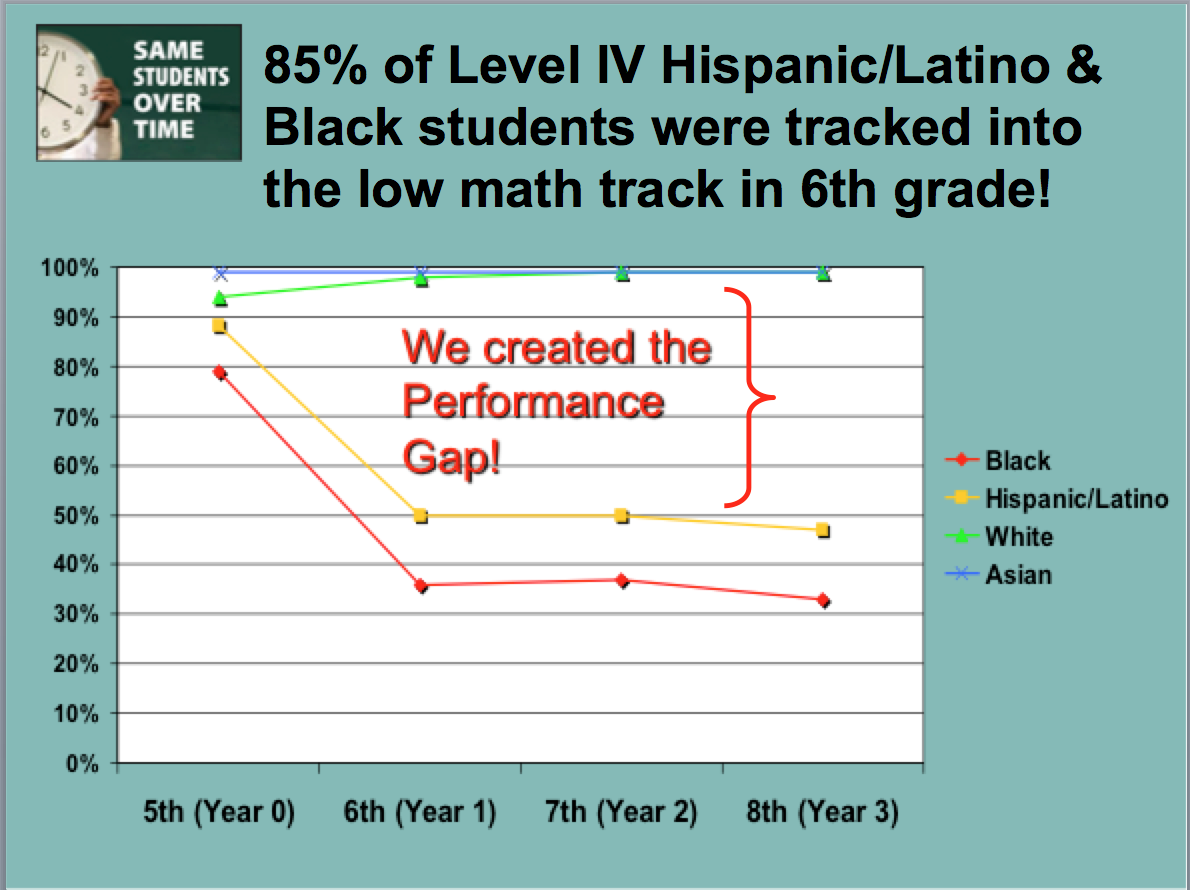
Student placement and support should be based on DATA not DEMOGRAPHICS.
We create the gap!!
Teaching Practices that Support Student Learning of Mathematics — Peg Smith, University of Pittsburgh
Dr. Smith had us read through a well-known task, the Hexagon Train, and then analyzed it through the lens of each of the Teaching & Learning Principles in Principles to Actions (Summarized Below):
It’s all about the task. Choosing the task really matters.
“What you put in front of the students frames their opportunity to learn the mathematics.”
Have your questions “locked and loaded,” and your responses “in your back pocket.”
It’s time to break out of the “postage stamp” lesson plan, (the homework, & examples fit in a little box), and write analytical, anticipatory lesson plans. (This one needs a cute name, too)
It’s difficult for teachers to use a high level task. It’s even more difficult for them to use it well.
Decrease the complexity of language without decreasing the cognitive demand of the task.
“Never Say Anything That a Kid Can Say.” (Article)
Writing “SWBT” objectives limit what students learn. Is the goal really to be able to find the length of the hypotenuse or to understand the relationship of the areas of the squares formed by the three sides of a right triangle?
Dr. Smith then asked us to restructure a standard series of textbook questions into a more robust task. The conversation at my table was very rich. It was a briefer version of a lesson makeover, and would be an awesome PD activity.
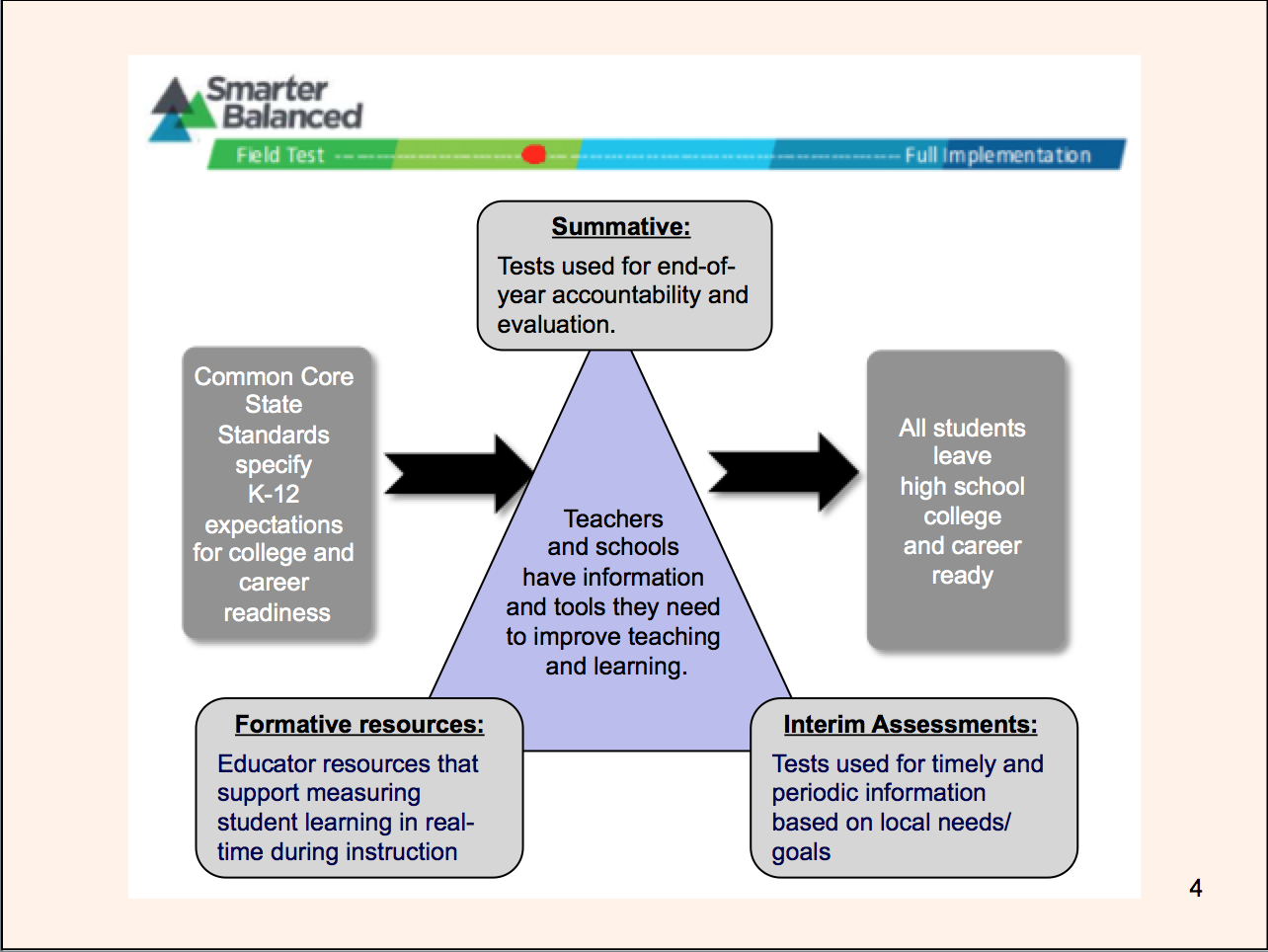
The Red Dot (•) is along a timeline from the start of the assessment initiative to full implementation. We are still in the early stages of perfecting it.
There do exist Interim Assessments that few schools (including mine) are using to check for student readiness.
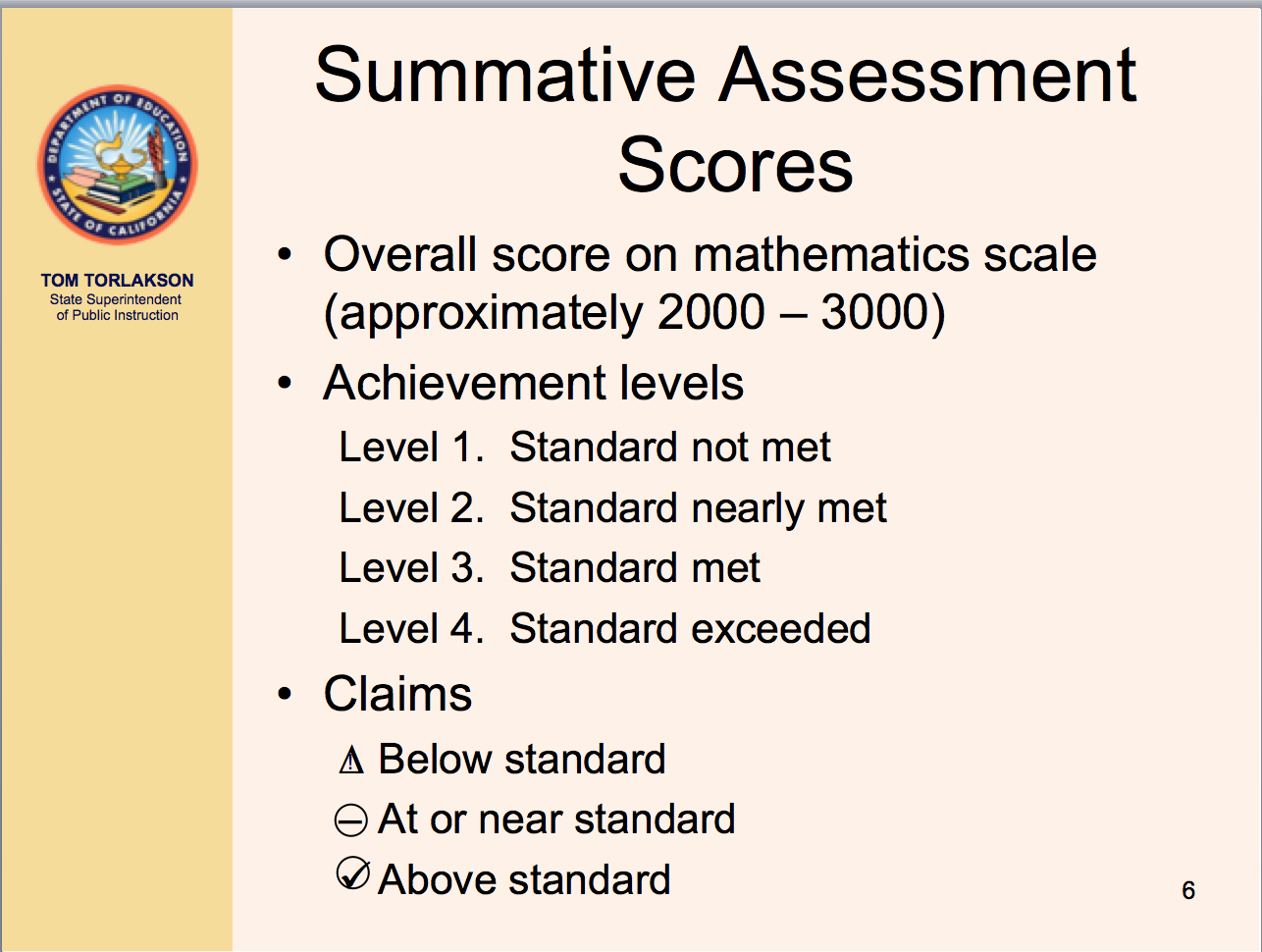
This day was the first I heard of the scaled score for the reporting of the test. It appears that there will now be some reporting on the standards as well as the claims, after all.
Challenging Spaces of Marginality (diminish status within class)
Drawing on Multiple Resources of Knowledge (including culture and experience)
Lesson: “He Was Suspended for Being Mexican” (excerpt from The Impact of Identify in K-8 mathematics Learning and Teaching) This was an anecdote of a teacher who took a students statement, “He was suspended for being Mexican,” and turned into a statistics lesson in which the students had to analyze data to determine if the school policies truly were racist or not. While we can’t tie every topic into a student-oriented context, I think it is a powerful idea that should be done more often.
Technology & Computation — Joe Fielder, Cal State Bakersfield
All computation outside the classroom is done by a machine.
Machine computation is mostly done with spreadsheets.
If we are going to teach students mathematics that is relevant beyond the college entrance exam, we need to give explicit instruction on the tools of computation.
Dr. Fiedler is currently working with the college board to change the SAT to reflect computations done by hand-held graphing calculators.
The introduction of the first scientific calculator 1972 was controversial, because teachers were worried that students would no longer be able to use tables.
“Students are idle, indifferent, irresponsible in response to absurd work. This is a rational response!”
There is no change without a loss. If there is no loss, there is no change. Similarly, literacy diminished the need for memory, but we still teach students to read and write.
Yes, part of education’s job is to pass on old knowledge, but it’s not the entire job. It’s time to get with the times.
BREAKOUT: Exploring the Common Core Statistics & Probability Standards — Jim Short, Ventura County Office of Ed
“Statistics means never having to say your certain.” The irony is that this is what makes math teachers uncomfortable with stats.
Teachers are avoiding the teaching of statistics, but the ponderous of the Performance Tasks on State Tests are based on Statistics and Data Analysis.
From the GAISE Report, 4 Components of Statistical Problem Solving I. Formulate Questions II. Collect Data III. Analyze Data IV. Interpret Results
You aren’t teaching statistics unless you are teaching modeling.Here are some great tools that we used in the session to generate statistical displays in a spreadsheet: g(math) {Google Sheets add-ons} Geogebra {box-n-whisker} Core Math Tools {NCTM} “=norminv(rand(), mean, s.d.)” {Excel Macro for generating a set of normalized data}
BREAKOUT: The Right Answer is Not Enough — Ivan Cheng, Cal State Northridge
What the teacher assesses is what the students think that the teacher values.
How is “doing math” defined differently under Common Core versus NCLB? How you answer that questions, determines how you teach and assess under the new standards.
After a test, if the teacher can’t state what the student misconceptions are, then the teacher needs to do some more digging.
Teachers should use assessment questions that intentionally reveal misconceptions.
Why “a” student missed a question is as important as which question they missed.
Clicking Smarter Balanced ASSESSMENTS (in SBAC navigation bar) will take you to documents that map targets to standards.
“Think about getting through to the kids instead of getting through the textbook.”
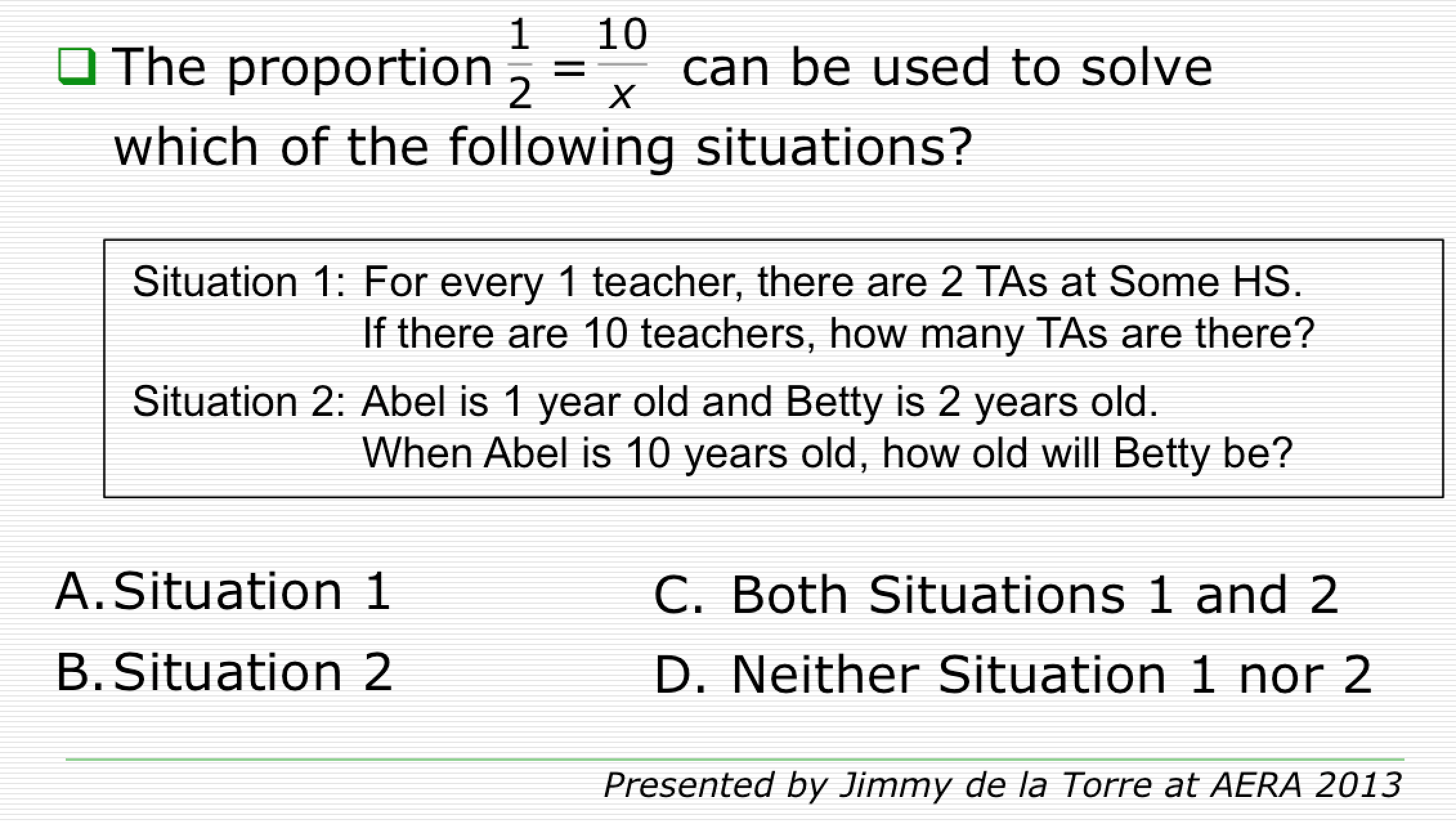
This sample question demonstrated why the students have issues with the new assessments. The students instantly think that the answer is “20,” because x = 20. Since 20 is not a given situation, they often choose “D: Neither.”
My Big Take-Aways
The achievement gap can be closed by the effective teaching of the Math Practices.
It’s all about the task!!
Two Big Words kept coming up: Meaningful & Equity. Equity is achieved by giving all students access to meaningful, high-level mathematics.
Get with the times, and start using technology in order to move from computation to deeper, higher mathematics.
There are some amazing tools available for Statistics tasks. This is a pervasive topic that needs serious attention and support.
Our assessments communicate what we value. The assessments are changing, because our goals are changing. Therefore, we teachers must change our values and practices.
We should all read Principles to Action.
The Region 10 Team is an amazing group of intelligent, passionate people. I look forward to seeing how we will put all these principles into action.
Innovative math lessons you can use in your classroom today

 As I do with all classes each year, I gave the students the blank copy of the quiz below, and told them this was not to be graded nor was it a test of their previous knowledge. It was like a movie trailer of things to come, but I still wanted them to give me their best shot. I then gave them my standard 3-response speech.


 I also saw an interesting take on the Snowball Activity. Students write down one comment and one question about a topic (notice and wonder), then wad up their papers and throw them around the room. Each student picks up a “snowball” and adds another comment and question. This is done again, until there are three of each. After the fourth toss of the snowballs, the students do not write, but instead debrief publicly as the teacher summarizes the comments and questions on the board. This is a strong way to have ALL students reflect on learning.



 We started by surveying the audience on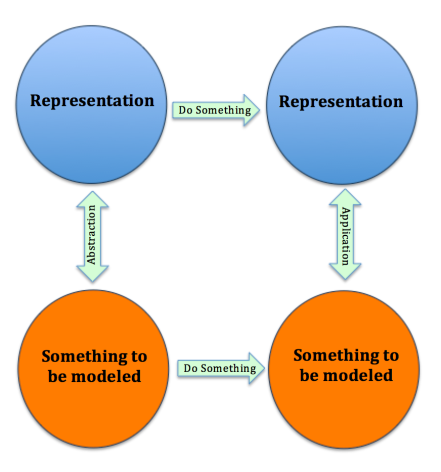
 He explained that you start with “something to be modeled,” (noticed he did not say a real-life situation) and then you create an abstract representation of it. This is a back-and-forth process of verifying the accuracy of the model’s description of the something as well as the “thing” that we want to do with it. (Use rocks to keep track of the sheep). So the audience was responses were spot on… collectively. Yes, modeling is Representation AND Application, but not necessarily just Representation OR Application. Furthermore, Edmond wanted to make it clear that modeling does not have to apply to only “real-world” examples. He claims that when we discuss the transformations of a family of functions, we are also modeling… using an abstract representation to “do something” to the original parent function.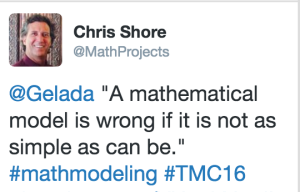







 Big Take-Away =
 The San Francisco USD Mathematics Teaching Toolkit: Changing the Practice Along with the Content — Glenn Kenyon & Kathy Bradley (
























 The Math Projects Journal
